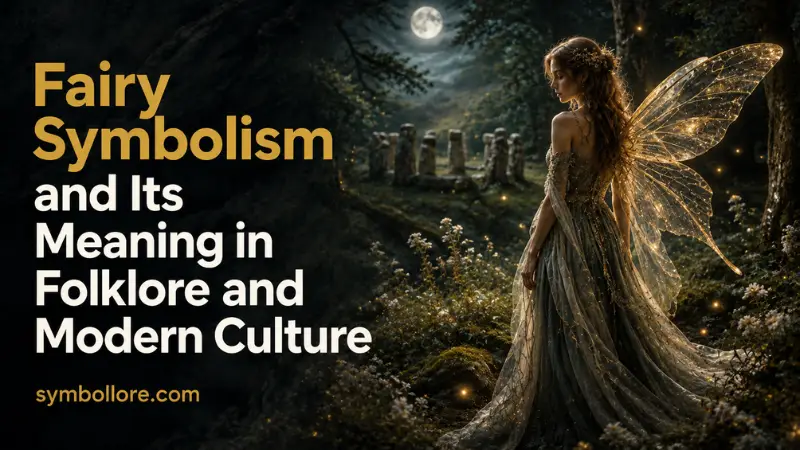
Fairy symbolism connects wonder and natural beauty with uncertainty, temptation, and the hidden rules of unfamiliar worlds. Modern images often present fairies as tiny, kind winged beings. Traditional European folklore, however, describes a much broader group of supernatural figures who could help, deceive, reward, or punish people.
That contrast matters because a fairy can symbolize innocent imagination in one setting and dangerous enchantment in another. Its meaning depends on the tradition, story, visual details, and relationship between the fairy and the human observer.
Quick Answer
Fairy symbolism commonly represents wonder, nature, transformation, imagination, and contact with an unseen world. Yet traditional folklore gives fairies a morally uncertain side involving deception, bargains, taboos, and danger. Therefore, a fairy’s meaning can range from playful freedom and hope to a warning about crossing boundaries or trusting appearances.
Key Takeaways
- Fairies represent wonder, nature, change, mystery, and imagination.
- Traditional fairies are not always small, winged, or kind.
- Darker stories connect them with deception, abduction, and broken rules.
- Victorian art helped create today’s delicate winged fairy.
- A fairy’s setting and behavior determine its most likely meaning.
- Modern interpretations are personal meanings, not universal ancient beliefs.
Fairy Meanings at a Glance
| Context or Image | Common Meaning | Important Distinction |
|---|---|---|
| Fairy with flowers | Growth, beauty, seasonal renewal | May reflect modern nature spirituality more than old folklore |
| Butterfly-like wings | Freedom, transformation, imagination | Wings became especially prominent in later art |
| Fairy ring or mushroom circle | Enchantment, thresholds, forbidden space | Folklore often treated such places cautiously |
| Helpful fairy | Favor, guidance, unexpected aid | Help may depend on courtesy or fulfilled conditions |
| Mischievous fairy | Trickery, disorder, unpredictability | Mischief can range from harmless play to real danger |
| Dark or shadowed fairy | Temptation, fear, hidden costs | Darkness does not belong to every fairy tradition |
| Fairy door or pathway | Entry into another world | Often symbolizes curiosity and crossing a boundary |
| Fairy tattoo or jewelry | Individuality, wonder, freedom, resilience | Personal intention should guide the final reading |
What Does Fairy Symbolism Mean?
Fairies symbolize the attraction and risk of what lies just beyond ordinary human experience. They occupy forests, hills, gardens, household spaces, and imagined otherworlds. As a result, they can represent curiosity, possibility, and the feeling that nature contains more than people can easily explain.
Their mixed character creates a second meaning: appearances can mislead. A beautiful supernatural visitor may offer a gift, impose a test, or conceal a danger. Fairy symbolism therefore joins enchantment with discernment. It invites imagination while warning that unfamiliar powers may follow rules humans do not understand.
This dual meaning separates the fairy from a simple emblem of sweetness. In folklore, beauty does not guarantee kindness. Likewise, strangeness does not always indicate evil.
Where Fairy Symbolism Came From
Fairy traditions do not come from one religion, country, or ancient “Celtic” source. The English term developed through Old French faerie, which referred to enchantment or the realm and activity of supernatural beings. Its linguistic history is also associated with fay and the Latin idea of fate.
Over time, European stories combined several kinds of beings and explanations. Fairies were described as nature spirits, hidden peoples, diminished deities, spirits of the dead, or beings caught between angels and demons. These theories belonged to different periods and communities, so they should not be treated as one shared doctrine.
Historic UK’s overview of the
origins and history of fairies
shows how varied those explanations became. That variety matters because the symbol inherited several meanings at once: fate, otherness, nature, danger, and enchantment.
Fairies as Symbols of Nature
Fairies often represent nature as alive, powerful, and independent of human control. Stories place them near old trees, springs, hills, wild fields, flowers, and isolated paths. Such settings turn the landscape into a participant rather than a passive background.
However, this connection does not simply mean “harmony with nature.” Traditional tales often warn against damaging a special tree, trespassing on a mound, interrupting a procession, or disrespecting an unfamiliar place. The symbolic lesson concerns relationship and restraint.
From this perspective, the fairy represents a natural world that can offer beauty without belonging to us. Modern environmental readings often emphasize stewardship and interdependence. Those are contemporary interpretations, but they fit the older pattern of respecting limits and acknowledging forces beyond human ownership.
Light and Dark Fairy Meanings
A bright fairy usually symbolizes hope, playfulness, creativity, freedom, or unexpected help. This familiar image appears in children’s stories, garden decorations, fantasy entertainment, greeting cards, and inspirational artwork. Light colors and open wings make the figure seem approachable.
A darker fairy may symbolize temptation, uncertainty, revenge, obsession, or the hidden price of desire. Older stories include beings who lead travelers astray, steal valuable objects, disguise worthless materials as treasure, or retaliate after an insult.
These two sides are not always separate species. The same being may reward courtesy and punish disrespect. Therefore, the central distinction is often not good fairy versus evil fairy. It is a relationship governed by conduct, conditions, and consequences.
Transformation, Liminality, and Hidden Worlds
Fairies symbolize transformation because they move between states that humans normally keep separate. They may cross between wilderness and settlement, night and day, human society and the otherworld. Some tales also give them powers of disguise, shape-changing, invisibility, or altered time.
These crossings make the fairy a liminal figure, meaning a being associated with thresholds. Doors, bridges, twilight, forest edges, caves, and seasonal turning points can all serve as symbolic boundaries. Once a person crosses one, familiar rules may no longer apply.
In modern use, this symbolism can represent personal change, creative awakening, or a life transition. That interpretation works best as a metaphor. Folklore itself does not establish one universal spiritual message about seeing a fairy or fairy-like sign.
Trickery, Boundaries, and Consequences
Fairy trickery often symbolizes the need to notice terms, limits, and appearances. A gift may carry an obligation. A beautiful feast may bind a visitor to another realm. Lost time, misleading paths, false treasure, and impossible tasks all express the risks of entering a system without understanding its rules.
This theme can be read through three recurring ideas:
- Respect boundaries. Do not assume every place or possession is available to you.
- Examine appearances. Beauty, wealth, and charm may hide another reality.
- Keep agreements. Promises and acts of hospitality can carry lasting weight.
Modern readers can treat these patterns as narrative lessons rather than supernatural instructions. The fairy becomes a symbol of situations where curiosity is valuable but careless confidence is costly.
Luck, Gifts, and Protection
A fairy can represent good fortune, but traditional fairy luck is often conditional. Helpful beings may reward generosity, humility, clean work, hospitality, or respect. In contrast, greed and boasting frequently turn a promising encounter into a punishment.
This makes fairy gifts different from random luck. They often symbolize reciprocity: conduct produces a response. Food, music, coins, household help, or special knowledge may appear as rewards, while spoiled goods and vanished wealth expose selfish motives.
Protective customs also varied by place. Iron, bread, bells, rowan, religious objects, and turned clothing appear in different traditions. These details should be understood as recorded folk practices, not proven methods. Symbolically, they express a community’s attempt to create safety when facing unexplained illness, loss, or misfortune.
Changelings and the Harmful Side of Fairy Lore
Changeling legends claimed that fairies could steal a person, often a child, and leave a supernatural substitute behind. Such stories helped earlier communities narrate sudden illness, disability, developmental differences, or unfamiliar behavior. Yet belief in them could also produce neglect and violence against vulnerable people.
The University of Pittsburgh’s collection of
changeling legends from Britain and Ireland
demonstrates how widely the motif circulated and how much regional variation it contained. George Mason University likewise notes that changeling stories can reflect concerns about disability, difference, dependence, and vulnerability.
Modern use should not turn this history into a charming tale of magical replacement. Symbolically, the changeling can represent alienation, mistaken identity, or fear of difference. Still, its social consequences require care, especially when discussing children, disability, or mental health.
Fairies in Art and Literature
Literature and visual art transformed the fairy from a varied folkloric being into the delicate winged figure familiar today. Medieval and early modern works featured enchanted women, otherworldly rulers, elves, and magical helpers. Shakespeare’s fairy characters later strengthened associations with moonlight, mischief, romance, and miniature supernatural worlds.
Nineteenth-century artists made wings, flowers, tiny bodies, and woodland gatherings especially prominent.
The Metropolitan Museum of Art’s record for Richard Doyle’s 1868 watercolor The Enchanted Tree
shows fairies emerging from an elm in an elaborate woodland society. The scene joins nature, play, royalty, music, and hidden community.
Victorian art did not merely illustrate ancient belief. It helped create a new visual language. Butterfly wings came to suggest lightness, beauty, freedom, and metamorphosis, even though traditional fairies were not consistently depicted that way.
Modern Fairy Symbolism in American Culture
In contemporary American culture, fairy imagery usually emphasizes individuality, imagination, femininity, nature, and freedom. Fantasy novels, role-playing games, films, festival fashion, garden ornaments, and digital art have expanded the fairy into many styles, from sparkling helpers to morally complex fae courts.
A fairy tattoo may represent a free spirit, recovery of childhood wonder, creative identity, transformation, or refusal to conform. Darker designs can express guardedness, seduction, rebellion, or the belief that beauty and danger may coexist. A fairy gift often communicates affection, playfulness, hope, or encouragement to remain imaginative.
These meanings are current cultural uses rather than fixed codes. Gender also does not limit the symbol. Although commercial imagery often presents fairies as feminine, folklore includes beings with varied appearances, roles, and identities.
How to Interpret a Fairy Symbol
Interpret a fairy by examining its context rather than assigning the first meaning found on a list. Four questions usually reveal the strongest reading:
- What is the fairy doing? Helping suggests favor; hiding or luring suggests uncertainty.
- Where does it appear? A garden stresses nature, while a doorway emphasizes transition.
- What surrounds it? Flowers, thorns, moonlight, mushrooms, keys, and crowns modify the message.
- How does it feel? A playful image and an unsettling encounter communicate different ideas.
Personal intention matters most in tattoos, jewelry, gifts, and private artwork. In a historical tale, however, the culture and period should guide the interpretation. Context prevents a modern positive meaning from erasing the caution found in older traditions.
FAQs
Fairies can represent good luck, especially when they offer help, gifts, or protection. Traditional stories often make that fortune conditional, however. Courtesy and generosity may receive rewards, while greed, trespassing, or broken promises can transform a fortunate encounter into trouble.
A winged fairy commonly symbolizes freedom, imagination, lightness, and transformation. Butterfly-like wings became especially influential through later illustration and Victorian art. They are now central to popular fairy imagery, although many beings called fairies in older folklore were not described with visible wings.
A dark fairy can represent temptation, hidden danger, revenge, forbidden knowledge, or mistrust of attractive appearances. In modern fantasy, it may also express independence and moral complexity. The term does not describe one historical class shared by every European tradition.
Some important fairy traditions come from Ireland, Scotland, Wales, Cornwall, and other Celtic-language regions. However, fairies are not exclusively Celtic symbols. English, French, Germanic, Scandinavian, Slavic, and literary traditions also shaped the broad modern idea of the fairy.
Fairy is the standard modern spelling for the being and the broader concept. Faerie is an older or deliberately archaic form that may refer to enchantment, the otherworld, or its inhabitants. Modern fantasy writers sometimes use faerie to suggest older, stranger, or less childlike beings.
Some people interpret fairy imagery as a reminder to notice nature, protect creativity, or approach change with curiosity. That is a personal spiritual interpretation rather than a scientifically verifiable sign. No single meaning applies across all religions, cultures, or fairy traditions.
Conclusion
Fairy symbolism holds wonder and warning in the same figure. Fairies can represent nature, imagination, transformation, luck, and hidden possibility, but older stories also connect them with deception, strict boundaries, and unpredictable consequences.
The most reliable interpretation comes from context. A flower-winged fairy on a gift carries a different message from a shadowed figure guarding an otherworldly path. Recognizing that difference preserves the symbol’s charm without flattening the culturally varied folklore behind it.