
Abalone shell symbolism commonly centers on protection, emotional balance, resilience, and connection to the ocean. Its rough outer surface and luminous interior create a natural contrast that many people interpret as hidden beauty, inner strength, and the ability to remain adaptable during change.
However, the shell does not carry one universal meaning. Coastal Indigenous communities, Māori artists, contemporary jewelers, spiritual practitioners, and tattoo wearers may value it for different reasons. In some traditions, it is a culturally specific material used in regalia, baskets, carvings, tools, and ceremonial objects. In modern American design, it often represents calmness, individuality, natural beauty, and coastal identity.
Understanding these distinctions matters. The shell’s meaning comes not only from its appearance but also from its ecological setting, material qualities, trade history, and continued use by living cultures.
Quick Answer
Abalone shell symbolism commonly represents protection, emotional balance, resilience, and a close relationship with the ocean in modern American culture. Historically, the shell also served as a valued material for adornment, exchange, tools, ceremonial clothing, and artistic inlay in several coastal cultures.
TL;DR
- Its hard exterior suggests protection and endurance.
- Iridescent colors represent change, perspective, and individuality.
- Coastal communities used the shell for tools, trade, and adornment.
- Native cultural meanings differ by nation and region.
- Modern uses include jewelry, tattoos, decor, and ritual vessels.
- Responsible sourcing matters because several abalone populations remain threatened.
What an Abalone Shell Looks Like
Abalone are marine snails with a flattened, ear-shaped shell and a strong muscular foot that helps them grip rocky coastal surfaces. A row of small openings runs along one side of the shell, allowing water to pass through the animal’s respiratory system.
The outside usually appears rough, dull, and marked by marine growth. The inner surface is dramatically different. It contains nacre, or mother-of-pearl, which reflects blue, green, silver, pink, and purple depending on the species and viewing angle.
This contrast strongly influences modern interpretation. The plain exterior can suggest defense, hardship, or privacy, while the colorful interior suggests a valuable inner life that is not immediately visible.
Core Meanings at a Glance
No single symbolic definition applies in every setting. The following table summarizes meanings commonly associated with the shell in the United States.
| Context | Common Meaning | Why the Association Developed | Important Note |
|---|---|---|---|
| Personal symbolism | Inner beauty | The luminous interior is hidden by a rough exterior | Usually a modern interpretation |
| Emotional symbolism | Calm and balance | Its colors and marine origin evoke the coast | Represents an intention, not a medical effect |
| Protection | Boundaries and endurance | The thick shell protects a vulnerable animal | Often chosen during periods of recovery |
| Jewelry and fashion | Individuality | Every piece has a different color pattern | Meaning may be mainly aesthetic |
| Coastal identity | Home and belonging | Abalone live along rocky Pacific shorelines | Especially relevant in western coastal communities |
| Cultural art | Heritage and continuity | Shell has long been used in regalia, baskets, and carvings | Meanings vary among distinct cultures |
Why Iridescence Suggests Change and Perspective
An abalone shell does not display one fixed color. Its appearance changes when it is turned toward a different light source or viewed from another angle. This visual movement has made it a fitting modern symbol of perspective.
Someone may choose the shell after changing careers, leaving a difficult relationship, moving to a new place, or reconsidering an old belief. The material can represent the idea that an experience looks different when examined from another position.
Iridescence also supports associations with complexity. Blue, green, violet, silver, and rose tones may appear together without forming a uniform pattern. For that reason, the shell is sometimes used to express a layered identity that cannot be reduced to one role, label, or emotion.
This is primarily a contemporary reading based on the shell’s visual behavior. It should not automatically be presented as an ancient teaching shared by all coastal peoples.
Protection and Resilience
Protection is one of the most direct interpretations of any shell. Abalone survive in wave-exposed environments by attaching firmly to rock and shielding their bodies beneath a strong outer covering. Their structure naturally suggests defense, stability, and persistence.
In personal symbolism, this can represent healthy emotional boundaries. The message is not necessarily to withdraw from other people. Instead, the shell may remind its wearer that openness and self-protection can exist together.
The contrast between the hard exterior and delicate color inside also supports a more specific meaning: difficult experiences do not erase sensitivity. A person may become more cautious while retaining compassion, creativity, or hope.
For someone recovering from grief, burnout, betrayal, or another disruptive experience, abalone jewelry or artwork may therefore represent survival without emotional numbness.
Connection to the Ocean and Coastal Belonging
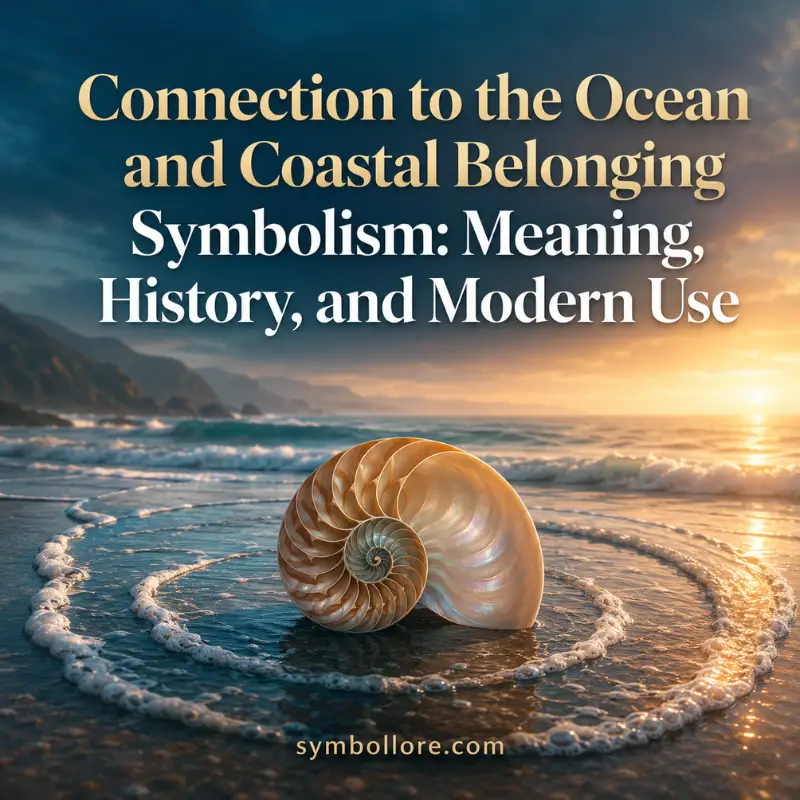
Because abalone live on rocky coastlines, their shells naturally evoke tides, kelp forests, saltwater, diving, and shoreline life. In the United States, this association is especially strong along the Pacific Coast.
A shell displayed in a home may symbolize attachment to California, Oregon, Washington, Alaska, Hawaii, or another marine environment. It can also serve as a reminder of childhood beach visits, fishing traditions, family trips, or a former coastal home.
For people who live inland, the meaning may be more aspirational. The shell may stand for rest, spaciousness, freedom, or a slower pace associated with the sea.
Its ocean connection can also suggest cycles. Tides advance and retreat, weather reshapes shorelines, and marine life adapts to changing conditions. These patterns make the shell a suitable symbol for accepting periods of activity, withdrawal, loss, and renewal.
Ancient Coastal Use in North America
Abalone shells have been part of human life along the Pacific Coast for thousands of years. Archaeological evidence shows that coastal peoples used abalone as food and transformed the shells into fishhooks, ornaments, inlay, tools, pendants, and exchange items.
Shell material also moved through extensive trade networks. Abalone artifacts have been found far from the animals’ natural coastal habitat, showing that their usefulness and beauty were valued by inland communities as well. Evidence cited by marine researchers indicates that abalone shell trade extended across much of the continent.
These uses did not produce one shared “Native American meaning.” Hundreds of Indigenous nations maintained distinct economies, artistic systems, ceremonies, and relationships with coastal resources. Historical use must therefore be described by community whenever possible.
California Native Traditions
For Native peoples of California, abalone was more than an attractive object. Its value could come from its availability, durability, reflectiveness, sound, labor-intensive preparation, and role within community traditions.
The Island Chumash used marine resources extensively and exchanged shell materials with mainland communities. Abalone shells were made into adornments, inlay, and specialized fishing equipment, while other shell species were commonly shaped into bead currency.
In Northern California, abalone appears in necklaces, pendants, clothing, and ceremonial regalia. A documented Karuk dance outfit, for example, includes abalone and clam shells that create sound as the wearer moves. Museum collections also preserve Hupa necklaces and other objects made with abalone.
The material remains part of living artistic practice. Contemporary Ohlone and Coast Miwok–Kashaya Pomo basketry has incorporated abalone pieces while continuing community-specific weaving knowledge. These works demonstrate continuity and innovation rather than a custom frozen in the past.
Abalone in Northwest Coast Art
Abalone also became important in Northwest Coast art, where its reflectiveness could emphasize eyes, water, movement, status, and supernatural imagery within particular cultural systems.
Tlingit ceremonial frontlets and crest objects have used carefully fitted abalone inlay. On some carved animal forms, the shell creates the appearance of light reflecting from wet skin or moving water. Tlingit clan leaders may wear frontlet headdresses decorated with abalone during major ceremonial gatherings.
Contemporary artists continue to use the material. In works by Haida artist Freda Diesing, abalone contributes to representations of authority, respect, matriarchal power, and Northwest Coast identity.
These examples do not mean that abalone always symbolizes power in every Indigenous context. Its meaning depends on the design, ownership, crest, story, artist, and ceremonial setting in which it appears.
Pāua in Māori Art and Identity
New Zealand abalone is commonly called pāua. Its intense blue-green interior is widely used in Māori carving, jewelry, decorative work, and contemporary art.
One of its best-known traditional applications is the inlaying of eyes in carved figures. In some carving traditions, the shell’s origin in the sea connects it to narratives about the source of carving knowledge. Its reflective surface also gives carved ancestors and figures a vivid, attentive presence.
Pāua has additionally been used as food, as a container for mixing pigments, and as a material in personal adornment. Today it remains closely associated with New Zealand’s natural environment and cultural identity.
Māori meanings should not be casually transferred to California Native traditions or generic “ocean spirituality.” Pāua belongs to specific histories, communities, artistic practices, and relationships with place.
What It Commonly Means in the United States Today
In contemporary American culture, most people encounter abalone through jewelry, coastal decor, art materials, musical instruments, spiritual shops, or tattoo imagery. Its meaning is usually personal rather than governed by a formal symbolic system.
Common interpretations include:
- Remaining calm during uncertainty
- Protecting a sensitive inner self
- Finding beauty after hardship
- Adapting without losing individuality
- Maintaining a connection to the ocean
- Recognizing that identity changes with perspective
The shell may also communicate an environmentally conscious or nature-oriented identity. Someone wearing it may simply appreciate organic textures and ocean colors, while another person may attach a detailed story of recovery or belonging to the same object.
Aesthetic use does not always indicate spiritual belief. Sometimes abalone is chosen because its changing colors make a design visually distinctive.
Meaning in Tattoos
An abalone tattoo can represent resilience, emotional boundaries, transformation, coastal heritage, or a private self that is more complex than outward appearances suggest.
Design choices often narrow the meaning. A closed shell may emphasize protection or privacy. An open shell can represent trust, self-revelation, or the decision to show one’s authentic identity. Waves may strengthen the connection to change, while pearls or flowers can add ideas of personal value, growth, or remembrance.
Some tattoos reproduce the shell’s natural oval shape and row of holes. Others focus entirely on its iridescent interior through watercolor effects, blue-green gradients, or geometric fragments.
A tattoo does not automatically carry an Indigenous ceremonial meaning. Unless a design comes from the wearer’s own culture or was created through an informed collaboration, it is more accurate to describe it as personal symbolism inspired by the shell’s natural form.
Meaning in Jewelry, Fashion, and Decor
Abalone jewelry often conveys individuality because no two cut pieces reflect light in exactly the same way. Rings, pendants, earrings, bracelets, belt buckles, and watch faces use the shell as a natural alternative to uniform gemstones.
As a gift, it can communicate several messages:
- “Your inner qualities deserve to be recognized.”
- “Stay steady while circumstances change.”
- “Carry a reminder of the ocean.”
- “Your differences are part of your beauty.”
In home decor, abalone appears in bowls, frames, boxes, furniture inlay, mosaics, and wall art. It commonly supports coastal, bohemian, Southwestern, or nature-inspired interiors.
Its visual appeal can easily overshadow its origin. Thoughtful use recognizes that the material once belonged to a living marine animal and may also resemble shellwork associated with living Indigenous traditions.
Use in Smoke-Cleansing Practices
Abalone shells are sometimes used as heat-resistant vessels for holding herbs during smoke-cleansing practices. A documented ceremonial offering in a national collection, for example, combines an abalone shell with sage and textile materials. Some institutions also recognize abalone vessels within policies accommodating Indigenous smudging.
Modern spiritual retailers frequently explain the shell as representing water, while burning herbs, flame, and smoke represent earth, fire, and air. This four-element explanation is popular, but it should not be presented as a universal Indigenous doctrine.
Smudging is a culturally specific term connected to the practices of particular Native nations. Not every Indigenous community uses the same medicines, prayers, vessels, or procedures. People outside those communities can avoid misrepresentation by describing their activity accurately, learning from appropriate cultural authorities, and not claiming a generic Native ceremony.
Common Misunderstandings and Commercial Distortions
One common misconception is that the shell has a single ancient spiritual meaning. Historical evidence instead shows many practical, economic, artistic, and ceremonial uses. Meaning varied according to community and context.
Another distortion is the claim that abalone automatically possesses scientifically proven healing energy. People may find its color, texture, or ocean association emotionally comforting, but symbolic objects do not replace medical or mental health care.
Commercial descriptions also tend to combine unrelated traditions. A product may be marketed with Māori ideas, California Native imagery, generalized chakra language, and modern crystal beliefs as though they came from one system. This erases important cultural differences.
The most accurate approach separates documented cultural use from personal interpretation. A person can value the shell as a symbol of calm or resilience without inventing an ancient origin for that meaning.
Conservation and Responsible Ownership
The shell’s beauty has an ecological cost when collection or trade is poorly managed. Abalone populations have been affected by intense harvesting, poaching, disease, warming waters, food shortages, and changes in kelp forest ecosystems.
White and black abalone are federally listed as endangered in the United States. California’s recreational red abalone fishery is also closed through at least April 1, 2036 because of severe population decline.
Responsible buyers can look for reclaimed, vintage, legally imported, farmed, or clearly documented material. Sellers should be able to provide more than vague assurances that a shell is “natural” or “ethically sourced.”
Wild shells found on a beach should not automatically be removed. Local laws, protected areas, species regulations, and ecological conditions differ. Leaving a shell in place may also allow it to serve as shelter or return minerals to its environment.
Conservation adds a modern layer to the shell’s meaning. It can represent not only ocean beauty but also the responsibility to protect the living ecosystems that produce it.
How Its Meaning Has Evolved
The earliest significance of abalone was closely connected to survival, food, craftsmanship, exchange, ceremony, and relationships with coastal places. Its value was material as well as symbolic.
As shells entered wider trade networks, they appeared in the artwork and regalia of communities located beyond abalone habitats. Their reflectiveness made them particularly effective for eyes, water imagery, pendants, dance clothing, and prominent decorative details.
Commercial harvesting later turned abalone into a restaurant delicacy and luxury material. Jewelry manufacturers, souvenir makers, interior designers, and instrument makers expanded its use beyond traditional coastal settings.
Today, its symbolism is more individualized. Americans may associate it with emotional healing, self-expression, environmental awareness, or memories of the sea. At the same time, Indigenous artists continue to use shell within cultural traditions that cannot be reduced to modern lifestyle symbolism.
F AQs
It most commonly symbolizes protection, resilience, inner beauty, adaptability, and connection to the ocean. The exact meaning depends on whether it appears in personal jewelry, cultural art, ceremony, decor, or a tattoo.
It is generally interpreted positively, especially as a sign of endurance, emotional balance, and individuality. Its harder associations—such as defensiveness or withdrawal—usually arise when someone focuses on the shell as a barrier rather than a form of healthy protection.
A tattoo may represent surviving hardship while preserving one’s sensitivity or creativity. It can also express coastal roots, privacy, transformation, or the idea that a person’s inner identity is more colorful than outward appearances reveal.
There is no single religious meaning shared across faiths or cultures. The shell appears in certain Indigenous ceremonial objects and cultural arts, but its role must be understood within the specific community using it.
Its bowl-like form and heat-resistant structure make it a practical vessel for holding some burning plant materials. However, the use of sage, smoke, and shell differs among Indigenous nations, so the practice should not be described as one universal Native ritual.
It can express admiration for someone’s inner qualities, resilience, independence, or love of the ocean. It is especially suitable for a person experiencing transition because the shell’s shifting colors suggest changing perspective.
Abalone shell contains mother-of-pearl, also called nacre, on its inner surface. Mother-of-pearl can come from several mollusks, while abalone is known for especially vivid blue, green, purple, and silver coloration.
Conclusion
The meaning of an abalone shell begins with its physical reality: a protective exterior, a luminous inner surface, and a life shaped by moving water. These features support modern associations with resilience, emotional boundaries, changing perspective, individuality, and coastal belonging.
Its historical significance is more specific. Native Californian communities, Northwest Coast peoples, Māori artists, and other cultures have used abalone within their own systems of art, exchange, identity, ceremony, and environmental knowledge. Those traditions should be recognized separately rather than blended into a generic spiritual story.
Ultimately, abalone shell symbolism reflects both beauty and responsibility. The shell can remind people that strength may protect sensitivity, but appreciation should also extend to the cultures and marine environments from which the material comes.