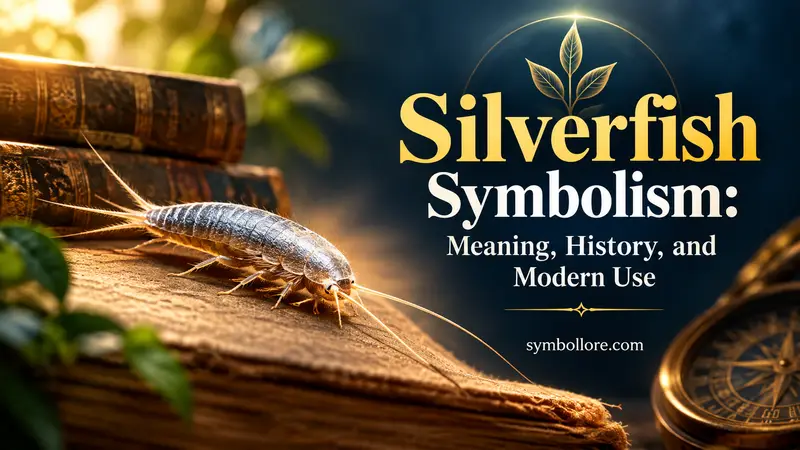
Silverfish symbolism most often centers on adaptability, quiet persistence, hidden problems, gradual change, and survival. These meanings make sense because the insect stays concealed, moves quickly, survives in demanding environments, and continues molting even after reaching adulthood.
However, silverfish do not have the same well-documented symbolic history as scarab beetles, butterflies, snakes, or some birds. Much of what appears online today is modern spiritual interpretation built from the insect’s real traits. That distinction matters. Silverfish can still be a useful personal symbol, but their meaning should not be presented as an ancient universal belief when evidence is limited.
Quick Answer
Silverfish symbolism commonly represents adaptability, persistence, hidden concerns, gradual personal change, and survival. These associations largely come from the insect’s concealed lifestyle, ancient evolutionary lineage, rapid movement, continued molting, and ability to live around overlooked materials such as paper and glue. Spiritual interpretations are mainly modern and personal rather than one documented meaning shared across cultures.
TL;DR
- Silverfish can symbolize adaptability and persistence because they survive in many environments.
- Their preference for concealed spaces inspires associations with hidden issues, memories, and overlooked details.
- Continued molting can provide a modern metaphor for gradual growth and renewal.
- Their long connection with books makes time, knowledge, preservation, and decay especially meaningful themes.
- There is little evidence for one ancient or universal silverfish spiritual tradition.
- Seeing a silverfish is not a proven omen; its symbolic meaning depends on personal and cultural context.
Silverfish Meanings at a Glance
| Context | Possible Meaning | Why the Association Exists | Important Limit |
|---|---|---|---|
| Survival | Resilience, endurance | Silverfish belong to an ancient insect lineage | Biology inspires the metaphor; it does not prove a spiritual message |
| Hidden spaces | Secrets, overlooked concerns | They commonly hide in dark, concealed areas | This is mostly modern symbolism |
| Molting | Growth, renewal | Silverfish continue molting throughout life | They do not undergo butterfly-like metamorphosis |
| Fast movement | Alertness, quick response | They run rapidly when disturbed | Personal interpretation varies |
| Books and paper | Memory, knowledge, time | They can feed on starches, paper coatings, and bookbinding materials | Historically grounded association, not necessarily spiritual |
| Household infestation | Neglect, something needing attention | Their presence can be associated with suitable moisture and food sources | A real infestation should first be treated practically |
| Dreams or spirituality | Inner reflection, quiet change | Modern interpreters build metaphors from their habits | No fixed prophetic meaning exists |
Why Silverfish Became Symbols of Survival and Adaptability
Adaptability is one of the most reasonable modern meanings attached to silverfish.
Silverfish belong to the insect order Zygentoma, an ancient lineage of primitively wingless insects. Modern research describes Zygentoma as an old and still scientifically interesting group, while fossil evidence places similar primitive insects hundreds of millions of years into the past.
That history can naturally inspire a symbolic connection with endurance.
However, it is better to say that silverfish can inspire resilience than to claim that ancient people universally treated them as resilience symbols. Those are two different statements.
A modern reader facing a long, difficult period may therefore use the silverfish as a reminder that persistence can be quiet. Survival does not always look dramatic.
For a related insect symbol with much stronger documented historical traditions, see
Beetle Symbolism: Meaning, History, and Cultural Context.
Hidden Spaces and the Symbolism of What We Ignore
Silverfish usually become visible when something disturbs their hiding place.
University and extension sources describe them as insects that favor concealed, dark, and often humid spaces such as basements, bathrooms, attics, cracks, cupboards, and areas under objects.
That behavior provides a clear basis for one of today’s strongest symbolic readings: something overlooked is asking for attention.
Symbolically, that might mean:
- an unresolved concern;
- an ignored responsibility;
- an old memory;
- a small problem becoming harder to ignore;
- a part of yourself that receives little attention.
This should be treated as a reflective metaphor, not a supernatural diagnosis. A silverfish in a bathroom does not prove that a hidden emotional problem exists.
Still, the metaphor works because the creature literally occupies spaces people often overlook.
The Connection Between Silverfish, Books, Memory, and Time
The relationship between silverfish and books gives this insect a more historically grounded symbolic dimension.
Silverfish feed on materials rich in starches and cellulose. They may damage paper, book bindings, wallpaper paste, labels, cereals, and similar materials. Libraries and museums therefore monitor them as preservation pests.
That relationship is not merely modern.
In Robert Hooke’s 1665 Micrographia, he described a tiny book-damaging creature that later commentators identify as the silverfish. Hooke compared such a creature to one of the forces that slowly consume material objects over time. The Science History Institute discusses this episode while tracing the long history of insects that damage books.
This creates several useful symbolic themes:
Time. Paper can preserve ideas for centuries, yet a tiny insect can slowly erode the physical object.
Memory. Books, letters, archives, and stored papers often carry personal or cultural memory.
Neglect. Damage happens most easily where materials remain undisturbed.
Preservation. What matters must sometimes be actively protected.
Because of this real material history, a silverfish beside an old book can make a powerful symbol of the tension between memory and decay.
Silverfish Symbolism and Gradual Transformation
Transformation appears on many silverfish-meaning pages, but it needs a careful explanation.
Silverfish do not undergo the dramatic complete metamorphosis seen in butterflies or beetles. Their young resemble smaller versions of the adults.
Yet silverfish do something unusual: they continue molting even after reaching maturity. North Carolina State University’s entomology material notes that adults keep shedding their exoskeletons throughout life.
That makes gradual development a better metaphor than dramatic rebirth.
A silverfish can therefore represent:
- slow personal improvement;
- releasing an outdated habit;
- becoming more capable over time;
- change that occurs without public attention;
- growth that does not require becoming an entirely different person.
This distinction makes silverfish different from moth or butterfly imagery.
A moth emphasizes visible metamorphosis. Silverfish symbolism fits quieter, repeated adjustment.
Silverfish Spiritual Meaning Today
Modern spiritual interpretations usually connect silverfish with resilience, hidden awareness, flexibility, inner growth, and attention to neglected matters.
These themes appear repeatedly across current symbolism pages.
They make sense as metaphors because of the insect’s actual behavior. Yet there is an important difference between saying:
A silverfish can remind me to notice what I have been ignoring.
and saying:
A silverfish was sent to predict what will happen next.
The first is personal symbolic reflection. The second is a supernatural claim that an ordinary insect encounter does not establish.
A grounded spiritual interpretation can therefore use the creature as a prompt without assuming that the universe has assigned every silverfish sighting one fixed message.
Is There an Ancient Cultural Meaning of Silverfish?
The evidence is much thinner than many popular websites suggest.
During research for this article, strong institutional or primary documentation was not found for widely repeated claims that silverfish universally represented prosperity in ancient China, renewal among Native American peoples, magical messengers in Celtic tradition, or good fortune in ancient Greece.
That does not prove that no local belief ever existed. It means those broad claims should not be presented as established cultural history without stronger evidence.
There are genuine old references to insects identified as silverfish or silverfish-like book pests.
For example, historical Chinese lexical material records an insect called 蟫, associated with clothing and books and translated in modern references as silverfish.
But identifying an insect in an old text is not the same as proving that it carried a specific spiritual meaning.
This difference is important. Reliable symbolism writing should preserve uncertainty rather than filling historical gaps with attractive folklore.
What Does Seeing a Silverfish Mean?
Seeing a silverfish usually means one practical thing first: the insect found conditions suitable for food, shelter, or moisture.
Silverfish frequently occur indoors in concealed areas. They may feed on paper, starch, cereals, wallpaper paste, and bookbinding materials.
Symbolically, however, the encounter can become a useful prompt.
You might ask:
- What small issue have I ignored?
- Where am I adapting instead of resisting?
- What deserves preservation before it deteriorates?
- Am I making steady progress even if nobody sees it?
- What old belief, document, memory, or habit am I still carrying?
These questions create meaning through reflection rather than prediction.
If multiple silverfish are appearing in a home, address the actual infestation rather than treating it only as a spiritual sign.
Is a Silverfish a Good or Bad Omen?
There is no reliable evidence that a silverfish predicts good luck, bad luck, death, money, or another specific future event.
Modern symbolism can support both positive and uncomfortable readings.
On the positive side, the insect may suggest:
- endurance;
- adaptability;
- patience;
- quiet strength;
- survival;
- gradual improvement.
On the shadow side, it can suggest:
- neglect;
- hidden damage;
- unresolved concerns;
- deterioration;
- avoidance;
- something small growing unnoticed.
Neither interpretation is inherently correct.
The setting changes the meaning. A silverfish drawn as part of a resilience tattoo communicates something very different from a silverfish damaging a family archive.
Silverfish Dream Meaning
A silverfish in a dream does not have one established universal meaning.
Dream interpretation works better when the insect’s role and the dreamer’s emotions are considered.
A silverfish eating old papers could suggest anxiety about memory, knowledge, unfinished work, or losing something from the past.
One hiding beneath an object might represent something unnoticed or deliberately avoided.
Repeated silverfish could create a feeling of irritation or problems multiplying below the surface.
A calm dreamer may instead associate the insect with endurance and quiet adaptation.
These are interpretive possibilities, not predictions. The dream’s emotional context usually matters more than a symbolic dictionary definition.
Silverfish Tattoo Meaning
A silverfish tattoo can work as an unusual personal symbol because the insect is rarely used compared with butterflies, moths, beetles, or dragonflies.
Possible meanings include:
- surviving difficult circumstances;
- adapting without losing yourself;
- private strength;
- gradual transformation;
- living outside the spotlight;
- respect for overlooked forms of life;
- memory and the passage of time.
A silverfish paired with a book could emphasize knowledge, memory, decay, or preservation.
A shedding skin could emphasize gradual change.
A dark background might highlight secrecy or hidden life, while an open page could strengthen the connection with learning and history.
The wearer ultimately determines the tattoo’s personal meaning.
Why “Ancient Wisdom” Needs Careful Wording
One common symbolism claim says silverfish represent “ancient wisdom” because their evolutionary lineage is very old.
The first half is factual: Zygentoma is an ancient insect lineage. Modern museum and scientific sources describe silverfish as primitively wingless insects with a very deep evolutionary history.
The second half is metaphor.
Evolutionary age does not mean an insect literally possesses ancient human wisdom.
A more accurate interpretation is that the insect’s long evolutionary continuity can evoke endurance, continuity, survival through change, or connection with deep natural history.
That wording keeps the symbolic idea while avoiding a false factual claim.
Silverfish Versus Other Insect Symbols
Silverfish occupy a different symbolic space from several better-known insects.
Ants commonly evoke cooperation, disciplined effort, preparation, and collective strength because of colony behavior. Ant Symbolism: Meanings, History, and Modern Interpretations
Beetles can carry stronger historical symbolism, especially through the ancient Egyptian scarab and its associations with Khepri, renewal, and the solar cycle. Beetle Symbolism: Meaning, History, and Cultural Context
Moths often suggest transformation because they undergo complete metamorphosis. Giant Leopard Moth Symbolism: Meaning & Spiritual Signs
Silverfish are subtler.
Their strongest distinctive themes are quiet survival, hidden spaces, gradual change, neglected things, old paper, memory, and the slow effects of time.
How to Interpret Silverfish Symbolism Responsibly
A useful interpretation begins with context.
First, ask whether the meaning comes from documented history, biology, modern spirituality, art, a dream, or your own personal association.
Next, notice what the insect is doing. A silverfish hiding, running, molting, or damaging paper creates different imagery.
Then consider the setting. A bathroom, archive, dream, tattoo, illustration, or real infestation should not automatically carry the same meaning.
Finally, separate reflection from certainty.
It is reasonable to say:
“The silverfish reminds me to pay attention to something neglected.”
It is much harder to support:
“Silverfish guarantee that money or transformation is coming.”
Symbolism becomes more meaningful, not less, when its limits are clear.
FAQs
In modern spiritual interpretation, a silverfish can symbolize resilience, adaptability, hidden awareness, gradual growth, and attention to neglected matters. These meanings are mainly metaphors drawn from the insect’s real habits rather than one ancient spiritual doctrine shared across cultures.
There is no reliable evidence that seeing a silverfish predicts good luck. Some modern spiritual writers attach positive meanings such as survival or adaptability to the insect, but these are interpretations rather than proven omens.
Prosperity claims appear on some modern symbolism websites, but strong historical evidence for a widespread silverfish-and-wealth tradition is difficult to establish. The insect’s silver color may inspire a modern association with money, yet visual resemblance alone should not be presented as ancient cultural fact.
Symbolically, someone may interpret a household silverfish as a reminder to notice hidden, neglected, or slowly developing issues. Practically, silverfish seek suitable shelter, humidity, and food. They are known to occur in bathrooms, basements, attics, and areas containing paper or starch-rich materials. Ask IFAS – Powered by EDIS
They can represent gradual transformation in modern symbolism. Unlike butterflies, silverfish do not undergo complete metamorphosis. However, they continue molting after maturity, making repeated adjustment and ongoing growth a particularly fitting metaphor. GenEnt
Silverfish may feed on starches, glue, paper coatings, and other materials found around books and archives. Their book-damaging reputation also has historical roots; a creature described by Robert Hooke in Micrographia in 1665 has been identified by later writers as a silverfish. Ask IFAS – Powered by EDIS
No clear biblical tradition specifically establishing the household silverfish as a spiritual symbol was found in the sources reviewed for this article. Biblical interpretations found online are usually modern symbolic readings rather than meanings explicitly assigned to Lepisma saccharina in the biblical text.
Sources and Further Reading
- University of Florida IFAS — Silverfish Lepisma saccharina
- Penn State Extension — Bristletails, Silverfish and Firebrats
- North Carolina State University — Order Zygentoma
- Australian Museum — DNA Barcoding and Silverfish Evolution
- Science History Institute — Book Pests and Hooke’s Silverfish
Conclusion
Silverfish symbolism is strongest when it reflects what makes the insect distinctive: quiet survival, adaptability, hidden activity, gradual change, and an unusual relationship with books, paper, memory, and time. Its continued molting can inspire a metaphor for slow personal growth, while its concealed habits can suggest overlooked concerns.
What the evidence does not support is one universal ancient spiritual meaning. Most familiar silverfish meanings today are modern interpretations of natural behavior. Culture, setting, personal experience, and artistic intent therefore matter. Used thoughtfully, the silverfish becomes less a supernatural prediction and more a symbol of what survives, changes, or remains unnoticed beneath the surface.