

Poinsettia symbolism most often centers on Christmas, celebration, goodwill, generosity, and seasonal warmth. These meanings grew from the plant’s brilliant winter color, its use in Mexican Christmas traditions, and its later popularity in American homes and churches.
However, the poinsettia did not begin as an American Christmas decoration. Indigenous peoples in Mexico cultivated the plant long before European colonization. Its history includes ceremonial use, practical uses, Catholic traditions, folklore, international horticulture, and modern holiday marketing. Each layer adds meaning, but they should not be treated as one universal tradition.
Quick Answer
Poinsettia symbolism commonly represents Christmas joy, goodwill, generosity, hope, and the warmth of gathering with others. Its red, star-like bracts and winter display helped connect it with Christian Christmas imagery. However, the plant has older Indigenous Mexican roots, and its meaning changes across historical, religious, and modern decorative settings.
TL;DR
- The poinsettia is best known as a symbol of Christmas celebration and seasonal warmth.
- Indigenous Mexican use came centuries before its association with the United States.
- Mexican Catholic tradition linked the plant with Christmas Eve and Nativity displays.
- Christian interpretations connect its shape with the Star of Bethlehem and red with Christ’s sacrifice.
- Most color meanings beyond red and white are modern, flexible conventions.
- A poinsettia gift usually communicates welcome, goodwill, remembrance, or holiday cheer.
Poinsettia Meanings at a Glance
| Context | Possible Meaning | Why the Association Exists | Important Limit |
|---|---|---|---|
| Modern Christmas décor | Celebration, warmth, family tradition | Bright bracts appear during the winter holiday season | It can also be purely decorative |
| Mexican cultural setting | Heritage, continuity, ceremonial identity | The plant originated in Mexico and has centuries of cultural use | Meanings vary by region and period |
| Christian display | Star of Bethlehem, sacrifice, purity | Star-like form and red or white coloring invite devotional readings | The Bible does not name the poinsettia |
| Christmas gift | Goodwill, welcome, generosity | Potted plants are commonly shared during holiday visits | The relationship between giver and recipient matters |
| Living plant after winter | Endurance, renewal, patient care | A poinsettia can survive and color again under suitable conditions | This is mainly a modern personal interpretation |
| Red poinsettia | Joy, love, vitality, sacrifice | Red carries both festive and Christian associations | Red does not have one universal meaning |
| White or cream poinsettia | Peace, sincerity, purity | These meanings follow wider Western color symbolism | They are not a fixed ancient poinsettia code |
What Does Poinsettia Symbolism Mean?
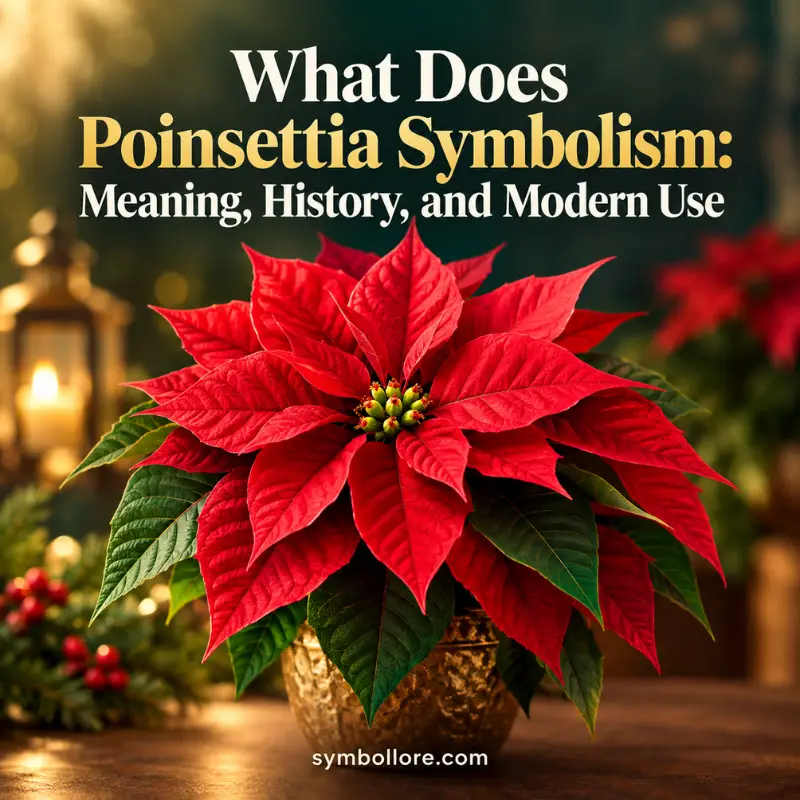
The poinsettia’s strongest modern meaning is joyful celebration during the Christmas season. In an American home, a red poinsettia near a doorway or dinner table often communicates welcome, hospitality, and shared holiday spirit. In a church, the same plant may carry a more specific Christian meaning.
Several secondary meanings grow from that central association:
- Generosity and heartfelt giving
- Hope during winter
- Family and community tradition
- Warmth, welcome, and hospitality
- Remembrance of a loved one
- Faith and Christmas devotion
- Beauty that appears in its proper season
These meanings are connected, but they are not identical. A church altar, commercial display, family memorial, and personal tattoo each give the plant a different symbolic role.
Its meaning also overlaps with
Both plants can express continuity and hope during winter. However, evergreens gain that meaning from foliage that remains green, while poinsettias gain it from their vivid seasonal transformation.
The Mexican Roots of Poinsettia Symbolism
The poinsettia is native to Mexico and parts of Central America. In the wild, it grows as a large woody shrub rather than the small foil-wrapped plant commonly sold in December.
Nahuatl speakers knew the plant as cuetlaxochitl. Mexican sources offer related translations, including “flower that withers” and “leather flower.” That variation matters because online articles often present one poetic translation as the only settled meaning.
Long before the plant became a Christmas emblem, Mexica communities used it in ceremonial settings and produced coloring material from its red bracts. Historical sources also describe medicinal applications. These records document cultural and practical use; they do not prove every modern spiritual claim attached to the plant.
Mexico’s National Institute of Anthropology and History describes the
cuetlaxochitl as a sacred plant associated with blood and renewed life.
Another INAH account connects it with purity and the renewed life of warriors who died in battle. Such meanings belong to specific Mexica religious ideas, not to all Indigenous cultures or every modern Mexican community.
How the Flower of Christmas Eve Became a Christmas Symbol
In Mexico, the plant is widely called flor de Nochebuena, meaning “Christmas Eve flower.” Its natural seasonal color made it especially suitable for December observances.
During the colonial period, Franciscan friars used the plant to decorate churches, Nativity scenes, and Christmas processions. This practice joined an existing Mexican plant with Catholic Christmas worship. Mexico’s environment ministry notes that the flower’s use in colonial churches helped it become an international Christmas icon.
Its account of the National Day of the Nochebuena
also recognizes the plant as part of Mexico’s Indigenous botanical heritage.
A popular Mexican legend adds another layer. In the best-known version, a poor child has no valuable gift to place before the Christ child on Christmas Eve. The child gathers roadside plants and offers them with love. They then transform into brilliant red poinsettias.
The story makes the poinsettia a symbol of humility, sincere giving, and the belief that love gives value to a modest gift. Yet it remains a religious folk legend. It should not be treated as a documented botanical event or the sole reason the plant entered Christmas tradition.
Christian Meaning of the Poinsettia
Christian poinsettia symbolism comes mainly from devotional interpretation rather than a biblical passage. The Bible does not mention the poinsettia, which is native to the Americas.
Christians commonly interpret its visible features in these ways:
- The star-shaped arrangement recalls the Star of Bethlehem.
- Red bracts represent Christ’s sacrificial blood.
- White bracts represent purity, peace, or innocence.
- Green leaves suggest continuing life and hope.
- The small central flowers can represent humility beneath outward splendor.
The United Methodist Church’s explanation of poinsettia symbolism
documents the Star of Bethlehem, red-sacrifice, and white-purity readings used in Christian settings. These are meaningful church traditions, but no worldwide Christian authority requires one official interpretation.
Churches also place poinsettias near altars in honor or memory of people. In that context, the plant can represent remembrance, community, faith, or support for church work in addition to Christmas itself.
From Cuetlaxochitl to an American Holiday Icon
The plant’s journey into American culture involved naming, horticulture, and commerce.
A short timeline helps separate those stages:
- Before European colonization: Indigenous Mexican communities cultivate and use cuetlaxochitl.
- Colonial period: Catholic churches in Mexico incorporate the plant into Christmas displays.
- Late 1820s: U.S. minister Joel Roberts Poinsett sends specimens from Mexico to the United States.
- 1830s: The English common name “poinsettia” begins to spread.
- Twentieth century: Breeding, mass production, and holiday promotion make compact potted poinsettias widely available.
- Today: The plant serves as a religious, cultural, commercial, and family symbol.
The common English name honors Poinsett, but the naming story has become more complicated. Poinsett interfered in Mexican politics and later served as U.S. secretary of war. Because of this history, some people prefer cuetlaxochitl or flor de Nochebuena.
Ohio State University’s Origins project provides a detailed account of
Poinsett’s activities in Mexico and the plant’s introduction to Americans.
Using an Indigenous or Mexican name can recognize the plant’s much older history, although “poinsettia” remains the familiar English term.
Why the Plant’s Appearance Shapes Its Meaning
The colorful parts of a poinsettia are bracts, or modified leaves. The true flowers are the small yellow structures in the center. Smithsonian Gardens explains that wild poinsettias can grow 12 to 15 feet tall and that modern breeding has produced hundreds of colors and varieties.
also traces the plant’s cultivation from Mexico to the United States.
This structure adds several useful symbolic readings.
The star-like arrangement supports Christmas imagery. Meanwhile, the small central flowers surrounded by dramatic bracts can suggest hidden worth, humility, or attention to what lies beneath appearances.
Poinsettias also develop color in response to long nights. As a result, modern artists and writers may use the plant to represent proper timing, rest before renewal, or beauty emerging during a dark season. These are reasonable visual interpretations, but they are not universal ancient meanings.
Poinsettia Color Meanings
Color changes the emotional tone of a poinsettia, although most modern color meanings are flexible. They usually combine the plant’s Christmas identity with broader Western color symbolism.
Red poinsettias
Red poinsettias most strongly represent Christmas cheer, warmth, love, vitality, and celebration. In Christian displays, red may also symbolize Christ’s sacrifice.
Because red is the traditional and most recognizable form, it works well for classic holiday décor, family gatherings, church displays, and welcoming gifts.
White and cream poinsettias
White or cream varieties suggest peace, sincerity, purity, simplicity, and calm. Christian interpretation may connect white with Christ’s purity.
These varieties suit quiet, elegant decorations and sympathy or remembrance displays. However, white does not carry the same meaning in every culture.
Pink poinsettias
Pink poinsettias communicate gentle affection, appreciation, joy, and friendly warmth. They feel less formal than white and less intense than red.
A pink plant can work as a thoughtful gift for a friend, relative, host, teacher, or caregiver. The meaning resembles other modern flower-gifting traditions, including the flexible messages discussed in
Marbled, speckled, and multicolored varieties
Mixed-color poinsettias can suggest individuality, playfulness, variety, and modern celebration. Their strongest meaning often comes from their unusual appearance rather than an established historical tradition.
As with lavender rose symbolism,
unusual colors should not automatically be assigned ancient meanings. The recipient, occasion, and personal association offer better guidance.
What Does Giving a Poinsettia Mean?
Giving a poinsettia usually means “welcome,” “happy holidays,” or “I am thinking of you.” Because it is a living plant, it can also express continuing care rather than a brief festive gesture.
A poinsettia makes sense for:
- A Christmas host or hostess
- A neighbor, teacher, coworker, or caregiver
- A church or community gathering
- Someone celebrating a December birthday
- A family honoring a loved one
- A person who enjoys seasonal plants
- A household beginning a new holiday tradition
Red offers the clearest Christmas message. White feels peaceful and formal, while pink feels more personal and gently affectionate.
Consider the recipient’s traditions before choosing one. A poinsettia may carry strong Christian meaning for one person, Mexican cultural meaning for another, and simple seasonal beauty for someone else.
Like an orchid given as a living gift,
its message depends on the relationship and setting.
Poinsettias in Modern American Culture
In the United States, poinsettias appear in homes, churches, offices, hotels, stores, public displays, greeting cards, and holiday artwork. Their red-and-green contrast makes them instantly recognizable, even when the plant is shown as a printed pattern rather than a living specimen.
Modern American uses include both religious and secular meanings. A church arrangement may represent the Nativity and sacrifice. The same red plant in a shopping center may simply signal that the Christmas retail season has arrived. In a family home, it may evoke memory because a parent or grandparent displayed poinsettias every year.
This range explains why no single interpretation fits every setting. The most accurate reading starts with the object’s location, color, surrounding imagery, and intended audience.
How to Interpret a Poinsettia in Art, Tattoos, or Dreams
First, identify the context. A poinsettia beside a Nativity scene points toward Christian Christmas symbolism. One paired with Mexican designs may emphasize cultural heritage. A solitary plant against a dark winter background may suggest hope, timing, or resilience.
In tattoos, poinsettias can honor Mexican identity, Christmas memories, a December birthday, family tradition, faith, or a loved one. The wearer’s stated intention matters more than a generic flower chart.
Dream interpretations require greater caution. A poinsettia in a dream does not predict an event or deliver one guaranteed spiritual message. It may reflect recent holiday experiences, family memories, religious feelings, gift-giving, stress, or the dreamer’s personal connection with the plant.
Common Misconceptions About Poinsettias
Several popular claims need correction or qualification:
- The poinsettia is not originally an American plant. Its roots lie in Mexico and Central America.
- The red parts are not petals. They are modified leaves called bracts.
- The Christmas miracle story is folklore. It communicates religious meaning but is not documented history.
- The plant has no direct biblical meaning. Christian symbolism developed through later devotional use.
- Every color does not have an ancient fixed meaning. Many color associations come from modern floral and design conventions.
- The plant is not considered highly poisonous to people. Its sap can irritate, and eating it may cause mild symptoms, but MedlinePlus states that the plant is not considered toxic.
- Medical guidance on poinsettia exposure should replace exaggerated warnings.
FAQs
A poinsettia may spiritually represent hope, humble giving, renewal, faith, and light during a dark season. Christian interpretations connect it with the Star of Bethlehem and Christ’s sacrifice. Broader ideas such as personal transformation are modern interpretations rather than one universal spiritual teaching.
No, the Bible does not mention the poinsettia. The plant is native to the Americas, while biblical events took place in the ancient Near East. Its Christian meanings developed later through Mexican Catholic customs, Christmas displays, and devotional interpretation.
In Mexico, the poinsettia is known as flor de Nochebuena, or “flower of Christmas Eve.” The name reflects its December color and its long use in Mexican Christmas Eve observances, churches, Nativity scenes, and seasonal markets.
Good luck is not the poinsettia’s best-established historical meaning. Some modern gift guides connect it with success and good wishes, but Christmas joy, generosity, welcome, faith, and seasonal warmth have clearer cultural support.
A poinsettia tattoo may represent Mexican heritage, Christmas memories, family, faith, a December birthday, warmth, or hope after hardship. Color and surrounding imagery change the message. A Nativity star creates a different meaning from a design featuring Mexican folk-art elements.
Yes. Churches and families often display poinsettias in memory or honor of loved ones during Christmas. In this setting, the plant can express remembrance, continuing love, faith, and a person’s place within family or community tradition.
Sources and Further Reading
- Smithsonian Gardens: Poinsettias—Oh So Beautiful
- Mexico’s INAH: Cuetlaxochitl, from Mexica Festivals to the Nativity
- Government of Mexico: National Day of the Nochebuena
- Ohio State Origins: Poinsettia Day and U.S.–Mexican Relations
- United Methodist Church: Poinsettias, the Christmas Flower
Conclusion
Poinsettia symbolism most strongly expresses Christmas joy, heartfelt giving, welcome, faith, and warmth during winter. Its vivid bracts and December display explain much of that appeal, but its history reaches far beyond modern holiday décor. Indigenous Mexican cultivation came first, followed by colonial Christmas use, Christian interpretation, U.S. horticulture, and worldwide popularity.
Context provides the best interpretation. A poinsettia may honor Mexican heritage, decorate a secular gathering, mark Christian devotion, or recall a family tradition. Understanding those separate layers gives the plant greater meaning without forcing one definition onto every person or culture.


