
Piercing symbolism can express identity, transformation, status, ritual, resistance, or beauty. Yet no piercing has one universal meaning. Its symbolism depends on the culture, period, body location, jewelry, social setting, and reason for wearing it.
Archaeological and anthropological evidence shows that body piercing has a long history. In different societies, it could mark status, identity, life transitions, ritual participation, or social belonging. Modern wearers may also use piercings for individuality, aesthetics, personal milestones, or self-expression.
The key is context. A nose ornament in an ancient Andean society cannot automatically be interpreted like a modern septum ring. Understanding that difference makes piercing symbolism more accurate and much more meaningful.
Quick Answer
Piercing symbolism commonly represents identity, individuality, transformation, status, belonging, beauty, ritual, or resistance. These meanings developed differently across cultures and periods. Ancient body ornaments could communicate rank or ritual identity, while modern piercings often express personal style or life experiences. A piercing therefore has no fixed universal message; its meaning depends on history, culture, community, and the wearer.
TL;DR
- Piercings have served symbolic, social, ritual, and decorative purposes for thousands of years.
- Identity and status are well-documented meanings in several historical cultures.
- Some traditions used body piercing during rites of passage or ritual practices.
- Modern Western piercing developed new associations with individuality and alternative subcultures.
- A piercing can carry private meaning that outsiders cannot accurately determine.
- Spiritual or dream meanings should be treated as interpretations, not universal facts.
Piercing Meanings at a Glance
| Context | Possible Meaning | Why the Association Exists | Important Limit |
|---|---|---|---|
| Identity | Social or personal identity | Body ornaments can distinguish individuals or groups | Identity systems vary by culture |
| Status | Rank, wealth, or authority | Precious materials and distinctive ornaments can display position | Not every historical piercing marked rank |
| Ritual | Initiation or transition | Body modification can accompany life-cycle ceremonies | Ritual meanings are culture-specific |
| Transformation | Entering a new social state | Permanent body changes can mark important transitions | Modern personal meanings vary |
| Resistance | Nonconformity or independence | Visible modification can challenge expected appearance | Not every modern piercing is rebellious |
| Beauty | Decoration and attractiveness | Jewelry enhances or changes the appearance of the body | Aesthetic choices need no deeper symbolism |
| Belonging | Community or subculture | Shared styles can communicate affiliation | Mainstream fashion can weaken older signals |
| Personal memory | A milestone, loss, recovery, or change | The wearer attaches a private story to the body mark | Outsiders cannot know the story from appearance alone |
Why Piercings Become Symbols
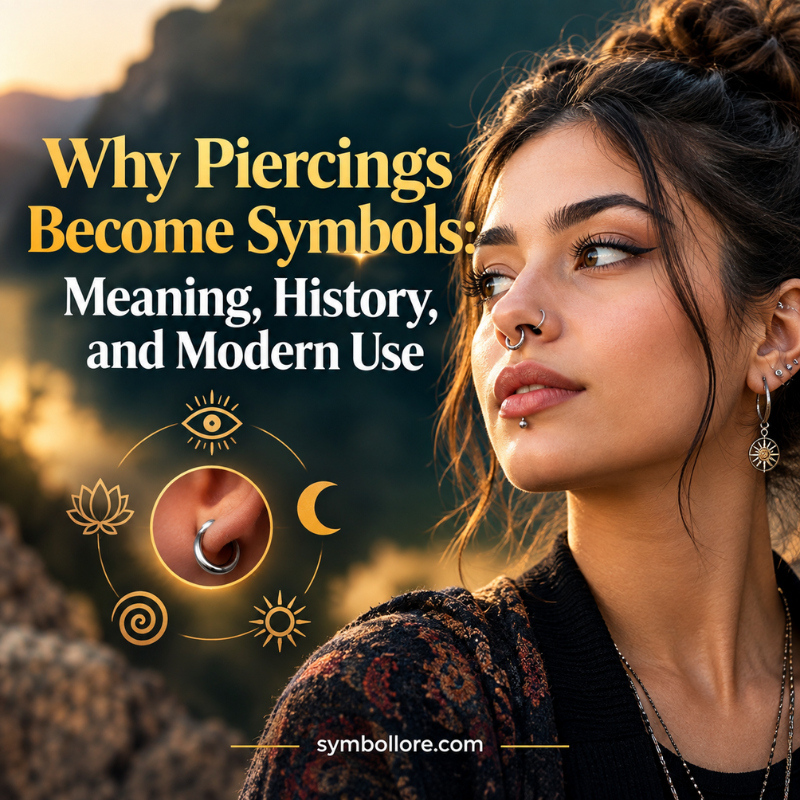
A piercing becomes symbolic because the human body is socially visible. Jewelry does more than decorate skin. It can change how a person is recognized, categorized, or remembered.
Anthropologist Rosemary Joyce describes body modification as closely connected with how people constitute themselves within social groups. In her framework, modifications can mark distinctions such as age and gender, especially when communities give them ritual meaning.
This helps explain why piercing can communicate more than beauty. The modification is placed directly on the body, so the message becomes part of the wearer’s visible identity.
However, symbolism does not always come from a formal tradition. A modern person might choose a piercing simply because it looks attractive. Another person might use the same style to mark independence or a major personal change.
Both uses are possible. One does not need to replace the other.
Piercing Symbolism in Ancient Cultures
Historical evidence shows that body piercing is far older than modern fashion culture. Archaeologists have found evidence of pierced ears, noses, lips, and other forms of body modification in different regions.
The Oxford Handbook of the Archaeology and Anthropology of Body Modification documents body piercing as a subject involving identity, ritual, gender, status, and social distinction. It also emphasizes the difficulty of reconstructing meanings from archaeological evidence because the original body and social context may not survive.
That limitation matters. Finding an ancient ornament does not automatically tell us exactly what every wearer believed.
Instead, researchers combine archaeological remains, historical records, artwork, and cultural context. This produces a more careful picture of how piercings functioned.
Ancient Andean Examples
The ancient Andes provide a particularly clear example of piercing as social symbolism.
The Metropolitan Museum of Art documents nose ornaments from ancient Peru that were suspended from the nasal septum. Some were connected with status and identity. Their precious materials also made the wearer’s social position visually apparent.
Moche nose ornaments provide another example. The Met explains that these ornaments could indicate status and identity among communities on Peru’s North Coast. Some were elaborate works of gold and silver that became part of elite regalia.
A British Museum guide likewise describes Moche nose rings as accessories associated with high status and the ability to embody a divine being during ceremonial events.
These examples show why “piercing means rebellion” is far too narrow. In some historical contexts, piercing communicated rank and sacred or ceremonial identity instead.
Piercing as Identity and Social Status
One of the strongest recurring symbolic functions of body adornment is identity.
A particular ornament can show who someone is within a community. It may communicate age, gender, rank, ethnic identity, ritual position, or membership.
The Oxford research on Mesoamerica shows that facial ornaments could help communicate gender, ethnicity, and status. Piercing could also become connected with rites of passage, sacrifice, self-sacrifice, and political or ritual authority.
The important point is that these meanings were not simply decorative. The ornament could help place a person within a social structure.
Museum collections provide similar evidence. The Met explains that ancient Andean body ornaments could distinguish wearers and transform how their identities were presented.
Modern readers should not assume that every piercing today carries an equivalent social code. Contemporary societies often allow much more individual choice.
Piercing and Rites of Passage
Piercing can symbolize transition because changing the body can visibly mark a change in social status.
A rite of passage may involve entering adulthood, marriage, initiation, religious participation, or another important stage of life. Body modification can make that transition visible.
Research on Mesoamerican body modification specifically connects piercing with important rites of passage.
The symbolism is therefore not simply “pain equals strength.” A more accurate interpretation is that the body becomes a record of social change.
Modern people can create a similar personal meaning without following an ancient ritual. Someone may choose a piercing after graduation, recovery, independence, a major relationship change, or another turning point.
That modern meaning is personal. It should not be presented as an ancient universal tradition.
What Nose and Septum Piercings Can Symbolize
Nose and septum piercings demonstrate why placement cannot be separated from culture.
In ancient Andean societies, nose ornaments could communicate status and identity. Some were also connected with elite regalia and ceremonial presentation.
The British Museum also holds nose ornaments from different regions and periods. Its collection includes examples from Colombia, New Guinea, West Africa, and other cultural settings, showing that nose adornment has never belonged to one symbolic system.
Today, a septum or nostril piercing may simply be a fashion choice. It can also express individuality, alternative style, cultural identity, or personal confidence.
Therefore, a specific placement should not be treated like a universal symbolic dictionary. The wearer, community, and cultural source matter.
Ear Piercing Symbolism and Belonging
Ear piercing is one of the most widespread forms of body piercing.
Because earrings are highly visible, they can function as ordinary decoration while also carrying social meaning. In some cultures, ear ornaments have marked age, gender, status, or belonging.
The historical record is complex because jewelry often survives more easily than the soft tissue it once adorned. This makes it difficult to determine exactly how every ancient piercing was worn or interpreted.
Modern ear piercing has an additional layer. A person can build a collection of piercings that reflects personal style rather than a formal cultural code.
The same ear can therefore communicate several things at once: fashion, identity, memory, or affiliation.
Piercing, Resistance, and Alternative Culture
Modern piercing symbolism also developed around nonconformity.
The contemporary Euro-American body-piercing movement expanded significantly during the second half of the 20th century. Research in the Oxford Handbook traces the revival of broader body piercing practices during the 1970s and examines how enthusiasts experimented with practices beyond the conventional Western ear piercing.
Alternative communities helped give some piercings associations with punk, goth, counterculture, and resistance to conventional appearance.
Yet these associations changed as piercing became more mainstream.
A person wearing an eyebrow piercing today may not be making a deliberate statement against social norms. They may simply like the design.
That shift illustrates an important rule of symbolism: a symbol can keep its historical association while gaining new meanings.
Piercing as Self-Expression and Individuality
Contemporary research often treats body modification as a form of identity construction.
A peer-reviewed study of tattoos and body piercings identified recurring motivations including marking important events or relationships, signaling group membership, and expressing individuality.
Research on youth cultures similarly describes contemporary body marks as voluntary resources for constructing identities around individuality, difference, and authenticity.
This helps explain why modern piercing symbolism can feel intensely personal.
Two people can have identical piercings but completely different reasons. One may celebrate independence. Another may honor a friendship. A third may simply enjoy the appearance.
The jewelry alone cannot reveal which story is true.
Spiritual and Religious Piercing Symbolism
Piercing has appeared in religious and spiritual contexts, but those meanings must be tied to specific traditions.
Some modern symbolism websites describe piercing as spiritual awakening, energy balancing, protection, or healing. These claims are not universal religious facts. They belong to particular traditions, contemporary spiritual interpretations, or individual beliefs.
Medical and cultural literature confirms that traditional piercing practices can occur within religious customs and ceremonies involving culture-specific symbolism. DermNet also notes that traditional piercing practices continue in various communities around the world.
The distinction is important.
A person may regard a piercing as spiritually meaningful. That personal belief can be respected without claiming that the piercing objectively changes spiritual energy or predicts an outcome.
Piercing Symbolism in Modern American Culture
In contemporary U.S. culture, piercing has moved across many social boundaries.
It appears in fashion, entertainment, workplaces, alternative communities, youth culture, professional body-art studios, and everyday personal style. This wider acceptance means that a piercing no longer automatically signals membership in one specific group.
The symbolism has therefore become more flexible.
A piercing may communicate:
- individuality;
- confidence;
- creativity;
- alternative style;
- independence;
- beauty;
- personal history;
- friendship or remembrance;
- cultural identity; or
- nothing beyond aesthetic preference.
That final possibility matters. Symbolism should not be forced onto everyone.
Sometimes jewelry is simply jewelry.
Why Pain Does Not Automatically Mean Strength
A common modern interpretation says that getting pierced symbolizes courage because the process involves discomfort.
That can be a meaningful personal interpretation. However, it should not be presented as the historical meaning of piercing everywhere.
Some body-modification traditions did place value on endurance, initiation, or ritual difficulty. Yet other piercings were primarily decorative, social, ceremonial, or status-related.
Medical literature also shows that motivations for piercing are varied rather than reducible to one psychological explanation.
So “piercing equals strength” is better treated as one possible modern interpretation.
The stronger symbolic explanation is that a deliberate change to the body can become a visible marker of choice, transition, identity, or commitment.
Common Misconceptions About Piercing Symbolism
Several popular claims deserve caution.
“Every piercing has a secret meaning.”
No. Many people choose piercings for appearance alone. Meaning depends on context and personal intention.
“A certain side always means something specific.”
Historical and subcultural codes can exist, but they are not universal. Meanings change across places and periods.
“All ancient cultures pierced for the same reason.”
No. Archaeological evidence shows different combinations of status, identity, ritual, beauty, and social meaning.
“Piercing always represents rebellion.”
Rebellion is one modern association, especially in some alternative subcultures. It is not the universal meaning of body piercing.
“Ancient piercing stories online are automatically historical.”
Not necessarily. The BMJ has specifically noted that several popular piercing-origin stories are modern myths rather than established history.
These corrections make piercing symbolism more useful because they replace rigid rules with evidence and context.
How to Interpret the Symbolism of a Piercing
If you are interpreting a piercing in artwork, literature, photography, or real life, start with context rather than a symbolism list.
First, identify the type and placement. An earring, septum ring, lip ornament, and industrial piercing do not have identical histories.
Next, identify the culture and period. Ask whether the design references an ancient tradition, a modern subculture, or contemporary fashion.
Then consider the material and design. Precious metal may emphasize status in one context. A simple steel ring may communicate minimalism or alternative style in another.
Finally, consider the person’s stated intention. Personal meaning is usually stronger evidence than an outside observer’s guess.
This approach prevents a common mistake: assuming that a visible symbol gives you complete access to someone’s identity.
FAQs
Piercing symbolism refers to the cultural, historical, social, or personal meanings associated with body piercing. Depending on context, a piercing may represent identity, status, ritual, transformation, beauty, belonging, resistance, or individuality. The meaning is not fixed because different cultures and wearers can use the same type of piercing in different ways.
A piercing can hold spiritual meaning within a particular religious or personal tradition. Some people interpret it as a sign of transformation, devotion, initiation, protection, or personal awakening. These interpretations should be attributed to the relevant belief system rather than treated as scientifically proven effects or universal spiritual rules.
It can, especially in modern alternative and countercultural settings. The association developed partly because visible body modification challenged conventional expectations about appearance. However, widespread acceptance has weakened the idea that every piercing is rebellious. Many people now wear piercings primarily for fashion or personal expression.
A nose piercing can symbolize different things depending on its cultural and historical setting. Ancient Andean nose ornaments could communicate status and identity, while modern nose piercings may express beauty, individuality, fashion, cultural identity, or personal preference. There is no single meaning that applies to every nose piercing.
Yes. A person may choose a piercing to mark recovery, independence, a relationship, graduation, personal growth, or another important transition. This is a modern personal meaning rather than a universal historical rule. The wearer’s own explanation is the strongest evidence for the intended symbolism.
Some historical and subcultural communities have used placement as a social signal. However, these codes are not universal and can change over time. A modern piercing placement may have no hidden message at all. It is safer to identify the specific culture or community before assigning a meaning.
No. Pain and endurance can become part of an individual’s interpretation, and some ritual traditions have emphasized endurance. Yet many piercings have also served decorative, social, ceremonial, or status-related purposes. Modern motivations are equally varied.
Sources and Further Reading
- Oxford Handbook: Piercing the Body in Mesoamerica
- Oxford Handbook: Cultural Transmission in the West
- The Metropolitan Museum of Art: Ancient Andean Nose Ornament
- The Metropolitan Museum of Art: Moche Nose Ornament
- BMJ: Body Piercing
- DermNet: Body Piercing
Conclusion
Piercing symbolism is best understood as a relationship between the body, culture, history, and personal choice. Across different societies, piercings have communicated identity, status, ritual participation, belonging, beauty, and social transition. In modern culture, they can also express individuality, resistance, memory, or simple aesthetic preference.
The most important distinction is context. An ancient nose ornament, a ritual piercing, a punk-era body modification, and a modern fashion piercing may look related while carrying very different meanings. Rather than assigning one universal message, consider the culture, period, placement, community, and wearer’s own intention. That approach makes piercing symbolism more accurate, respectful, and useful.


