Moon symbolism often centers on cycles, change, time, mystery, renewal, and reflection. These meanings developed partly because people could watch the Moon change shape while remaining a constant presence in the night sky. Its phases also helped communities measure months and organize religious and seasonal calendars.
Yet the Moon does not have one universal meaning. Ancient Egyptians, Greeks, Romans, Norse communities, Chinese traditions, Islamic cultures, Christian writers, artists, and modern Americans have all used lunar imagery in different ways. Some traditions connect the Moon with deities or sacred time, while others emphasize beauty, mortality, love, or change.
Understanding moon symbolism therefore requires context. A crescent on a religious building, a full moon in a poem, a lunar image in a tattoo, and the Moon on a calendar can communicate very different ideas.
Quick Answer
Moon symbolism commonly represents cycles, time, change, mystery, renewal, and reflection because the Moon repeatedly moves through visible phases. In some cultures it also carries religious, mythological, or calendar-related meanings. However, moon symbolism is not universal: its meaning depends on culture, period, form, surrounding imagery, and personal use.
TL;DR
- The Moon commonly symbolizes cycles and the passage of time because its phases repeat.
- Lunar imagery can represent renewal, change, mystery, beauty, love, or mortality.
- Ancient cultures often connected the Moon with gods, goddesses, calendars, fertility, or sacred time.
- Islamic traditions give the lunar cycle an important role in determining religious months, while the crescent became a later cultural emblem rather than an original universal Islamic symbol.
- Modern Americans often use moon imagery in art, literature, jewelry, tattoos, design, and popular culture.
- A Moon image should be interpreted through its cultural and visual context rather than assigned one fixed meaning.
Moon Meanings at a Glance
| Context | Possible Meaning | Why the Association Exists | Important Limit |
|---|---|---|---|
| Lunar phases | Change and renewal | The Moon visibly grows, becomes full, and wanes | Not every culture interprets the cycle in the same way |
| Calendars | Time and order | Lunar cycles helped organize months and festivals | Solar and lunar calendars developed differently |
| Night imagery | Mystery and reflection | Moonlight reveals part of the night while leaving much in darkness | “Mystery” is mainly an interpretive association |
| Ancient mythology | Divine power or personification | Many cultures represented the Moon through deities or mythic beings | Lunar deities differ greatly between cultures |
| Religious traditions | Sacred time and observance | Lunar cycles help determine some religious dates | Religious meaning depends on the specific tradition |
| Literature and art | Beauty, longing, change, mortality | Artists use the Moon as a visual and emotional contrast to darkness | Meaning belongs to the individual work |
| Modern personal symbolism | Growth, healing, identity, or reflection | People adapt familiar lunar imagery to personal experiences | Personal meaning is not proof of an ancient tradition |
What Does Moon Symbolism Mean?
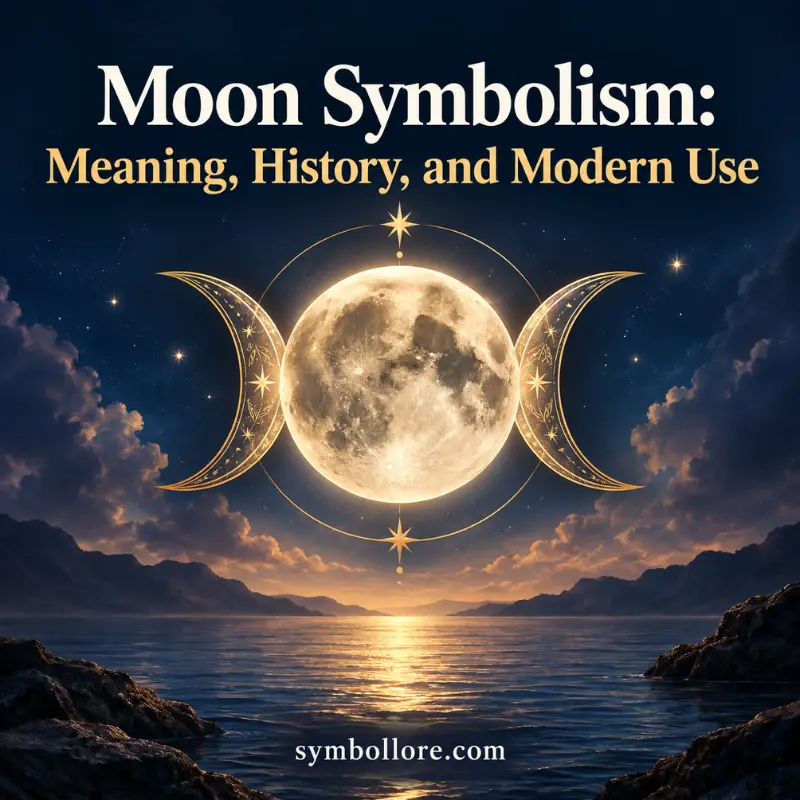
The strongest broad meaning of the Moon is cyclical change. Unlike the stars, which can appear relatively fixed from night to night, the Moon visibly changes shape over a repeating sequence. That makes it an unusually powerful image for growth, decline, endings, and beginnings.
The Moon also became connected with time. A complete cycle from one new moon to the next is roughly 29.5 days, making lunar observation useful for organizing months and tracking recurring events. Ancient communities could therefore experience the Moon as both a natural object and a practical measure of time.
That connection explains why lunar symbolism often moves between opposite ideas. A full Moon may suggest fullness or completion, while a waning Moon can suggest decline. A new Moon may represent absence, but it can also represent a hidden beginning.
The symbol is powerful because the same physical cycle can support several interpretations without requiring the Moon to have one fixed definition.
Why the Moon Represents Cycles and Change
The Moon’s phases provide one of the clearest natural models of repetition.
A thin crescent becomes more visible. The Moon reaches fullness. It then appears to shrink before disappearing into the new-moon phase and beginning the sequence again.
People observing this pattern can naturally connect it with human experiences such as birth, maturity, aging, death, grief, recovery, and renewal. These are symbolic interpretations rather than scientific claims about a person’s life.
The repeated cycle also makes the Moon useful as a metaphor for temporary conditions. Something can disappear without being permanently destroyed. A dark lunar phase may therefore represent a pause rather than an ending.
This is one reason lunar imagery works well in literature and personal art. It can communicate change without suggesting that change is always linear.
The Moon as a Symbol of Time
The Moon’s connection with time is one of its strongest historical associations.
Ancient Mediterranean societies carefully observed lunar phases, and lunar cycles became part of calendars and practical planning. The Open University notes that the roughly 29.5-day lunar cycle helped provide a unit of time between the shorter solar day and longer solar year.
The International Astronomical Union also notes that cultures across the world developed names and traditions for the Moon. The Latin word luna, for example, remains visible in words such as “lunar,” while Norse tradition associated the Moon with Máni and Hawaiian traditions with Mahina.
This history gives the Moon a symbolic connection with:
- passing time;
- recurring seasons;
- calendars;
- memory;
- patience;
- aging; and
- the return of familiar cycles.
The meaning is especially strong when the Moon appears alongside clocks, calendars, seasons, or other time-related imagery.
Moon Symbolism in Ancient Mythology
Ancient cultures often personified the Moon rather than treating it only as an astronomical object.
In ancient Egypt, Khonsu was associated with the Moon. The Open University notes that Khonsu was also connected with healing. In ancient Greece, Selene personified the Moon, while Roman tradition associated the Moon with Luna. In parts of Anatolia, the lunar deity Mēn carried different associations.
These examples show why it is misleading to say that “the Moon meant femininity” or “the Moon always represented fertility” in ancient cultures.
Some lunar deities were male. Others were female. Their powers also differed.
Greek mythology, for example, gave Selene a prominent lunar role and connected her with the story of Endymion. Egyptian lunar traditions developed within a different religious system. Norse mythology personified the Moon through Máni.
The Moon was therefore not one universal ancient symbol. It was a flexible celestial image interpreted through separate religious worlds.
Moon Symbolism Across Cultures
Chinese Traditions
The Moon has a major place in Chinese mythology, literature, language, and festival culture. The story of Chang’e and the jade rabbit is one well-known lunar tradition.
The Mid-Autumn Festival provides another important example. The full Moon is strongly associated with reunion and family gathering, and the festival’s imagery includes mooncakes and lanterns. The Open University describes the festival as a celebration in which the full Moon carries an important association with family reunion.
Here, the Moon can represent more than mystery. It can suggest family connection, seasonal rhythm, beauty, and togetherness.
Islamic Traditions
The Moon has an important practical role in Islamic timekeeping because Islamic months follow a lunar calendar. The sighting of the new crescent helps mark the beginning of months such as Ramadan and Shawwal.
However, an important distinction is needed. The crescent and star are widely recognized today as symbols associated with Muslim identity, but they were not established at the beginning of Islam as one universal official emblem.
Their later association with the Muslim world became especially strong through historical political and cultural use, including Ottoman imagery. SymbolLore’s own discussion of Islamic symbolism similarly distinguishes the modern crescent-and-star emblem from foundational Islamic practice
. Islamic symbolism and the crescent and star
Greek and Roman Traditions
Greek and Roman cultures developed rich lunar mythology. Selene was the Greek personification of the Moon, while Luna became the Roman lunar figure.
The Moon also became connected with other goddesses through later artistic and religious associations. The Metropolitan Museum of Art’s discussion of lunar imagery shows how Moon-related imagery continued into European art and mythology, including representations connected with Diana and other mythological traditions.
The key point is that “lunar goddess” does not automatically mean one identical religious idea. Each deity belongs to a specific mythology.
Norse Traditions
Norse mythology personified the Moon as Máni. The International Astronomical Union notes that this tradition also influenced Scandinavian words for the Moon.
This example is useful because it challenges the modern assumption that lunar symbolism is always feminine. A lunar figure can be male, female, divine, human-like, animal-associated, or simply an astronomical object depending on the tradition.
Why the Moon Symbolizes Mystery
The Moon is strongly associated with mystery because it is visible in darkness without fully eliminating darkness.
Moonlight illuminates a landscape, but it does not provide the same clarity as daylight. This creates a natural visual contrast between what can be seen and what remains hidden.
Artists and writers have used that contrast for centuries. The Moon can therefore represent:
- the unknown;
- imagination;
- secrecy;
- dreams;
- solitude;
- reflection; and
- hidden knowledge.
These meanings should be treated as artistic and cultural associations, not as evidence that the Moon possesses supernatural powers.
A crescent Moon surrounded by darkness usually creates a different emotional effect from a bright full Moon above a familiar landscape. The surrounding composition matters as much as the Moon itself.
Moon Symbolism in Religion and Sacred Time
The Moon appears in several religious traditions because lunar cycles provide a visible way to organize sacred time.
Islam is a clear example because the Islamic calendar is lunar. Religious observances such as Ramadan and Eid depend on the lunar month and the observation of the new crescent.
Christian literature and medieval European art provide a different example. The Moon could be used as a metaphor for change, limitation, imperfection, or earthly mutability. Recent Oxford research on medieval texts such as Ancrene Wisse and Pearl shows that lunar imagery could carry complex theological meanings rather than one simple definition.
This illustrates an important rule in symbolism: religious meaning belongs to the tradition and text in which the image appears.
A Moon in a Christian poem should not automatically be interpreted through modern astrology. Likewise, a lunar symbol in Islamic practice should not be explained using unrelated Western occult traditions.
Full Moon, Crescent, and New Moon Meanings
The Moon’s form can change the symbolic message.
Full Moon
A full Moon often suggests fullness, completion, visibility, maturity, beauty, or emotional intensity. Its bright circular form makes it visually complete.
In some artistic contexts, however, the full Moon can create an eerie or unsettling atmosphere. That is why “full Moon equals positive energy” is too simple.
Crescent Moon
A crescent often suggests transition because it shows only part of the lunar disk.
It can represent beginnings, growth, change, or an incomplete stage. In Islamic cultural contexts, the crescent also has a strong association with lunar months and later Muslim identity. That historical use should be distinguished from a claim that the crescent is a universal Islamic religious requirement.
New Moon
The new Moon is difficult to see from Earth, so it can symbolize hidden beginnings, rest, absence, privacy, or potential.
These meanings are particularly useful in modern art and personal symbolism, but they should be described as interpretive possibilities rather than universal historical definitions.
Moon Symbolism in Art and Literature
Artists use the Moon because it can establish setting, mood, scale, and emotional tension at the same time.
A small Moon above a large landscape can emphasize solitude or human vulnerability. A bright Moon behind a person can create mystery or separation. A reflected Moon on water can suggest memory, distance, or emotional longing.
The Moon also works well in literature because it can appear unchanged while characters experience dramatic transformation.
The Metropolitan Museum’s historical discussion of Moon imagery demonstrates how artists have repeatedly returned to lunar subjects across different periods and cultures.
The symbol therefore does not have to “mean” one thing in every artwork. A poet may use it for longing, while a painter may use it for atmosphere and a filmmaker may use it to foreshadow uncertainty.
Moon Symbolism in Modern American Culture
In modern American culture, Moon imagery appears in jewelry, tattoos, posters, fashion, photography, music, film, fantasy art, children’s media, and home décor.
Common modern associations include:
- personal growth;
- emotional reflection;
- femininity;
- mystery;
- independence;
- change;
- healing;
- romance; and
- connection with nature.
Some of these meanings draw from older cultural traditions. Others are modern interpretations.
For example, a person may choose a crescent Moon tattoo to represent a period of personal change. That meaning can be meaningful without claiming that ancient cultures used the exact same tattoo design for the same purpose.
Modern symbolism is often layered. A Moon tattoo may combine personal memory with an older cultural image of cycles and renewal.
How Color Changes Moon Symbolism
Color can strongly affect the mood of lunar imagery.
A silver or white Moon often emphasizes purity, calm, distance, or night.
A golden Moon can feel warmer and may suggest abundance, illumination, nostalgia, or sacred beauty.
A red Moon can create associations with danger, conflict, transformation, or dramatic change. These meanings are especially dependent on the surrounding image.
A blue Moon may suggest tranquility, sadness, rarity, or fantasy. The phrase “blue moon” also has an established cultural meaning related to an uncommon occurrence.
None of these color meanings is universal. The same red Moon can represent an eclipse in one image and emotional intensity in another.
Moon Symbolism in Dreams and Spirituality
Modern spiritual and dream traditions often give lunar imagery personal meanings. A Moon dream may be interpreted as representing emotional change, intuition, hidden feelings, or a new stage of life.
However, dream symbolism does not provide a scientifically verified dictionary in which every Moon dream has one fixed meaning.
A dreamer’s emotional response is more useful than a rigid rule.
A calm full Moon might remind someone of security or completion. A disappearing Moon might reflect uncertainty or loss. A frightening lunar scene may reflect anxiety rather than predict an outside event.
Similarly, seeing the Moon in everyday life can become spiritually meaningful to an individual. That experience can be respected without claiming that the Moon objectively sent a supernatural message.
What Moon Symbolism Does Not Prove
Several popular claims go further than the evidence supports.
The Moon does influence Earth’s tides through gravity, but this does not prove that lunar phases control a person’s emotions, personality, or destiny. The Natural History Museum explains the Moon’s gravitational role in Earth’s tides, while symbolic interpretations belong to a different category.
Likewise, the fact that many cultures created lunar myths does not prove that all cultures shared one ancient Moon religion.
It is also inaccurate to claim that every lunar symbol represents feminine energy. Some traditions use male lunar deities, while others do not personify the Moon at all.
The safest approach is to separate astronomy, documented history, religious tradition, folklore, modern spirituality, and personal symbolism.
How to Interpret a Moon Symbol Correctly
A useful interpretation begins with five questions.
- What form does the Moon have?
Is it full, crescent, half-lit, eclipsed, or barely visible? - Where does it appear?
Is it in religious art, literature, jewelry, a tattoo, a national emblem, or a landscape? - Which culture or period does it belong to?
A Chinese festival image and a medieval European manuscript should not be interpreted through the same symbolic system. - What appears around it?
Stars, water, animals, flowers, people, buildings, or religious text can change the meaning. - Is the meaning historical or personal?
A documented cultural association is different from an individual’s chosen interpretation.
This method prevents the most common symbolism mistake: treating every appearance of the same image as though it carries the same message.
FAQs
Moon symbolism most often centers on cycles, time, change, mystery, renewal, and reflection. These associations developed partly from the Moon’s repeating phases and its role in calendars. Specific cultures can add very different meanings, so the context remains essential.
A crescent Moon can symbolize beginnings, transition, growth, or an incomplete stage. In Islamic contexts, it is also associated with the lunar calendar and Muslim identity through later historical use. However, the crescent is not a universally mandated symbol of Islam.
The Moon is associated with femininity in some traditions, but not all. Some cultures personified the Moon as a goddess, while others used male lunar figures such as Norse Máni. Therefore, femininity is one historical association rather than a universal lunar meaning.
A full Moon can represent fullness, completion, maturity, visibility, beauty, or heightened emotion. Its meaning changes with context. In a peaceful landscape it may feel calm and beautiful, while in a horror story it may create tension or danger.
A Moon tattoo may represent change, renewal, mystery, personal growth, emotional reflection, or connection with nature. A crescent may emphasize transition, while a full Moon may suggest completion. The design’s surrounding symbols and the wearer’s intention determine the strongest personal meaning.
Yes, lunar imagery appears in many spiritual and religious traditions, but spiritual meanings differ widely. Some traditions use lunar cycles to organize sacred time, while modern spiritual communities may connect the Moon with intuition or reflection. These interpretations should not be presented as scientifically proven supernatural effects.
There is no reliable evidence that symbolic lunar imagery predicts a person’s future or determines personality. Astrology and other spiritual systems may assign such meanings, but those claims belong to systems of belief rather than established scientific evidence. Symbolic interpretation is better treated as cultural or personal meaning.
Conclusion
Moon symbolism remains powerful because the Moon combines visibility with change. Its repeating phases naturally suggest cycles, time, renewal, growth, decline, and return, while its presence in darkness supports associations with mystery and reflection.
Across cultures, however, the details differ. Lunar deities, religious calendars, myths, artworks, and modern designs each create their own symbolic language. The most reliable interpretation therefore begins with context rather than a universal meaning.
Today, the Moon can represent personal change, beauty, memory, spirituality, or simply the wonder of the night sky. Its richest meaning comes from understanding both the history behind the image and the reason it appears where it does.


