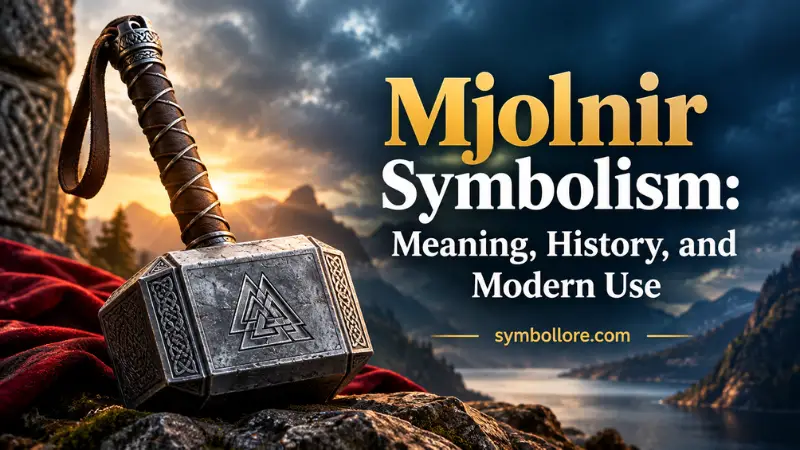
Mjolnir symbolism centers on protection, strength, sacred power, and the defense of order. Mjölnir is the hammer of Thor, the Norse god associated with thunder, and its meaning comes from what the hammer does in surviving myths and how people used hammer-shaped amulets during the Viking Age. It was both a fearsome weapon and a ritual object connected with blessing and protection.
The symbol is more complex than a simple image of violence. In Norse stories, Mjölnir protects gods and humans from giants, while archaeological finds show that miniature hammers were worn and used in religious contexts. Over time, the symbol also became connected with Norse identity, modern Heathen practice, popular culture, and, unfortunately, extremist appropriation. Its meaning therefore depends strongly on historical period, community, and setting.
Quick Answer
Mjolnir symbolism most strongly represents strength, protection, divine power, blessing, and the defense of order. These meanings developed from Thor’s role as a powerful defender and from the hammer’s ritual use in Norse tradition. Viking Age hammer pendants support its religious importance, but modern meanings vary, so Mjölnir should not be treated as a universal symbol with one fixed interpretation.
TL;DR
- Mjölnir is Thor’s hammer and one of the best-known symbols of Norse mythology.
- Its strongest meanings include protection, strength, power, blessing, and defense against chaos.
- Viking Age hammer pendants show that the symbol had religious and social importance beyond mythology.
- Mjölnir could have a ritual role connected with marriage, burial, protection, and consecration.
- Modern Heathens may wear it as an expression of religious identity or connection to Norse heritage.
- Some extremist groups have appropriated the hammer, but that use does not represent the symbol’s broader historical meaning.
Mjölnir Meanings at a Glance
| Context | Possible Meaning | Why the Association Exists | Important Limit |
|---|---|---|---|
| Thor’s weapon | Strength and power | Thor uses Mjölnir against giants and monsters | Not simply a symbol of violence |
| Protection | Defense and safety | Thor protects gods and humans from dangerous forces | Protection is rooted in Norse tradition |
| Thunder | Storm power and divine force | Thor is the thunder god and Mjölnir is linked to his power | Lightning is not the hammer’s only meaning |
| Blessing | Hallowing and sacred authority | The hammer appears in a wedding episode and ritual contexts | Exact Viking rituals remain partly uncertain |
| Fertility | Rain, crops, and growth | Thor was connected with rain and agricultural life | This meaning is broader than Mjölnir alone |
| Norse identity | Religious or cultural belonging | Hammer pendants were widespread in Viking Age Scandinavia | Modern wearers have different reasons |
| Modern Heathenry | Faith and devotion | Contemporary Heathens use Mjölnir as a religious emblem | Modern practice should not be projected directly onto the Viking Age |
| Extremist appropriation | Racial or ideological signaling | Some far-right groups have adopted Norse symbols | This is a modern misuse, not the symbol’s universal meaning |
What Does Mjolnir Symbolism Mean?
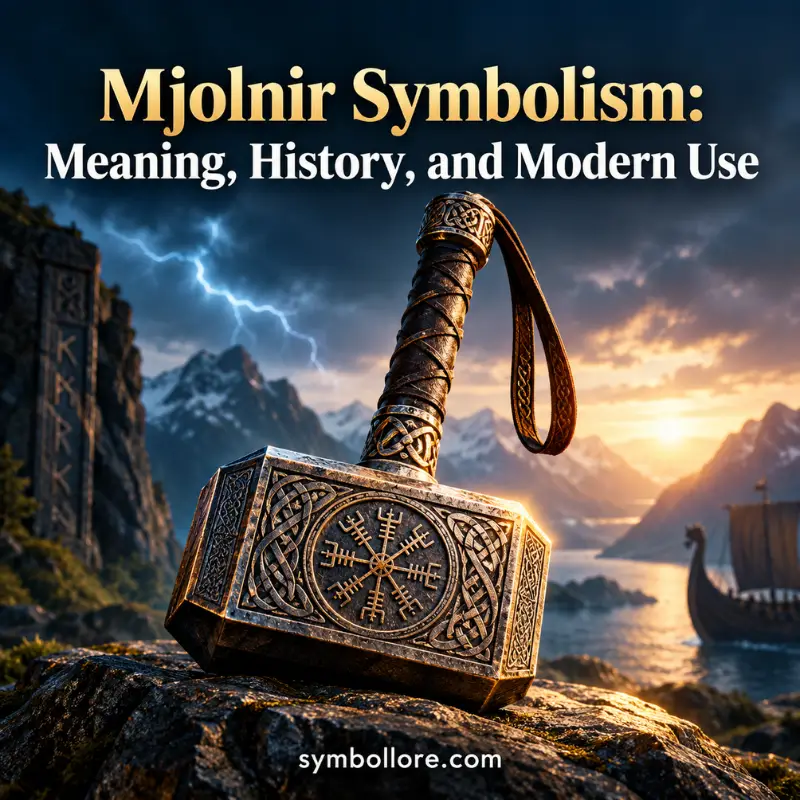
Mjolnir symbolism is best understood through Thor’s role as a defender. In Norse mythology, Thor uses his hammer in conflicts with giants and other threats to the divine and human worlds. The Swedish History Museum describes Thor as a guardian of cosmic order who fights giants and identifies Mjölnir as his powerful hammer.
That background explains why protection and strength became central meanings. Mjölnir does not merely represent physical force. It represents force used to defend a particular order against forces portrayed in myth as threatening it.
This distinction matters. Calling Mjölnir only a “war symbol” misses its ritual and protective dimensions. The hammer could destroy an enemy, but it could also be connected with blessing and important moments in life.
Why Mjölnir Became a Symbol of Protection
Protection is one of the strongest interpretations of Mjölnir because it follows directly from Thor’s mythological role.
Thor repeatedly confronts the giants, or jötnar, who threaten the gods and their world. His hammer is his most recognizable weapon in these encounters. The Swedish History Museum describes Thor’s symbolism through thunder, strength, protection, and his struggle against giants.
The archaeological record strengthens this interpretation. Small hammer pendants were found across areas associated with Viking Age Scandinavian culture. Their widespread distribution suggests that the image was more than a decorative representation of a mythological weapon.
However, archaeology cannot always tell us exactly what an individual wearer intended. A pendant may have expressed devotion, protection, identity, or several ideas at once.
Strength, Power, and the Defense of Order
Mjolnir symbolism also expresses strength under pressure.
Thor is one of the strongest figures in Norse mythology, and Mjölnir concentrates that strength into a single object. The hammer is described as capable of striking its target and returning to Thor after being thrown. It therefore represents controlled and reliable power rather than strength without purpose.
This is why a modern artistic image of Mjölnir can suggest courage, resilience, or the ability to confront danger. Those are reasonable modern interpretations because they grow from Thor’s established role.
Still, these psychological meanings should not be presented as official ancient definitions. Medieval Norse texts do not provide a simple list saying, for example, “Mjölnir means personal resilience.” Such interpretations are modern extensions of the older stories.
Thunder, Lightning, and the Power of Nature
Mjölnir is closely tied to thunder because Thor is the Norse thunder god.
The hammer’s blows were traditionally connected with thunder, making the object a visual expression of divine power in the natural world. The Swedish History Museum also notes Thor’s relationship with farmers and rain, showing that his significance extended beyond combat.
This creates an important symbolic connection between destructive weather and life-giving rain. Thunderstorms can threaten people, yet rain is essential to agriculture. Thor’s wider role reflects that tension.
Therefore, Mjölnir can represent power that is dangerous but also necessary. It is not simply an emblem of destruction.
Mjölnir and Blessing
One of the most important parts of Mjölnir symbolism is its connection with hallowing or blessing.
The poem Þrymskviða, preserved in the Poetic Edda tradition, tells how the giant Þrymr steals Mjölnir. He demands Freyja as payment for returning it. Instead, Thor disguises himself as the bride and travels to the giant’s hall. When the hammer is finally brought out, it is placed in the bride’s lap as part of the supposed wedding ceremony. Thor then recovers his weapon and defeats the giants.
The episode is unusual, but it reveals something important: Mjölnir is not presented only as a battlefield weapon. Its placement in a wedding setting gives it a consecrating or blessing function within the story.
The exact historical relationship between this literary scene and real Viking wedding customs remains uncertain. It is safer to say that the poem associates the hammer with hallowing than to claim that every Viking wedding used Mjölnir in exactly this way.
Mjölnir, Fertility, and Agricultural Life
Mjolnir symbolism can also include fertility and agricultural prosperity, although this meaning requires more context.
Thor was not only a thunder god. Museum sources connect him with farmers, free people, rain, and agricultural growth. Rain was essential to Scandinavian farming, so Thor’s control of thunder and weather had practical importance for communities dependent on crops.
This creates a symbolic chain:
Thor → thunder and rain → fertile fields → food and survival.
That connection helps explain why Thor could be viewed as both a warrior and a protector of ordinary agricultural life.
It also shows why reducing Mjölnir to aggression gives an incomplete picture. The hammer belongs to a religious world where protection, weather, fertility, community, and conflict could overlap.
Viking Age Mjölnir Pendants and Amulets
The archaeological record provides some of the clearest evidence for the importance of Mjölnir outside written mythology.
Hammer-shaped pendants have been discovered throughout Scandinavia and in other areas connected with Viking Age exchange. The Swedish History Museum records examples made from silver and iron, dating roughly to the Viking Age.
These objects are especially valuable because they show that people did not merely know Thor’s hammer as a literary idea. They reproduced its shape as a physical object.
The exact purpose of every pendant remains uncertain. Some may have functioned as amulets, religious markers, offerings, or expressions of identity. Archaeologists can establish the objects and their contexts more securely than they can reconstruct each wearer’s private intention.
The museum’s discussion of Thor’s hammer rings is particularly useful because some were found in graves while others occurred at settlement sites. Their precise ritual function is not always known.
Mjölnir in Burial and Ritual Contexts
Mjölnir’s relationship with death is another area where careful wording matters.
Small Thor’s hammers have been found in cremation graves, including hammer rings placed with or near burial urns. The evidence suggests a ritual connection, but scholars cannot always determine exactly what the object was intended to accomplish.
This means Mjölnir can reasonably be discussed in connection with ritual protection, religious practice, and burial, but claims about a single fixed funerary meaning go beyond the evidence.
The archaeological setting is especially important because the same symbol could operate differently in daily life and in a grave. Context tells us more than the hammer shape alone.
Mjölnir and the Christianization of Scandinavia
Mjolnir symbolism became especially meaningful during the period when Christianity spread through Scandinavia.
Thor’s hammer appears on some objects and runestones during a period when the Christian cross was also becoming an important religious symbol. The Swedish History Museum notes that hammer symbols could appear in contrast with the cross as Christianity spread in what is now Sweden.
This does not mean every Mjölnir pendant was deliberately anti-Christian. Religious change was complex, and different communities adopted Christianity at different rates.
Still, the coexistence of hammer and cross shows how symbols could communicate religious belonging during a period of major cultural change.
The hammer could therefore carry an additional meaning: continuity with an older Norse religious tradition.
What Does the Shape of Mjölnir Symbolize?
The familiar Mjölnir shape is usually a compact hammer with a broad head and short handle. Different archaeological examples vary considerably, so there is no single historical design that every Viking Age hammer had to follow.
That variation is important when interpreting modern artwork.
A modern Mjölnir with elaborate runes, knotwork, lightning, wolves, ravens, or other Norse imagery may communicate several ideas at once. Yet those additions are not automatically ancient attributes of the hammer.
The strongest historical reading starts with the object itself: Thor’s hammer, a powerful divine weapon and ritual symbol.
Some modern designs also imitate the Marvel version of Mjölnir, which introduces the idea that the hammer can be lifted only by someone deemed worthy. That concept is important in modern popular culture, but it should not be presented as an original Norse belief.
Mjölnir Symbolism in Modern American Culture
In the United States today, Mjölnir appears in jewelry, tattoos, games, films, fantasy art, historical reenactment, popular culture, and modern Heathen religious practice.
For some people, wearing the hammer represents connection with Norse mythology or Scandinavian heritage. For others, it symbolizes personal strength, protection, resilience, or admiration for Thor as a fictional or mythological figure.
Modern Heathen communities may also use Mjölnir as a religious emblem. That is a living religious use, not simply a historical reenactment.
Popular entertainment has added another layer. Marvel’s Thor has made the hammer familiar to millions of people who may have little knowledge of the medieval Norse sources. As a result, modern audiences may associate Mjölnir with worthiness, heroism, and superhero power.
Those meanings are culturally real today, but they belong to a different period from Viking Age symbolism.
Mjölnir and Modern Heathen Religious Identity
Contemporary Heathen and Ásatrú communities use Mjölnir in ways that can include religious devotion, ritual, identity, and connection to pre-Christian Norse traditions.
The hammer’s continued use is significant because it shows how an ancient symbol can become part of a living religious identity. Modern practitioners do not necessarily interpret it exactly as medieval Scandinavians did, and modern religious communities themselves differ in beliefs and practices.
That distinction should be respected.
A person wearing Mjölnir may be expressing faith, ancestry, historical interest, personal values, or simply appreciation for Norse mythology. The symbol alone cannot reveal the wearer’s beliefs.
Mjölnir and Extremist Appropriation
Mjolnir symbolism also has a difficult modern association: some white supremacist and far-right groups have appropriated Norse symbols, including Thor’s hammer.
That modern use deserves acknowledgment without allowing it to define the symbol as a whole. Academic discussion of contemporary extremist imagery notes that Thor’s hammer and runes have appeared in far-right environments, while also emphasizing that the hammer is widely used without political or extremist meaning.
Context is therefore essential.
A historically informed Mjölnir pendant, a modern Heathen religious pendant, a Marvel-inspired necklace, and an extremist display may look similar while communicating very different things.
The symbol should not automatically be treated as extremist simply because some extremist groups have appropriated it.
How to Interpret Mjölnir in Art, Tattoos, and Jewelry
The surrounding imagery often tells you which meaning an artist or wearer intends.
For example:
- Mjölnir alone: Norse heritage, Thor, strength, protection, or religious identity.
- Mjölnir with lightning: Thunder, divine power, and natural force.
- Mjölnir with agricultural imagery: Rain, fertility, farming, and prosperity.
- Mjölnir with Norse knotwork: Cultural or mythological identity.
- Mjölnir with a modern superhero design: Marvel-inspired heroism and worthiness.
- Mjölnir with explicitly extremist imagery: A modern political appropriation rather than a neutral historical reference.
The safest interpretation starts with the complete design rather than assigning one meaning to the hammer automatically.
What Mjolnir Symbolism Does Not Prove
Many websites present Mjölnir as though every modern spiritual claim were an established Viking belief. The evidence does not support that approach.
Several distinctions are useful:
It does not prove a universal protective power. Archaeological amulets demonstrate religious use, but they do not scientifically establish supernatural protection.
It does not have one fixed ancient meaning. The hammer appears in myth, archaeology, ritual contexts, and changing historical settings.
It does not automatically symbolize masculinity. Thor is male, but the hammer’s documented associations extend to protection, blessing, weather, agriculture, and religious identity.
It does not automatically mean warrior strength. Its ritual and protective dimensions are equally important.
It does not automatically signal extremism. Modern appropriation by some groups is only one chapter in the symbol’s much broader history.
These distinctions make Mjölnir symbolism more historically useful and less vulnerable to modern stereotypes.
FAQs
Mjolnir most strongly symbolizes strength, protection, divine power, blessing, and the defense of order. These meanings come from Thor’s role as a powerful defender and from the hammer’s appearance in Norse mythology and Viking Age material culture. Modern users may add meanings such as resilience, heritage, or personal identity.
Yes, protection is one of the strongest interpretations of Mjölnir. Thor uses the hammer to fight giants and other threats, while Thor himself is described as a protector of gods and humans. Viking Age hammer amulets also support the idea that the symbol had a religious or protective role, although their exact individual purpose is not always known.
In Norse mythology, Mjölnir is Thor’s powerful hammer and his main weapon against giants and other enemies. It is also associated with hallowing or blessing in the story of its recovery from Þrymr. The surviving sources therefore connect it with both destructive power and sacred protection.
Mjölnir can be associated with fertility indirectly through Thor’s connection with rain and agricultural life. Thor was important to farming communities, and rain supported crop growth. However, fertility was not the hammer’s only or universal meaning, so it is more accurate to describe fertility as one part of Thor’s wider symbolic role.
A Mjölnir necklace can express Norse religious identity, interest in Scandinavian history, cultural heritage, admiration for Thor, personal strength, or protection. Contemporary Heathens may wear it as a religious symbol. Because intentions vary, the pendant alone cannot establish exactly what its wearer believes.
Mjölnir is strongly associated with the Viking Age because numerous hammer-shaped pendants and other objects have been found in Scandinavian archaeological contexts. The hammer also belongs to older Norse religious traditions preserved in later written sources. It is therefore reasonable to call it a Viking Age symbol, while remembering that its history extends beyond that period.
Some white supremacist and far-right groups have appropriated Mjölnir and other Norse symbols. However, that association is modern and does not define the hammer’s broader historical or religious meaning. Context matters, especially when distinguishing historical, religious, popular-cultural, and extremist uses.
Conclusion
Mjolnir symbolism grew from the role of Thor’s hammer as a weapon, protector, and sacred instrument. Its strongest associations are strength, protection, divine power, blessing, and the defense of order, while its connection with thunder and agriculture adds another layer to its meaning. Viking Age pendants and burial finds show that the hammer was more than a mythological object; it also had a place in material religious culture. Today, Mjölnir can represent Norse heritage, modern Heathen faith, popular culture, or personal resilience. Its meaning is strongest when interpreted through its historical and cultural context rather than treated as one universal spiritual code.
Related Articles from symbollore.com
- Freyja Symbolism: What Her Norse Symbols Really Mean —
https://symbollore.com/freyja-symbolism/


