
Island symbolism brings together several opposing ideas. An island can represent solitude, independence, refuge, paradise, or freedom from ordinary life. However, the same stretch of enclosed land may suggest loneliness, captivity, exile, danger, or separation.
These meanings grow from the island’s physical form. Water creates a visible boundary between the island and surrounding land. Reaching or leaving it requires a crossing, so islands also become natural symbols of transition, discovery, and personal change.
Still, no interpretation applies everywhere. Mainland literature, sacred traditions, tourism, colonial history, and island communities can understand the same landscape in very different ways.
Quick Answer
Island symbolism commonly represents solitude, independence, refuge, escape, mystery, and transformation because water separates the land from its surroundings. In darker settings, an island can signify loneliness, exile, imprisonment, or danger. Cultural context matters: many Pacific traditions view the ocean as a route connecting communities rather than a barrier that leaves each island isolated.
TL;DR
- An island often symbolizes solitude, privacy, independence, or separation.
- A beautiful island may represent refuge, paradise, rest, or escape.
- A remote island can also suggest exile, captivity, danger, or abandonment.
- Crossing the water makes islands strong symbols of transition and transformation.
- Sacred and literary meanings differ across cultures and historical periods.
- For many island communities, the sea connects people instead of dividing them.
Island Meanings at a Glance
| Context | Possible Meaning | Why the Association Exists | Important Limit |
|---|---|---|---|
| Solitary island | Independence or loneliness | Water visibly separates it from other land | Solitude may be chosen or forced |
| Tropical island | Paradise, rest, or escape | Warm scenery and distance suggest relief from routine | Tourist imagery may ignore local life |
| Storm-bound island | Danger and vulnerability | Bad weather can prevent travel or rescue | The island may also represent endurance |
| Prison island | Exile, punishment, or control | Water functions as a natural barrier | This meaning depends on historical context |
| Sacred island | Holiness, pilgrimage, or mystery | Separation can mark a place as exceptional | Each religious tradition needs separate study |
| Uncharted island | Discovery or the unknown | The island lies beyond familiar maps and rules | Exploration stories may contain colonial assumptions |
| Archipelago | Community and connection | Several islands form a network across the sea | It challenges the lone-island metaphor |
Why an Island’s Physical Form Creates Meaning
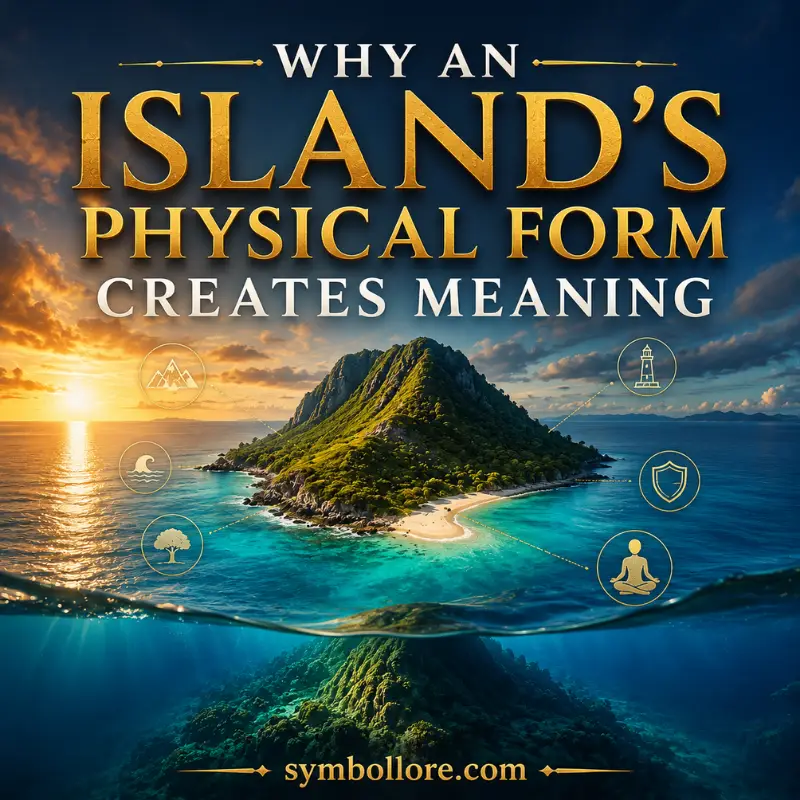
An island is both complete and separated. Its coastline gives it a clear shape, while the surrounding water distinguishes it from a larger mainland. Therefore, people often imagine it as a world with its own limits, rules, resources, and identity.
The land itself can suggest stability and material security. Similar associations appear in
where solid ground represents support, structure, and physical reality. Yet an island complicates that stability because moving water surrounds it.
This combination creates symbolic tension. The land offers shelter, but the sea may prevent departure. A coastline can protect the island’s interior while also enclosing anyone who lives there. As a result, island meanings often shift between safety and restriction.
The horizon also matters. From the shore, the viewer can see a distant boundary but may not know what lies beyond it. That visual experience supports ideas of uncertainty, longing, possibility, and separation from another life.
Solitude, Isolation, and Independence
Solitude is one of the most familiar island meanings. A single piece of land surrounded by open water resembles a person standing apart from a larger group. Writers and artists use this image to represent privacy, self-reliance, emotional distance, or the desire to think without interruption.
Chosen solitude usually gives the symbol a positive tone. A quiet island can represent rest, concentration, independence, and freedom from social pressure. It may express the need to establish personal boundaries or discover an identity that does not depend on other people’s approval.
Forced isolation creates a darker meaning. The island may then represent abandonment, loneliness, rejection, or an inability to reach help. A distant light, unreachable boat, or empty house can intensify that emotional reading.
However, physical distance does not always equal emotional loneliness. An island may support a close community with deep family, cultural, and trade relationships. Consequently, the isolation meaning often reveals the observer’s viewpoint more than the daily experience of island residents.
Refuge, Paradise, and Escape
Islands can symbolize refuge because water appears to separate them from conflict, noise, and ordinary demands. A protected cove or fertile island may feel like a self-contained sanctuary where people can recover, begin again, or live at a slower pace.
Popular tropical imagery strengthens the paradise meaning. Blue water, green vegetation, warm sunlight, and an open horizon suggest abundance, beauty, and release.
An academic review of island representations
notes that literature and culture have imagined islands as paradises, refuges, homes, prisons, and places of punishment.
The paradise symbol has limits, however. A vacation advertisement presents an island differently from a resident facing high living costs, political pressures, environmental threats, or limited services. Describing an inhabited island as untouched paradise can erase its people and history.
Personal objects can carry a gentler form of this coastal association. For example,
connects ocean imagery with resilience, calm, belonging, and memories of shoreline life.
Captivity, Exile, and Danger
The same water that protects an island can turn it into a prison. If a character cannot leave, the symbolic meaning changes from privacy to confinement. Distance becomes a tool of control rather than a source of freedom.
Historical prison islands have reinforced this association. Names such as Alcatraz and Robben Island remind many readers that authorities have used surrounding water to isolate prisoners, political opponents, and people considered threatening. In such settings, the island represents exclusion from society and the power to control movement.
Exile adds an emotional layer. A person sent to an island may remain physically safe while losing home, status, community, and influence. The land becomes a place of survival but also a constant reminder of forced separation.
Nature can deepen the danger. Storms, cliffs, limited food, disease, and the absence of rescue may turn a beautiful place into a hostile environment. Therefore, a deserted island story often tests whether human skill, cooperation, or moral order can survive without outside support.
The Island as a Boundary and Threshold
An island is not only enclosed land. It is also a destination reached by crossing a boundary. The journey from mainland to island can symbolize leaving ordinary rules and entering a different state of life.
This threshold quality is sometimes called liminality. A liminal place exists between familiar conditions: childhood and adulthood, guilt and forgiveness, society and wilderness, or the known and unknown. Because water marks the crossing so clearly, islands work especially well as settings for trials and transformation.
Arrival may strip away a character’s usual role. Money, job titles, social reputation, and daily routines may lose their power. The person must then decide what values, abilities, and relationships still matter.
Departure completes the symbolic pattern. A character who returns from an island may bring knowledge, regret, maturity, treasure, or trauma. If the person chooses to stay, the decision may represent acceptance, withdrawal, independence, or rejection of the former world.
Sacred Islands in Religion and Myth
Some traditions regard islands as sacred because their distance and defined shorelines set them apart from everyday space. A difficult crossing may also resemble a pilgrimage, preparing visitors to approach a monastery, shrine, burial place, or legendary realm.
Research on sacred islands and religious landscapes
connects their special status with isolation, clear boundaries, distinctive environments, cultural heritage, and religious devotion. Still, sacredness does not arise from geography alone. Communities create and maintain it through stories, rituals, buildings, journeys, and relationships with place.
Mythic islands may lie beyond normal maps. They can hold immortals, ancestors, hidden knowledge, perfect societies, dangerous beings, or tests for travelers. Their remoteness explains why they can remain mysterious: ordinary people cannot easily confirm what exists there.
Otherworld stories share this boundary-crossing pattern with
Both may use an attractive but unfamiliar place to represent wonder, temptation, altered time, or rules that outsiders do not understand.
Island Symbolism in Ancient and Imperial China
Ancient and imperial Chinese traditions developed rich island meanings that should not be treated as copies of European ideas. From at least the third century BCE, some Chinese accounts described distant maritime islands as homes of immortals and sources of life-extending substances.
The sacred islands Penglai, Fangzhang, and Yingzhou became linked with difficult quests, immortality, and divine realms. Rulers also created artificial islands in palace gardens. These landscapes gave symbolic form to sacred geography even when no voyage to a legendary island occurred.
A study of sacred island symbolism in Chinese history
explains that these associations influenced religious practice, garden design, literature, and adventure stories. Yet actual islands also served as places of political exile.
This contrast is important. The distant island could represent an immortal paradise in one account and forced removal from power in another. Chinese examples therefore show that the paradise-prison duality is not limited to modern Western storytelling.
Pacific Perspectives: Connection Rather Than Isolation
The common image of an island as a tiny, isolated dot often reflects a mainland viewpoint. Many Pacific perspectives instead understand islands, ocean routes, ancestry, trade, and migration as parts of one connected world.
Tongan-Fijian scholar Epeli Hau‘ofa challenged the idea that Oceania consists of small, helpless places divided by empty water. The Australian National University’s presentation of
his “sea of islands” perspective
explains that the ocean can function as a pathway, homeland, and source of relationships rather than a barrier.
This viewpoint changes the symbolism. An island may represent cultural identity without suggesting total separation. The sea can stand for movement, exchange, navigation, kinship, skill, and continuity across generations.
Pacific symbols connected with fishing and travel show this relationship clearly.
can express provision, strength, ancestry, ocean connection, and hopes for safe passage. However, Māori, Hawaiian, and other Pacific traditions remain distinct and should not be blended into one universal “island spirituality.”
Island Symbolism in Literature
Literature often turns an island into a small stage where a writer can test human behavior. Limited space and resources bring conflicts into focus. Meanwhile, distance from established society allows different rules, identities, and power structures to emerge.
In The Tempest, the island supports themes of exile, authority, freedom, colonization, magic, forgiveness, and reconciliation. Prospero treats it as a place from which he can control events. However, Caliban’s relationship with the land raises questions about ownership, dispossession, and whose perspective defines the island.
Robinson Crusoe helped shape the castaway story in English-language culture. Its island can represent hardship, religious reflection, self-reliance, control, and colonial possession. Later survival stories often repeat or challenge these themes.
Modern narratives use islands in similarly flexible ways. An academic comparison of The Tempest and Lost describes the
where characters face altered rules, moral tests, identity changes, and possible redemption.
Islands in Art, Film, and Popular Culture
Visual art can make an island seem peaceful, unreachable, threatening, or timeless through color and composition. Bright water and open skies create invitation. Dark cliffs, narrow entrances, and heavy clouds produce secrecy or dread.
Arnold Böcklin’s 1880 painting Island of the Dead offers a famous example. The Metropolitan Museum of Art explains that the painting’s commissioner requested a
coffin and shrouded figure in the approaching boat
as part of a memorial to her late husband. The enclosed rocky island, dark trees, still water, and arriving vessel turn the setting into an image of mourning and passage.
Film and television frequently use islands as controlled story worlds. A survival drama may emphasize scarce resources and social conflict. Horror treats the island as a place where escape is difficult. Fantasy may present it as an enchanted realm, while romance and advertising often use it as a promise of privacy and relief.
Video games add another layer. Players explore limited maps, collect resources, build communities, or search for a route home. The island becomes both a manageable world and a space of possibility.
One Island Versus an Archipelago
A single island often emphasizes individuality, concentration, or separation. Its isolated outline makes it an easy metaphor for one person, one secret, one community, or one self-contained world.
An archipelago changes that message. Several islands separated by water can represent a network of distinct identities. Each place retains its shape, yet travel, culture, ecology, trade, and family relationships connect the whole group.
Therefore, an archipelago may symbolize unity without sameness. It offers a useful alternative to the idea that connection requires every person or community to merge into one mass. Distance can exist alongside cooperation.
Bridges, boats, ferries, and shared routes further shape the image. A broken bridge may suggest damaged communication. Regular boat traffic can represent trust and exchange. An unseen route may symbolize relationships that outsiders fail to recognize.
Island Symbolism in Modern American Life
Americans commonly encounter island imagery in vacation advertising, fiction, television, tattoos, memorial art, logos, and language. Phrases such as “private island” suggest wealth, exclusivity, and freedom from interruption. In contrast, describing someone as “an island” usually implies emotional self-containment or disconnection.
A tropical island tattoo may represent freedom, travel, peace, cultural heritage, or an important home. A small island beneath a sunset can preserve memories of a honeymoon or family trip. Stormy water may instead mark survival, loneliness, or a difficult period of change.
However, images of Hawaii, Puerto Rico, the Caribbean, and other inhabited islands should not reduce living communities to decorative paradise. These places have Indigenous histories, political realities, working communities, and modern cultural identities.
Climate concerns have also changed island imagery. A low shoreline may now suggest environmental vulnerability, threatened homes, adaptation, and responsibility. Thus, the island can represent both resilience and the limits of romantic escape.
How to Interpret an Island Image
Begin with the relationship between land and water. Calm water may suggest peace, safe distance, or emotional balance. Rough water can imply danger, conflict, or an obstacle to connection. A bridge, boat, harbor, or visible mainland changes the meaning by showing whether travel remains possible.
Next, examine the island’s condition. A green, inhabited island may signify home and abundance. A barren rock can express endurance, abandonment, or emotional emptiness. Ruins suggest a lost community or forgotten past, while a lighthouse introduces guidance and watchfulness.
The observer’s position matters as well. Someone approaching an island may seek refuge, adventure, or discovery. A person leaving it may be escaping captivity or abandoning safety. Someone watching from another shore may feel longing, exclusion, or fear of separation.
Finally, identify the cultural source. Do not assume that a Pacific navigation symbol, Chinese immortal island, European prison island, modern tattoo, and fictional castaway setting share one definition. The strongest interpretation explains how the context creates the meaning.
FAQs
An island may spiritually represent retreat, sacred separation, pilgrimage, inner reflection, or movement into an unfamiliar state. However, these meanings depend on a particular religious tradition or personal belief. An island is not automatically sacred, nor does encountering one prove that a supernatural message has been sent.
An island can be either positive or negative. Chosen solitude, refuge, independence, and paradise create positive meanings. Forced separation, exile, captivity, and abandonment create darker ones. The condition of the island, surrounding water, available transportation, and the observer’s emotional response reveal the intended tone.
A deserted island often symbolizes extreme self-reliance, loneliness, survival, escape, or removal from society. In literature, it can also become a testing ground for morality and social order. “Deserted” does not necessarily mean physically barren; it usually means that permanent human companionship appears absent.
An island in a dream may reflect feelings about privacy, independence, loneliness, safety, or emotional distance. Calm surroundings may suggest welcomed solitude, while being unable to leave could reflect feeling trapped. Dream interpretation is personal and does not predict future events, so current emotions offer more guidance than a fixed symbol dictionary.
An island tattoo can represent home, travel, freedom, rest, resilience, or a wish for greater independence. Palm trees and sunsets usually create a peaceful tone, while storms or a stranded figure suggest hardship. Cultural imagery should be researched carefully, especially when the design refers to a specific island community.
A single island usually emphasizes individuality, solitude, or self-containment. An archipelago more often represents connected but distinct people, cultures, or ideas. Water still marks boundaries, yet boats, routes, and shared seas show that separation does not prevent community.
Conclusion
Island symbolism draws its power from a simple physical contrast: firm land enclosed by moving water. That form can represent independence, solitude, refuge, paradise, transformation, captivity, or exile. However, culture and viewpoint determine which meaning becomes strongest.
Mainland stories often emphasize remoteness, while many island communities understand the sea as a source of connection, travel, livelihood, and belonging. Therefore, an island should never be interpreted from its outline alone. Consider who approaches it, who lives there, whether departure is possible, and what the surrounding water means within that particular story or tradition.
Five Related Articles from symbollore.com
- Abalone Shell Symbolism: Meaning, History, and Modern Use — https://symbollore.com/abalone-shell-symbolism/
- Fish Hook Symbolism: Meaning, Culture, Luck, and Strength — https://symbollore.com/fish-hook-symbolism/
- Earth Element Symbolism: Meanings Across History and Culture — https://symbollore.com/earth-element-symbolism/
- Fairy Symbolism and Its Meaning in Folklore and Modern Culture — https://symbollore.com/fairy-symbolism/
- Hawthorn Symbolism: Hope, Protection, and Folklore — https://symbollore.com/hawthorn-symbolism/