Dead raccoon symbolism commonly points to an ending involving identity, adaptability, secrecy, or survival. Because raccoons are associated with masks, cleverness, and resourcefulness, their death can suggest that an old role has failed or a hidden issue now needs attention.
However, seeing a carcass does not predict tragedy or prove that the universe sent a message. Symbolism is interpretive, not scientific. The encounter may simply reflect wildlife mortality, yet it can still inspire an honest and useful moment of reflection.
Quick Answer
Dead raccoon symbolism may represent the end of a disguise, an outdated survival strategy, or a difficult period of change. It can encourage honesty, flexibility, and release, but it is not automatically a bad omen. Its meaning depends on the setting, your emotions, and what the raccoon personally represents to you.
Key Takeaways
- A dead raccoon often represents endings, exposure, or forced change.
- Its mask connects the symbol with identity and hidden truths.
- Road encounters may highlight interruption, risk, or life’s fragility.
- Dreams usually reflect emotions rather than predict future events.
- No universal spiritual meaning applies to every encounter.
- Physical safety must come before symbolic interpretation.
Dead Raccoon Meanings at a Glance
| Context | Possible Symbolic Meaning | Grounded Interpretation |
|---|---|---|
| In a yard | A boundary, habit, or private issue needs attention | The animal may have sought food, shelter, or a quiet place |
| On a road | A journey interrupted or the cost of moving without awareness | Vehicle collisions commonly kill nocturnal wildlife |
| Near a doorway | A transition, boundary, or identity at home | Treat the location as practical before calling it spiritual |
| Repeated encounters | A theme demanding attention or heightened awareness | Frequency alone does not prove a supernatural pattern |
| In a dream | An ending involving secrecy, fear, or adaptability | Consider the dreamer’s emotions and recent experiences |
| During major change | Release of an old role or coping method | The event may feel meaningful because it mirrors current stress |
What Does Dead Raccoon Symbolism Mean?
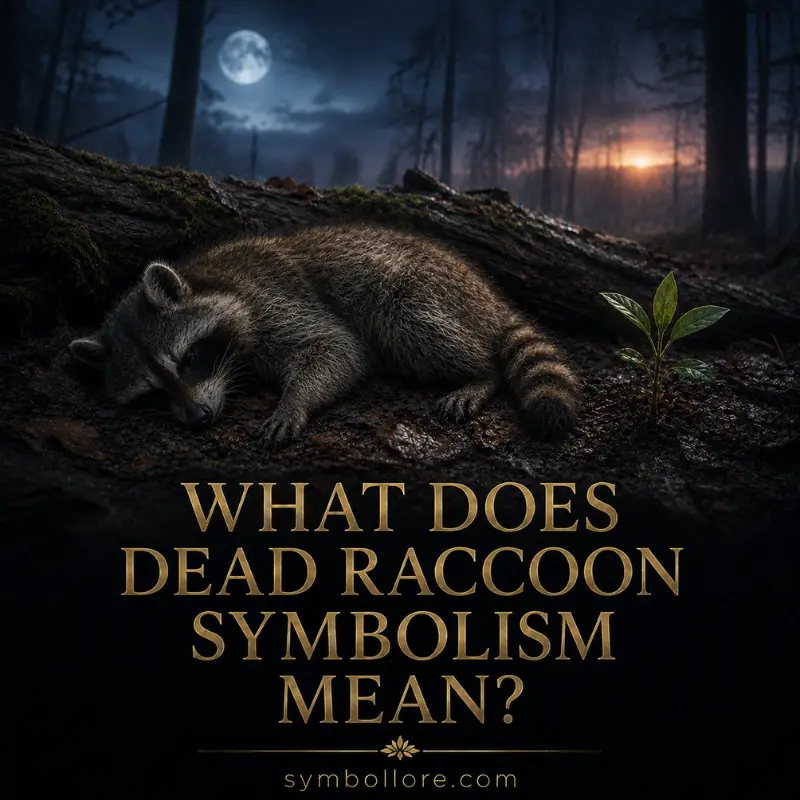
The clearest interpretation is that something connected with adaptation or concealed identity has reached an endpoint. A living raccoon survives by observing, exploring, and using available resources. Its dark facial markings also resemble a mask, which has made the animal a modern symbol of disguise and hidden motives.
Death reverses that active energy. Cleverness can no longer avoid the problem, and the protective mask no longer works. Therefore, the symbol may prompt questions about a role, secret, defense, or habit that has outlived its value.
This is a metaphor, not a universal spiritual law. A person experiencing a career change might see the encounter as the end of an old professional identity. Someone dealing with dishonesty may interpret it as a reminder that concealed matters eventually surface.
How Death Changes Raccoon Symbolism
Living raccoon imagery usually emphasizes ingenuity, curiosity, dexterity, disguise, and survival. Dead-animal imagery adds limits, loss, stillness, and irreversible change. Together, these ideas can represent the end of surviving through improvisation alone.
| Living Raccoon | Dead Raccoon |
|---|---|
| Adaptability | An old strategy no longer adapts |
| Curiosity | Curiosity has met a limit or consequence |
| Resourcefulness | Available methods may need reassessment |
| Masked identity | A role or disguise has fallen away |
| Night movement | Uncertainty has reached a turning point |
| Mischief or cunning | Cleverness must give way to accountability |
This contrast creates more depth than the broad idea of “transformation.” Sometimes the symbol is less about gaining a new life and more about admitting that a familiar approach has ended.
Endings, Identity, and Hidden Truths
The raccoon’s mask naturally invites reflection on identity. People wear social masks to protect themselves, meet expectations, or manage different roles. Such behavior is not always dishonest; it can be a normal response to work, family, or social pressure.
However, a dead masked animal can symbolize a persona that has become exhausting or ineffective. Perhaps you have been pretending to agree, hiding a need, or acting stronger than you feel. In that setting, the encounter may suggest that honesty now offers more protection than performance.
Resourcefulness adds another layer. Raccoons are widely recognized for adapting to human environments, but the symbol does not promise endless resilience. It may instead remind you that constant improvisation cannot replace rest, support, planning, or firm boundaries.
Is a Dead Raccoon a Bad Omen?
A dead raccoon is not inherently a bad omen. There is no reliable evidence that seeing one predicts death, financial loss, betrayal, or another future event. Those claims belong to personal belief rather than verifiable fact.
The image can still feel unsettling because death naturally evokes vulnerability and uncertainty. If the encounter feels meaningful, treat it as a reflective prompt instead of a forecast. You might ask what recently ended, what truth became visible, or where a familiar coping method stopped working.
This approach preserves the emotional value of symbolism without creating fear. A useful symbol helps you understand the present; it does not trap you in anxiety about an imagined future.
Dead Raccoon in a Yard or Near a Home
A yard represents personal space, privacy, family life, and boundaries in many modern interpretations. Therefore, finding a dead raccoon there may feel connected with a private problem, a strained boundary, or a hidden household concern.
The location also has an ordinary ecological explanation. Raccoons live successfully around towns and cities because food and shelter are often available. An injured or sick animal may also move toward a sheltered area.
Notice your first emotion before choosing a meaning. Fear may point toward safety or control concerns, while sadness may reflect grief or compassion. Disgust can indicate a boundary violation. Still, keep children and pets away and address the physical situation before beginning any spiritual reflection.
Dead Raccoon on the Road
A roadside encounter can symbolize interruption, direction, or the cost of moving without enough awareness. Roads represent chosen paths in familiar modern imagery, while roadkill shows how movement can meet forces outside an animal’s control.
This interpretation should not turn the animal’s death into a message created solely for the observer. Raccoons are active mainly at night, when darkness and vehicle speed increase collision risk. The encounter first represents a real animal’s mortality.
If the moment stays with you, use it to examine your pace or direction. You might need to slow down, notice a neglected risk, or reconsider a plan. The symbol supports mindful attention, but it does not order you to abandon a journey.
Dreaming About a Dead Raccoon
A dream about a dead raccoon often reflects the dreamer’s relationship with secrecy, identity, resourcefulness, or endings. Dreams combine recent events, memories, fears, and associations, so the emotional tone matters more than a fixed dream dictionary.
For example, relief could mean that a deceptive or stressful situation feels finished. Grief might mirror the loss of independence or a resourceful part of yourself. Fear could reveal worry about exposure, failure, or an unfamiliar transition.
Record three details after waking: where the animal appeared, what happened immediately before it, and how you felt. Then connect those details with current circumstances. A dream can support self-understanding, but it should not be treated as prophecy or proof of an external spiritual command.
Cultural Meanings and Respectful Interpretation
There is no single Indigenous meaning of the raccoon. North American nations have distinct languages, histories, ceremonies, and storytelling traditions. Combining them into one universal “Native American belief” can distort living cultures.
Documented raccoon stories differ by community.
The educational collection Native Languages of the Americas
notes that raccoons appear as mischievous tricksters in some traditions and as clever escape artists in others. These stories concern particular cultural settings; they do not establish one meaning for a dead raccoon.
The raccoon also has a long, changing place in North American culture.
A Smithsonian discussion of raccoons in North American history
shows how people have viewed the animal through many social roles. Respectful interpretation names the relevant community and avoids inventing sacred teachings.
A Grounded Way to Interpret the Encounter
A useful interpretation begins with context rather than a preset list of supernatural messages. Use these three questions:
- What did I feel first? Fear, sadness, relief, disgust, or curiosity can reveal the issue the image touched.
- What has recently ended or become visible? Consider a role, relationship pattern, secret, belief, or coping method.
- Which raccoon trait matters to me? The relevant association might be adaptability, disguise, curiosity, family protection, or survival.
Next, choose one modest takeaway. You might speak more honestly, review a risky plan, release an outdated role, or seek support instead of improvising alone.
Avoid searching endlessly for confirmation. If an interpretation increases panic or makes ordinary events feel threatening, step back. Meaningful reflection should create clarity, not compulsive fear.
What to Do If You Find a Dead Raccoon
Keep people and pets away, avoid bare-handed contact, and call local animal control, public works, or the health department for location-specific instructions. Removal and disposal rules vary across U.S. cities, counties, and states.
Raccoons are among the wildlife species involved in U.S. rabies surveillance.
The Centers for Disease Control and Prevention’s rabies overview
reports that wildlife accounts for more than 90% of reported animal rabies cases. A carcass does not automatically have rabies, but caution is appropriate.
The U.S. Department of Agriculture advises using gloves or a shovel if a dead wild animal must be moved and contacting local authorities when testing might be necessary.
Follow the agency’s rabies guidance for dead animals
rather than relying on a universal disposal method.
Also avoid nearby feces.
The CDC explains that raccoon roundworm exposure
can occur through contaminated material and recommends avoiding raccoons and their feces. If a person or pet had direct exposure, contact a medical professional, veterinarian, or local health department promptly.
FAQs
It may symbolize the end of an old identity, survival method, secret, or uncertain period. The interpretation comes from familiar raccoon traits such as adaptability and mask-like markings. It remains a personal or spiritual reading, not an established prediction.
No evidence shows that the encounter predicts a human death. It may remind someone of mortality, loss, or transition because the image itself involves death. That emotional association should not be mistaken for a literal warning.
It can symbolize exposed deception if the raccoon’s mask or “bandit” reputation personally suggests secrecy. However, the encounter does not prove that someone is betraying you. Look for real evidence and communicate directly before judging another person.
A doorstep represents the boundary between private life and the outside world, so the location may suggest changing boundaries or an issue entering awareness. Practically, contact local services and keep people and pets away from the carcass.
Repeated sightings may result from driving routes, local raccoon populations, seasonal movement, or increased attention after the first encounter. You may reflect on the pattern, but repetition alone does not establish a supernatural message.
The dream may express concern about exposure, lost independence, changing identity, or an unsuccessful coping strategy. It does not reliably warn of a future event. Interpret the setting and emotion alongside your recent experiences.
Do not touch it with bare hands or assume burial is permitted. Keep children and pets away, then ask animal control, public works, or the local health department about removal, testing, and disposal rules in your jurisdiction.
Conclusion
Dead raccoon symbolism most often centers on an ending involving adaptability, identity, secrecy, or survival. Its masked face can suggest exposed truths, while its resourceful nature may represent a coping strategy that no longer works.
Still, the encounter is not automatically an omen or supernatural prediction. Begin with the real-world context, handle the safety issue, and then consider your emotions and current circumstances. The most grounded interpretation is the one that encourages clear reflection and practical action without fear.


