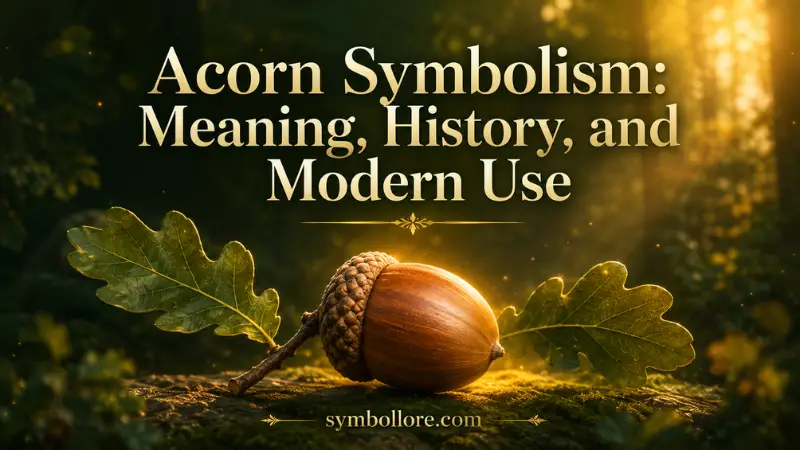
Acorn symbolism centers on growth, potential, patience, and the ability of something small to become strong over time. Because an acorn contains the seed of an oak, it offers a clear visual metaphor for beginnings that may appear modest but carry significant possibilities.
People encounter acorns in forests, parks, autumn decorations, jewelry, tattoos, family crests, children’s illustrations, and environmental campaigns. In the United States, they often suggest personal development, long-term planning, resilience, and connection to nature.
The meaning is also tied to the oak tree. Oaks have long represented durability, protection, honor, and endurance, so the acorn often expresses those same qualities in an earlier stage: strength that has not yet fully developed.
Quick Answer
Acorn symbolism commonly represents potential, gradual growth, perseverance, and promising new beginnings in modern American culture. Historically, it has also inherited associations with strength, endurance, nourishment, and protection from the oak traditions of Europe and the living cultural practices of Indigenous communities.
TL;DR
- Acorns represent potential contained within a small beginning.
- Their oak connection adds strength, endurance, and stability.
- Indigenous meanings vary and are rooted in living food traditions.
- Americans often associate acorns with autumn and personal growth.
- Tattoos may represent patience, family roots, or future achievement.
- The symbol is usually positive, but context determines its meaning.
What an Acorn Looks Like and Where It Appears
An acorn is the fruit, or nut, produced by an oak tree. Most acorns have a smooth or lightly textured shell attached to a scaly, cup-shaped cap. Their exact shape, size, and color vary among oak species, ranging from round and dark brown to narrow, pale, or elongated.
The cap gives the acorn its recognizable silhouette. Artists often exaggerate this feature, creating a rounded seed beneath a neatly patterned top. That simplified form appears in fabric prints, logos, children’s books, ornaments, ceramic pieces, carved furniture, and seasonal decorations.
In nature, acorns are more than decorative forest objects. They are seeds that can produce new oak trees, although many are eaten by wildlife or fail to germinate. They also provide important food for squirrels, deer, birds, rodents, and other animals. Oak woodlands support extensive ecological communities partly because of the food produced by their acorns.
The acorn’s real biological role explains much of its symbolism. It is physically small, but it contains the possibility of a tree that may eventually become far larger, older, and stronger than the seed itself.
The Core Meanings of the Acorn
The most common acorn meanings develop from the relationship between the seed and the mature oak.
Potential
An acorn suggests an ability, idea, or future that has not yet been fully realized. It may represent a young person, a new business, an early creative project, or the beginning of a long personal journey.
The symbol does not promise guaranteed success. A seed still requires suitable soil, moisture, time, and favorable conditions. For that reason, the acorn can represent realistic potential rather than instant transformation.
Growth
Unlike symbols connected with sudden change, the acorn represents slow development. An oak does not become mature in a season. The image therefore suits goals that require years of learning, practice, investment, or care.
Strength in Development
The oak symbolizes established strength, while the acorn represents strength in its earliest form. It communicates the idea that power may exist before it becomes visible.
Patience
An acorn encourages attention to long-term results. It can symbolize trusting a process, continuing through an unimpressive beginning, or accepting that meaningful progress may be difficult to measure at first.
Renewal
Because acorns fall and create the possibility of new trees, they may also represent continuation after loss, generational renewal, and the return of life through natural cycles.
Meanings at a Glance
| Context | Common U.S. Meaning | Typical Associations | Important Note |
|---|---|---|---|
| Personal growth | Untapped potential | Education, goals, confidence | Emphasizes gradual development |
| Family symbolism | Roots and legacy | Children, ancestry, generations | Often paired with oak leaves |
| Autumn decor | Harvest and seasonal change | Fall, forests, Thanksgiving | Usually decorative rather than spiritual |
| Tattoos | Resilience and future strength | Patience, recovery, ambition | Meaning depends on the wearer |
| Jewelry and gifts | Encouragement and good wishes | New ventures, graduation, birth | May suggest protection or longevity |
| Environmental use | Regeneration and conservation | Oak habitats, planting, wildlife | Reflects the acorn’s ecological role |
Why the Oak Tree Shapes the Meaning
The acorn receives much of its symbolic identity from the oak. Oaks are known for hard wood, broad canopies, long lives, and the ability of some species to withstand difficult conditions. These physical qualities encouraged associations with firmness, stability, endurance, and protection.
In European heraldry, the oak became a recognized emblem of strength and persistence. Oak leaves and acorns also appeared in clothing, furniture, military decoration, architecture, and ceremonial design. A nineteenth-century French child’s ensemble in the Metropolitan Museum of Art, for example, uses an oak-leaf-and-acorn motif associated with wishes for strength, stability, honor, and longevity.
The acorn modifies these mature oak meanings. It does not usually symbolize authority already achieved. Instead, it represents the origin of strength, the promise of endurance, or the first stage of something that may become firmly established.
This distinction explains why an oak tree may suit a monument, institution, or established family, while an acorn may be chosen for a child, student, startup, new home, or developing community.
Ancient European and Mediterranean Associations
Oak trees held important positions in several ancient European and Mediterranean traditions. They were connected with strength, sacred space, rulership, storms, and deities associated with the sky or thunder. Greeks, Romans, Celtic-speaking peoples, Slavic communities, and northern European cultures developed different oak traditions rather than one universal system.
Acorns appeared as decorative forms in the ancient Greek world. Surviving East Greek gold ornaments from the sixth century BCE combine acorns with bees, showing that the motif had a place in elite artistic design.
The surviving objects demonstrate the age of the image, although they do not support assigning one fixed meaning to every ancient acorn representation.
Roman oak wreaths were associated with honor, public merit, and military distinction. As the fruit of the honored tree, the acorn could share associations with courage, civic duty, or achievement when used alongside oak leaves.
Modern accounts sometimes reduce these traditions to claims such as “the acorn was a Celtic charm” or “Druids carried acorns for luck.” Such statements may be based on later folklore, modern spiritual practices, or incomplete interpretations. It is more accurate to say that the oak held significant religious and cultural associations in several European societies, while the acorn inherited portions of that broader symbolism.
Indigenous Foodways and Cultural Meaning in North America
Acorns have a major place in the histories and continuing traditions of numerous Indigenous peoples, particularly in California and parts of the western United States. They were not merely symbols. They were practical, carefully managed food resources connected with seasonal gathering, ecological knowledge, family labor, trade, and community life.
For many California Native communities, acorns were gathered in autumn, dried, stored, shelled, ground into meal, and leached to remove bitterness from tannins. The prepared meal could then be cooked into mush, breadlike foods, or other dishes.
Traditional gathering and preparation continue in some communities today.
These practices can support meanings such as nourishment, continuity, responsibility, seasonal abundance, and relationship with oak landscapes. However, there is no single “Native American acorn meaning.” Tribal nations have distinct languages, environments, ceremonies, and historical experiences.
Treating the acorn only as a generic spiritual emblem can erase its material importance. It may represent food sovereignty, cultural survival, ecological stewardship, and the continuation of knowledge passed through families and communities.
Traditional ecological practices also shaped oak habitats. Indigenous burning, gathering, pruning, and land management could improve access to oak resources and support acorn production. Contemporary restoration projects increasingly recognize the value of working with tribal knowledge rather than treating oak landscapes as untouched wilderness.
What Acorns Commonly Mean in the United States
In mainstream American culture, the acorn is most often understood as a sign of potential. The familiar relationship between the small seed and the large oak makes the metaphor easy to recognize without specialized religious knowledge.
The English proverb commonly expressed as “mighty oaks from little acorns grow” strengthened this interpretation. It is used to suggest that important institutions, accomplishments, fortunes, and personal abilities may begin on a very small scale. Forms of the proverb have circulated for centuries.
This message appears in American education, parenting, entrepreneurship, financial planning, and community development. A school might use an acorn to represent young students. A savings program may use it to communicate gradual accumulation. A nonprofit may choose it to show that a small contribution can produce lasting results.
The symbol also has regional associations. In parts of the South, live oaks represent endurance, beauty, history, and place. Acorns used in this context may suggest Southern landscapes, inherited memory, or a connection with established local communities. Live oak timber also holds a notable place in American naval history because of its strength and use in ships such as the USS Constitution.
Autumn, Harvest, and Seasonal Change
Acorns are strongly associated with fall because many oak species release mature acorns during that season. In American visual culture, they frequently appear beside pumpkins, leaves, pine cones, apples, and woodland animals.
As an autumn symbol, the acorn may represent harvest, preparation, abundance, and the transition toward winter. Squirrels collecting and storing acorns reinforce themes of planning ahead and using resources wisely.
Acorn imagery is common in Thanksgiving centerpieces, wreaths, table settings, greeting cards, classroom displays, and farmhouse-style decor. In most of these settings, the meaning is seasonal rather than religious. The acorn helps create a woodland atmosphere and signals the colors, textures, and natural cycles of fall.
It can also represent the relationship between endings and beginnings. The growing season is closing, yet the fallen seed contains the possibility of future growth. This makes the acorn especially suitable for artwork concerned with transition, retirement, graduation, moving, or the completion of one life stage.
Emotional and Psychological Meaning
Psychologically, the acorn can communicate grounded hope. Its message is optimistic, but it does not imply that change happens without work or suitable conditions.
Someone who identifies with the acorn may see themselves as being in development. They may possess skills that are not yet recognized, be recovering from a setback, or be beginning again after a major life change.
The symbol can also reduce the pressure to appear fully accomplished. It allows a person to value preparation, learning, and incremental progress rather than judging success only by visible results.
Several emotional themes commonly fit the image:
- Quiet confidence: Ability does not need to be fully displayed immediately.
- Patience: Development can be meaningful even when it is slow.
- Security: The oak connection suggests stability and dependable roots.
- Hope for children: A small beginning may lead to a capable adult life.
- Continuity: One generation creates conditions for the next.
- Belonging: The seed remains connected symbolically to its tree and landscape.
The acorn may be especially comforting during uncertain beginnings. It provides a concrete reminder that an early stage is not an inferior version of the final result. It is a necessary stage with its own purpose.
Family, Children, and Generational Symbolism
Acorns are often used to represent children because they are small, developing, and connected to a larger family tree. Parents may choose acorn jewelry, nursery prints, or keepsakes to express hopes for a child’s future.
When paired with an oak tree, the symbolism becomes generational. The tree may represent parents, grandparents, ancestry, or an established family, while the acorns represent descendants and future branches of the family line.
This imagery can appear in:
- Birth announcements
- Adoption gifts
- Family-tree artwork
- School and daycare logos
- Grandparent jewelry
- Memorial pieces
- Personalized holiday ornaments
The symbolism works particularly well for families because it combines individuality with connection. Each acorn is separate, yet it comes from a tree and may produce another tree.
In memorial art, an acorn may represent the influence a person leaves behind. The emphasis is not necessarily on death itself but on continuation through children, values, work, memories, or communities shaped by that person’s life.
Acorn Meaning in Tattoos
An acorn tattoo usually represents personal potential, resilience, patience, or the decision to build a stronger future. Its small size makes it suitable for minimalist tattoos, while its connection to the oak gives the image more meaning than an ordinary botanical design.
A person may choose one after beginning recovery, returning to school, launching a business, becoming a parent, or leaving an unstable period. In these cases, the tattoo marks a beginning rather than a finished achievement.
Common tattoo interpretations include:
- Starting over after hardship
- Growing into personal strength
- Honoring family roots
- Trusting a long-term goal
- Remembering a child or parent
- Connecting with forests or a hometown
- Accepting gradual rather than immediate progress
An acorn beside an oak leaf may emphasize endurance and heritage. One shown with visible roots can represent identity and belonging. Several acorns may stand for siblings, children, or different stages of growth.
The meaning is generally positive, although a tattoo does not have one universal definition. Personal history, accompanying imagery, placement, and artistic style may change what it communicates.
Jewelry, Gifts, Fashion, and Decorative Art
Acorn-shaped pendants, earrings, charms, cuff links, brooches, and ornaments have appeared in European and American decorative arts for generations. Their rounded form is visually appealing, recognizable, and easy to reproduce in metal, wood, glass, ceramic, or stone.
As a gift, an acorn may communicate encouragement. It suits occasions involving beginnings and long-term development, including graduations, new jobs, business launches, births, anniversaries, and new homes.
It may also convey:
- “Your abilities will grow.”
- “Small steps matter.”
- “Stay patient with the process.”
- “You come from strong roots.”
- “This beginning has a future.”
Victorian and later naturalistic design movements helped popularize leaves, nuts, flowers, and woodland forms in clothing and household objects. Acorns appeared in embroidered textiles, carved furniture, silverware, teapot finials, jewelry, and architectural ornament. Museum collections preserve acorn designs from ancient Greek goldwork through nineteenth-century European fashion and American decorative art.
In contemporary fashion, an acorn accessory may be worn simply because of its woodland appearance. Symbolic meaning should not be assumed unless the wearer or designer identifies one.
Spiritual and Religious Interpretations
The acorn is not a central universal symbol in Christianity, Judaism, Islam, Buddhism, or Hinduism. It may still acquire spiritual meaning through its natural qualities or through the broader symbolism of the oak.
In Christian-inspired art, the seed can suggest faith, spiritual development, resurrection, or the results of patient cultivation. However, these are interpretive applications rather than a single established biblical definition of the acorn.
Modern nature-centered spiritual practices may use acorns as symbols of protection, prosperity, masculine strength, earth connection, or future abundance. Some people place them on seasonal altars, carry them as personal tokens, or use them in rituals focused on goals and beginnings.
These practices vary widely and often combine folklore, personal spirituality, modern witchcraft, environmental awareness, and reconstructed traditions. Claims that every acorn has a fixed spiritual vibration or guarantees luck should be understood as matters of belief rather than historical fact.
A grounded spiritual interpretation focuses on what the object visibly demonstrates: life beginning in a compact form, growth requiring time, and mature strength emerging through sustained development.
Ecological Meaning and Conservation
The acorn can also symbolize ecological regeneration. It is both food and seed, supporting animals while allowing oak populations to reproduce.
Squirrels and jays often move and bury acorns. Although many are later eaten, forgotten seeds may germinate away from the parent tree. In this way, animal behavior can contribute to the spread and renewal of oak woodlands.
Acorns feed many species, including deer, squirrels, turkeys, ducks, mice, and other forest animals. The success or failure of an acorn crop can affect wildlife movement, nutrition, and reproduction.
Environmental organizations may use acorn imagery to represent tree planting, habitat restoration, climate resilience, and care for future generations. The symbol is effective because conservation itself often requires long timelines. Someone may plant or protect an oak whose mature canopy will primarily benefit people and wildlife decades later.
In this context, the acorn represents responsibility toward a future that the person beginning the work may never fully see.
Positive and Negative Interpretations
The acorn is overwhelmingly positive in contemporary American symbolism. It usually suggests growth, promise, endurance, nourishment, and patient preparation.
Its less positive meanings are usually created by context rather than established tradition. An ungerminated acorn might represent wasted ability, delayed action, or potential that has never been developed. A hard shell may suggest emotional defensiveness or resistance to change.
The symbol could also express the burden of expectations. Being told that one must become a “mighty oak” may feel encouraging to one person and restrictive to another. It can imply that every small beginning must eventually produce something impressive.
In environmental imagery, damaged or empty acorns may represent habitat decline, failed regeneration, or ecological instability. These interpretations depend heavily on presentation.
The acorn itself is not widely recognized as a symbol of danger, death, betrayal, or evil. Negative readings need visual or narrative clues to become clear.
Common Misunderstandings and Misuse
One frequent misunderstanding is treating the acorn as an identical symbol across all cultures. Similar themes may appear in different places, but each tradition has its own history.
Another problem is attributing a general “Native American meaning” to the acorn. For many Indigenous peoples, acorns are connected with specific lands, foods, technologies, seasonal practices, and community knowledge. Reducing those relationships to a generic charm for abundance can be inaccurate and disrespectful.
Claims about ancient European use also require care. Oak trees were culturally important in several societies, but modern websites often attach detailed magical properties to acorns without distinguishing documented history from recent spiritual practice.
The phrase about mighty oaks can also oversimplify growth. Real acorns need appropriate conditions, and most do not become mature trees. As a human metaphor, the image should not be used to suggest that effort alone determines every outcome. Opportunity, support, health, resources, and environment also matter.
Finally, an acorn motif may have no symbolic purpose at all. It can be chosen because it suits autumn decor, woodland branding, or the shape of a decorative object.
How the Meaning Has Evolved
The earliest importance of acorns was practical. They served as food for people and wildlife, supported seasonal economies, and contributed to the regeneration of oak landscapes.
As oaks accumulated cultural associations with endurance, authority, honor, sacred space, and protection, their fruit became part of the same visual language. Acorns appeared in ornaments, crowns, clothing, furniture, and architecture.
European proverbs then emphasized the contrast between the seed’s small size and the oak’s mature form. This helped establish the modern interpretation of humble beginnings leading to significant results.
In the United States, the symbol expanded into education, family identity, environmentalism, personal development, seasonal decor, finance, and entrepreneurship. Its meaning became more individual and future-focused.
The modern acorn therefore operates on several levels at once. It is a seed, a wildlife food, an autumn image, an Indigenous cultural resource, an inherited decorative motif, and a metaphor for long-term human growth.
F AQs
Spiritually, an acorn may represent potential, patient development, protection, and trust in gradual change. These meanings usually come from its natural growth into an oak rather than from one universal religious doctrine.
Some folklore and modern spiritual practices treat acorns as tokens of luck, prosperity, or protection. In mainstream American culture, they are more commonly associated with promising beginnings and future success than with supernatural luck.
An acorn tattoo often represents personal growth, resilience, family roots, or a goal that will take time to achieve. It may also commemorate a new beginning, a child, a recovery journey, or a connection to oak forests.
In family symbolism, the acorn commonly represents a child, descendant, or developing generation. When shown with an oak tree, it may express ancestry, inherited strength, and the continuation of family values.
The Bible does not assign the acorn one fixed symbolic meaning. Christians may interpret it as an image of faith, growth, renewal, or the development of something small, but those readings are devotional rather than direct biblical definitions.
Yes, although it usually represents strength in development rather than strength already established. Its connection to the mature oak allows it to suggest hidden ability, future resilience, and the foundations of lasting stability.
Conclusion
Acorn symbolism expresses the possibility contained within an early beginning. The seed’s relationship to the oak makes it a natural emblem of growth, patience, resilience, family continuity, nourishment, and strength that develops gradually.
Its meaning is most accurate when grounded in context. In American culture, it may encourage a student, honor family roots, mark a new venture, decorate an autumn home, or support a conservation message. In Indigenous communities, acorns may also remain connected to specific living traditions, foods, landscapes, and cultural responsibilities.
The acorn does not represent instant success. It represents the conditions, time, care, and persistence through which a small beginning may become something enduring.