Ace of hearts symbolism most commonly centers on love, emotional beginnings, affection, and the promise of a meaningful relationship. The card combines two familiar ideas: the heart as a sign of feeling and attachment, and the ace as a beginning, exceptional opportunity, or winning position.
People encounter the card at game tables, in tattoos, on jewelry, in romantic artwork, and across social media. In each setting, its meaning changes slightly. A couple may use it to represent lasting devotion, while another person may choose it as a sign of self-respect, emotional recovery, or the courage to love again.
The card does not have one official symbolic definition. Its meaning developed from several overlapping traditions, including European playing-card history, the language of romantic hearts, card-game rankings, fortune-telling systems, and modern American design culture.
Quick Answer
Ace of hearts symbolism commonly represents new love, emotional fulfillment, affection, and a promising beginning in modern American culture. Historically, the card has also been connected with the home, family happiness, friendship, celebration, and favorable personal news.
TL;DR
- The heart suit represents love, emotion, relationships, and personal attachment.
- The ace suggests beginnings, opportunity, distinction, or a decisive moment.
- Together, they often signify a new or renewed emotional connection.
- Older card-reading traditions linked it with home, affection, and celebration.
- Tattoos may represent devotion, self-love, luck, or emotional survival.
- Its meaning depends on context, surrounding imagery, and personal intention.
What the Card Looks Like and Where It Appears
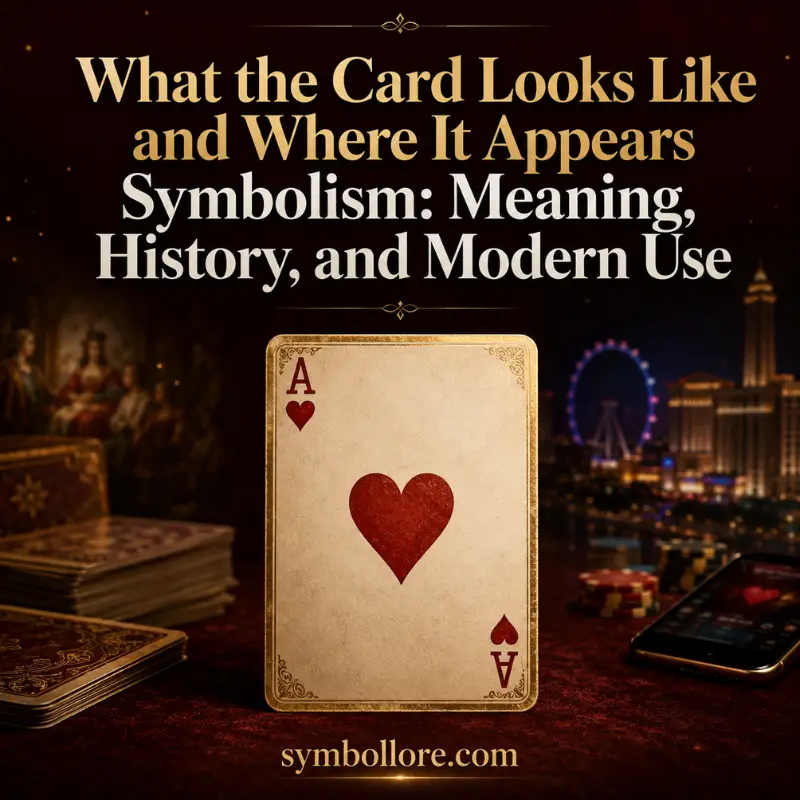
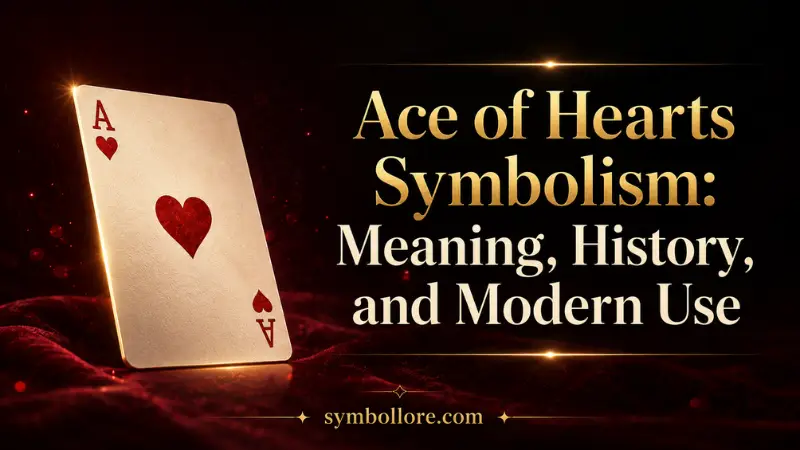
A standard ace of hearts is a white rectangular playing card marked with one large red heart. Smaller heart symbols and the letter “A” usually appear in opposite corners so players can identify the card while holding a fanned hand.
The design is simple, but it brings together several recognizable visual signals:
- Red suggests passion, warmth, urgency, or vitality.
- The heart shape suggests love, care, emotion, and attachment.
- The single suit symbol suggests unity, focus, or one important feeling.
- The ace rank can suggest excellence, opportunity, or a fresh start.
Americans commonly see the card in poker-style decks, magic performances, casino imagery, Valentine’s Day graphics, clothing, album artwork, tattoo designs, posters, greeting cards, and relationship-themed social posts.
Unlike the ace of spades, which often carries associations with danger, death, rebellion, or military history, the heart card usually communicates something warmer and more personal.
Meanings at a Glance
| Context | Common Meaning in the USA | Typical Associations | Important Note |
|---|---|---|---|
| Romance | New love or sincere devotion | Attraction, commitment, intimacy | May represent a specific partner |
| Personal growth | Emotional renewal | Healing, openness, self-respect | Not limited to romantic love |
| Family and home | Security and belonging | Marriage, household, reunion | Common in older card-reading systems |
| Games and luck | A favorable emotional opportunity | Winning, chance, confidence | Its actual rank depends on the game |
| Tattoos and fashion | Identity expressed through love | Loyalty, passion, resilience | Meaning is often highly personal |
| Cartomancy | Positive emotional news | Relationship beginnings, celebration | Interpretations vary by tradition |
Why the Ace Changes the Message
The ace is the card with a single suit mark. Its name developed from words meaning “one” or “a unit,” and an ace may hold either the highest or lowest value depending on the rules of a particular card game.
That flexible rank helps explain its symbolism. As the first card in a suit, it can represent origin, possibility, or something beginning to take shape. As the strongest card in many games, it can also represent achievement, advantage, quality, or a decisive opportunity.
When paired with hearts, the ace usually points toward the beginning or strongest expression of an emotional theme. That may include:
- Meeting someone important
- Recommitting to an existing relationship
- Rebuilding trust
- Welcoming a child or family member
- Finding a stronger sense of belonging
- Becoming emotionally available after disappointment
The card does not necessarily promise that love will succeed. A more grounded interpretation is that an important emotional opportunity has appeared and now requires honesty, judgment, and action.
Why Hearts Represent Emotion and Attachment
The familiar heart icon is not a realistic drawing of the human organ. It is a stylized shape that gradually became connected with emotion, devotion, memory, and romantic love in medieval European art.
Representations of people giving or holding hearts appeared in courtly-love imagery during the 13th and 14th centuries. By the 15th century, the recognizable red heart had become strongly established as a symbol of love and was also being used as a playing-card suit.
This history matters because the playing-card symbol inherited meanings that already existed outside games. The heart could refer not only to romance but also to character, courage, conscience, spiritual devotion, memory, and the emotional center of a person.
Modern American culture narrows the symbol toward love more often than earlier traditions did. However, phrases such as “follow your heart,” “have a change of heart,” and “home is where the heart is” preserve its broader connection with values, belonging, and personal truth.
From Early Playing Cards to the French-Suited Deck
Playing cards were used in Asia before reaching Europe, where they became established during the late Middle Ages. Early European decks did not share one fixed set of suit symbols. Regional packs included cups, coins, swords, batons, bells, leaves, acorns, hunting equipment, and many other designs.
The four suits familiar in the United States—hearts, diamonds, clubs, and spades—came from French cardmaking traditions. French suit signs became standardized around the 15th century, and their simple shapes were easier to reproduce than elaborate illustrated symbols.
The heart suit was related to earlier Germanic heart designs, although cardmakers changed and simplified suit systems as decks moved between regions. The modern deck is therefore the result of adaptation rather than a single inventor assigning permanent meanings to four symbols.
Claims that each suit was officially created to represent one social class—such as clergy, merchants, soldiers, or farmers—should be treated cautiously. Such explanations are popular, but historical decks varied too widely for one universal code to explain them all.
How the Card Gained Symbolic Meaning
The card was originally a game object, not a fixed spiritual emblem. Its modern meaning emerged because people combined the emotional associations of the heart with the rank and language of the ace.
The word “ace” once referred simply to the one-mark side of a die. Because one could be a low result, it was not always a compliment. As aces gained high status in many card games, the word developed positive meanings related to excellence, expertise, and outstanding performance.
This shift created a useful symbolic contrast. The ace could represent both the first step and the strongest card. In emotional imagery, that combination suggests a feeling that is new but potentially important.
Fortune-telling with ordinary playing cards added another layer. Historical cartomancy manuals did not always agree, but several associated the card with the household, feasting, friendship, affection, favorable messages, or a love letter.
These traditions helped turn an ordinary game card into a recognizable sign of emotional promise.
What It Commonly Means in the United States
In modern American culture, the card usually communicates a positive emotional message. It can stand for being fortunate in love, finding the right person, opening oneself to connection, or treating love as the most valuable part of life.
Its exact tone depends on how it is presented.
A clean card beside an engagement ring may symbolize commitment. A worn or burning card may suggest damaged trust. A card pierced by a knife may represent betrayal, while one surrounded by flowers may represent affection, growth, or remembrance.
The symbol also appeals to people who enjoy combining romance with risk. Playing cards suggest uncertainty and chance, while the heart suggests emotional investment. Together, they can communicate the idea that loving someone requires vulnerability because the outcome cannot be fully controlled.
This connection makes the image especially useful in tattoos, songs, fashion, and visual storytelling.
Romantic Love, Commitment, and New Relationships
Romantic love is the card’s most familiar interpretation. Couples may use it to represent the beginning of their relationship, a marriage proposal, an anniversary, or the belief that they have found their “winning hand.”
As a relationship symbol, it can express:
- Exclusive commitment to one partner
- The excitement of falling in love
- A relationship that changed someone’s life
- Loyalty through difficult circumstances
- Hope after heartbreak
- Readiness to begin dating again
The single heart can also represent undivided affection. Instead of many competing emotions, there is one central bond or person.
However, the card should not automatically be interpreted as marriage or permanent commitment. In some designs, it represents attraction, romantic possibility, or an important encounter rather than an established partnership.
Home, Family, Friendship, and Emotional Security
Love is broader than romance, and older interpretations often connected this card with the home. In historical card-reading traditions, it could signify a household, gathering, celebration, or affectionate social circle.
That domestic association remains understandable today. The heart represents where a person feels emotionally safe, while the ace suggests a central or primary source of belonging.
Someone might therefore use the card to honor:
- A supportive family
- A childhood home
- A chosen family
- A close friendship
- A family reunion
- The birth or adoption of a child
- A loved one who has died
In memorial art, the card may represent a person who was “the heart of the family.” In friendship jewelry or matching tattoos, it can communicate loyalty without romantic intent.
Context is essential. Names, dates, flowers, houses, banners, and surrounding cards often reveal whether the intended meaning is romantic, familial, or commemorative.
Self-Love, Healing, and a Fresh Emotional Start
The card has increasingly become a symbol of self-love and emotional recovery. In this interpretation, the single heart does not belong to another person. It represents the wearer’s own emotional life.
A person may choose it after leaving an unhealthy relationship, rebuilding confidence, setting boundaries, or learning to accept care without abandoning personal needs.
The ace adds a sense of beginning again. It can mark the point when someone decides to stop repeating a damaging pattern and create a healthier relationship with themselves.
This does not mean avoiding closeness. Instead, the symbol can express the belief that secure relationships begin with self-respect, emotional awareness, and the ability to recognize harmful behavior.
When used this way, the card is less about “winning” another person and more about reclaiming responsibility for one’s emotional choices.
Luck, Excellence, and “Winning at Love”
Because an ace is often a high-ranking card, the image can suggest luck, advantage, success, or having something valuable in hand. American designs frequently combine it with dice, chips, flames, horseshoes, or casino lettering to strengthen this interpretation.
In romantic use, “lucky in love” is the clearest message. The person may believe that meeting a partner was an unlikely but fortunate event.
The card can also represent emotional excellence. Calling someone an “ace” implies that the person is highly capable, dependable, or exceptional. Combined with a heart, it may describe someone who loves generously or remains loyal under pressure.
Still, the image can carry irony. A broken, stained, or discarded card may imply that the person gambled on love and lost. Artists often use this contrast to explore risk, regret, and the unpredictability of relationships.
Cartomancy and Spiritual Interpretation
Cartomancy is the practice of assigning interpretive meanings to ordinary playing cards. It is a divination tradition rather than a scientifically validated method of predicting events, and its meanings differ between readers and systems.
In many modern readings, the card represents new love, affectionate news, emotional openness, reconciliation, domestic happiness, or the beginning of a fulfilling relationship. Some readers also connect it with pregnancy, marriage, a new home, or an emotionally important invitation.
Historically, interpretations were less uniform. One manual might emphasize the house and celebration, while another focused on correspondence between lovers. This variation shows that card meanings were created and adapted within particular reading traditions rather than discovered as universal facts.
For people who use cartomancy reflectively, the card may function as a prompt to ask:
- Am I open to receiving affection?
- What relationship deserves more care?
- Do I feel emotionally secure at home?
- Am I beginning something from hope or loneliness?
- What would honest emotional communication require?
Such questions can be useful for reflection even when the card is not treated as a supernatural prediction.
Tattoo Meaning and Personal Identity
An ace of hearts tattoo usually represents love, devotion, emotional strength, or luck in relationships. Its compact design works well as a small standalone tattoo, but additional imagery can change its meaning considerably.
Common variations include:
- With a name or initials: devotion to a partner or family member
- With a date: anniversary, birth, death, or turning point
- With a crown: valued love, confidence, or emotional authority
- With a dagger: betrayal, sacrifice, or painful loyalty
- With flames: intense attraction or consuming passion
- With roses: romance, beauty, remembrance, or grief
- With wings: freedom, spiritual love, or memorial meaning
- With a skull: love and mortality, dangerous attraction, or loss
- With another card: partnership, shared identity, or a personal story
Matching tattoos can identify one person as the ace and another as a king or queen. These pairings may be affectionate, but their meaning depends entirely on the people involved.
Before interpreting someone else’s tattoo, it is better to ask than assume. Personal tattoos often commemorate events that cannot be understood from the design alone.
Jewelry, Fashion, Art, and Digital Culture
The card appears on pendants, rings, earrings, jackets, sneakers, handbags, phone cases, posters, and playing-card-inspired streetwear. Designers use it because the red, black, and white color scheme is instantly recognizable and visually bold.
In jewelry, it can function as a private token of affection. A small pendant may be given for an anniversary, Valentine’s Day, or the beginning of a relationship. It can also be worn simply because the person enjoys card games or graphic symbols.
Artists often use the card to explore the tension between feeling and chance. A perfect card may represent hopeful love. A torn card may suggest rejection. A card hidden inside a sleeve can imply secret affection or emotional manipulation.
Online, the image may appear in usernames, profile graphics, relationship announcements, gaming identities, and romantic edits. In these settings, it can mean “my heart belongs to one person,” “love is my strongest card,” or simply create a stylish casino-inspired aesthetic.
Cross-Cultural and Contextual Differences
The card belongs to the French-suited deck used widely in North America and many other parts of the world. However, not every card tradition uses hearts. Italian- and Spanish-suited decks commonly use cups, while German and Swiss decks retain different regional suit systems.
For that reason, the card’s exact symbolism is not universal. In cultures where another deck is more familiar, cups or other red suits may carry the emotional associations that Americans attach to hearts.
Modern cartomancy also frequently compares the heart suit with cups in tarot because both are commonly interpreted through relationships and feelings. The systems remain distinct, however. A playing card does not automatically have one fixed tarot equivalent, and readers may use different correspondences.
Individual context matters more than broad cultural claims. A poker player, magician, tattoo collector, card reader, and newly engaged couple may all recognize the same card while assigning it different meanings.
Common Misunderstandings and Shadow Meanings
The most common misunderstanding is treating the card as an automatic promise of romance. Symbols do not guarantee events, and a card reading cannot establish that a particular person will return, propose, or remain faithful.
Another mistake is assuming the card has always carried one secret historical meaning. Playing-card designs and interpretations changed across countries, games, and fortune-telling traditions.
The card also has less positive possibilities. Depending on the artwork, it may suggest:
- Emotional impulsiveness
- Idealizing a new relationship
- Mistaking attraction for compatibility
- Gambling with another person’s trust
- Obsession or possessiveness
- Dependence on romantic approval
- Pain caused by betrayal
A reversed, damaged, blackened, or bleeding heart often shifts the message from hopeful connection to loss, manipulation, or emotional danger.
The symbol is therefore best understood as emotional potential rather than guaranteed happiness. Love may be the opportunity represented by the ace, but the choices made afterward determine what that opportunity becomes.
FAQs
It is usually interpreted positively because it combines the heart’s connection with affection and the ace’s connection with opportunity or distinction. In darker artwork, however, it may represent risky love, betrayal, or a relationship that failed.
In a romantic context, it often represents new affection, renewed commitment, emotional openness, or meeting someone important. It can also describe a relationship that feels unusually fortunate or central to a person’s life.
The tattoo may symbolize devotion, self-love, emotional survival, loyalty, or being lucky in love. Names, dates, flowers, weapons, flames, and other cards can significantly change the intended message.
It can represent marriage when it appears with wedding imagery, rings, dates, or other commitment symbols. By itself, it more broadly suggests emotional opportunity, affection, home life, or a promising relationship.
Modern card readers often compare hearts with the tarot suit of cups because both can represent feelings and relationships. They belong to different card systems, so the comparison is interpretive rather than a strict historical identity.
Yes. Older cartomancy traditions linked it with the home, gatherings, friendship, and affection, making it suitable for family or chosen-family symbolism. Memorial designs may also use it to honor someone considered the emotional center of a household.
Finding the card has no universal predictive meaning. A person may treat it as a reminder to notice an emotional opportunity, reconnect with someone, care for themselves, or reflect on what love and belonging currently mean in their life.
Conclusion
Ace of hearts symbolism brings together emotional connection and the possibility contained in a single, important beginning. Its most familiar meanings include new love, sincere affection, domestic happiness, self-respect, loyalty, and the feeling of being fortunate in one’s relationships.
The card’s history also shows why symbolic meanings should be handled carefully. It began as part of an evolving European game system and later gathered associations from romantic art, card rankings, fortune-telling traditions, and popular culture.
Whether it appears in a tattoo, gift, reading, painting, or deck of cards, its clearest message is not that love is guaranteed. It is that an emotional opportunity has value—and that what follows depends on how thoughtfully it is handled.