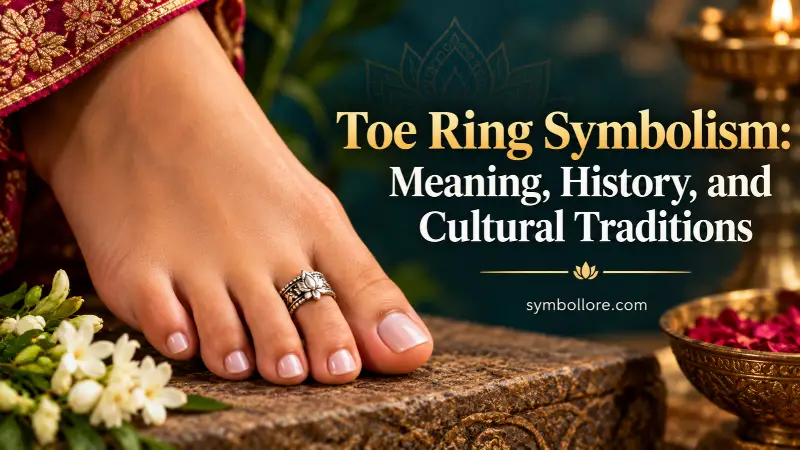
A tiny ring worn on a toe can carry a surprisingly personal meaning. In some cultures, it represents marriage and commitment. For others, it is simply a beautiful piece of jewelry that reflects their style.
Toe ring symbolism is especially important in several Hindu wedding traditions, where silver rings mark a woman’s married status. However, their meaning changes across communities, generations, and personal beliefs.
Understanding these differences helps explain why someone might wear a toe ring for cultural pride, spiritual reasons, or everyday fashion.
Quick Answer: What Does a Toe Ring Symbolize?
A toe ring commonly symbolizes marriage, commitment, cultural identity, or personal expression. In many Hindu communities, married women traditionally wear silver toe rings on the second toe of each foot. In modern Western fashion, toe rings usually serve as decorative accessories. Some people also associate them with grounding and spiritual balance, although these meanings depend on personal beliefs.
Key Takeaways
- Marriage and commitment: Toe rings traditionally identify married women in several Hindu communities.
- Cultural identity: Traditional designs may reflect regional customs and family heritage.
- Spiritual meaning: Some wearers connect toe rings with grounding, balance, and protection.
- Silver symbolism: Silver is traditionally preferred for toe rings in many Indian communities.
- Modern interpretation: Today, anyone may wear a toe ring as an expression of personal style.
What Is Toe Ring Symbolism?
Toe ring symbolism refers to the cultural, emotional, and personal meanings associated with wearing a ring on a toe.
Unlike ordinary decorative jewelry, some toe rings have established roles in religious and social traditions. Their meaning can depend on the wearer’s background, marital status, and the occasion.
In several Hindu communities, toe rings form part of traditional bridal jewelry. They may be worn during a wedding ceremony and kept afterward as a sign of marriage.
The Hindi term bichiya or bichhiya refers to this traditional ornament. In Tamil, a toe ring is often called metti. Names and customs vary across Indian regions.
Outside these traditions, toe rings may carry no formal message. Someone wearing one at the beach or with sandals might simply enjoy its appearance.
This difference matters because symbolism comes from cultural context rather than the object alone.
What Do Toe Rings Symbolize?
Toe rings can represent several ideas, but not every meaning applies to every wearer.
Marriage and Lifelong Commitment
Marriage is one of the most established meanings of traditional toe rings.
In many Hindu wedding customs, a bride receives toe rings as part of the marriage ceremony. Silver rings placed on the second toes can symbolize her new marital status.
Like a wedding band worn on the finger, these ornaments may communicate commitment. Their role, however, comes from a specific cultural tradition.
Not every married Hindu woman wears toe rings, and customs can differ between families.
Love and Partnership
Because toe rings can form part of wedding jewelry, they may also represent a lasting partnership.
Their meaning goes beyond romantic feelings. They can serve as a daily reminder of promises, shared responsibilities, and family bonds.
For some women, traditional toe rings become treasured keepsakes that connect their marriage to earlier generations.
Cultural Identity and Heritage
Traditional jewelry often helps people maintain a connection to their roots.
A woman wearing bichiya or metti may be honoring customs passed down through her family. The design might also reflect regional craftsmanship or personal history.
For people living outside India, traditional toe rings can carry memories of weddings, relatives, and cultural celebrations.
However, personal reasons vary. The wearer is the best source for understanding what the jewelry means to them.
Grounding and Stability
Some contemporary spiritual interpretations associate toe rings with grounding.
Because the feet connect us physically to the earth, people may see jewelry worn there as a reminder to stay present and emotionally steady.
These ideas are symbolic rather than scientifically established effects of wearing jewelry.
A person might choose a toe ring to represent stability during a major life change. That meaning can be personally valuable without belonging to an ancient religious rule.
Beauty and Self-Expression
Toe rings also symbolize individual style.
They can complement sandals, anklets, or other jewelry. Some wearers prefer simple bands, while others choose decorative patterns or gemstones.
In the United States, this fashion-based meaning is especially common.
A toe ring does not automatically communicate relationship status, religious identity, or spiritual beliefs.
Toe Ring Symbolism in Indian and Hindu Traditions
Toe rings hold a meaningful place in the wedding customs of many Hindu communities.
They are often associated with marriage, family traditions, and the bride’s transition into married life.
Why Do Married Hindu Women Wear Toe Rings?
Traditionally, toe rings identify a woman as married in communities that follow this custom.
During some wedding ceremonies, the groom places rings on the bride’s second toes. Other families follow different practices involving relatives or particular ceremonial moments.
After the wedding, a woman may continue wearing the rings as part of her everyday jewelry.
This custom should not be treated as universal across all Hindu families or Indian communities.
Marriage traditions differ by region, religion, family, and personal choice.
Why Are Toe Rings Traditionally Made of Silver?
Silver has a special place in traditional Indian foot jewelry.
In many Hindu communities, gold is considered sacred and is associated with prosperity and the goddess Lakshmi. For this reason, certain customs discourage wearing gold ornaments on the feet.
Silver therefore became a common material for toe rings and anklets.
Some traditional beliefs also connect silver with cooling, calming, or balancing qualities.
Those associations help explain its symbolic appeal. They do not establish that silver toe rings improve physical health.
Today, designs may use different materials depending on fashion, family customs, and individual preferences.
Why Are Toe Rings Worn on the Second Toe?
The second toe, located next to the big toe, is the traditional position for wedding toe rings in many Hindu communities.
Women often wear matching rings on both feet.
This placement follows a recognizable marriage custom. It makes the rings meaningful within communities familiar with the tradition.
Some explanations also connect the second toe with reproductive health. However, these health claims have not been established through reliable clinical evidence.
The cultural and ceremonial meaning remains the clearest explanation for this traditional placement.
Regional Names and Traditions
Toe rings have different names across India.
| Region or language | Common name | Cultural context |
|---|---|---|
| Hindi-speaking communities | Bichiya or bichhiya | Traditional marriage jewelry |
| Tamil | Metti | Associated with wedding customs |
| Telugu | Mettelu | Traditional married women’s jewelry |
| Marathi | Jodavi | Marriage-related adornment |
| Kannada | Kaalungura | Traditional foot jewelry |
These names offer a glimpse into India’s rich jewelry traditions.
Designs, ceremonies, and everyday practices vary among communities. A single description cannot represent every regional custom.
Spiritual Meaning of Wearing a Toe Ring
The spiritual meaning of a toe ring depends on the beliefs of the person wearing it.
Some people associate toe rings with spiritual connection, personal protection, emotional stability, or feminine identity.
These meanings should be understood as interpretations rather than universal religious teachings.
Connection to the Earth
Feet naturally represent movement, physical support, and contact with the ground.
In modern spiritual practices, a toe ring may serve as a symbol of feeling grounded or connected to daily life.
For example, someone could wear one as a reminder to stay calm when facing uncertainty.
The jewelry itself does not need supernatural properties to carry that meaning.
Protection and Positive Intentions
Some people give jewelry personal protective meanings.
A toe ring may become a reminder of a loved one, an important promise, or a comforting belief.
However, no single protective meaning applies to all toe rings across cultures.
If a ring was given as a meaningful gift, its emotional significance may matter more than any general symbolism.
Balance and Personal Growth
A ring forms a circle, which people sometimes associate with continuity, unity, and wholeness.
When applied to toe rings, these ideas can become personal symbols of balance or growth.
Someone beginning a new chapter might wear a toe ring to represent independence and self-confidence.
This is a modern personal interpretation, not a documented meaning of every traditional toe ring.
Toe Ring Meaning on Different Toes
One common question is whether wearing a ring on a particular toe changes its symbolism.
The answer depends on cultural tradition.
The second toe has an established role in several Hindu marriage customs. However, there is no widely accepted symbolic system assigning a fixed meaning to every other toe.
| Toe position | Traditional or modern interpretation |
|---|---|
| Big toe | Usually a fashion choice; no universal symbolic meaning |
| Second toe | Marriage in several Hindu traditions |
| Middle toe | Personal style; symbolic meanings vary |
| Fourth toe | Individual preference rather than an established relationship signal |
| Little toe | Decorative choice, often with delicate designs |
Some websites assign traits such as power, independence, love, or creativity to each toe.
These charts can be interesting as personal symbolism, but they should not be mistaken for established cultural rules.
The placement alone rarely tells you why someone wears a ring.
Silver vs. Gold Toe Ring Symbolism
The material of a toe ring can add another layer of meaning, particularly within cultural traditions.
Silver Toe Ring Meaning
Silver toe rings are strongly associated with traditional Hindu marriage jewelry.
They may symbolize commitment, family heritage, and continuity. In communities that follow these customs, silver also reflects traditional ideas about which metals are appropriate for foot ornaments.
Outside that cultural setting, silver may simply appeal to someone who prefers understated jewelry.
Gold Toe Ring Meaning
Gold commonly symbolizes wealth, beauty, celebration, and value in jewelry.
However, traditional Hindu customs in some communities discourage gold ornaments on the feet because of the metal’s sacred associations.
Modern gold toe rings may reflect personal fashion preferences rather than a traditional marriage custom.
Neither metal has one universal meaning.
Toe Ring Symbolism in Modern American Culture
In the United States, toe rings are commonly viewed as fashion accessories rather than formal signs of marriage.
They often appear in summer outfits, beachwear, and casual jewelry collections.
Their modern meaning is largely shaped by personal choice.
Freedom and Individuality
Some people choose toe rings because they enjoy wearing something less conventional than a bracelet or necklace.
For these wearers, the jewelry may express creativity, confidence, or independence.
However, these meanings come from the individual’s intentions rather than a widespread social rule.
Fashion and Personal Style
A simple toe ring can add a small decorative detail to an outfit.
Minimalist bands create a subtle appearance, while textured or gemstone designs draw more attention.
People may also combine toe rings with anklets to create a coordinated look.
The accessory does not have to represent anything beyond personal taste.
Honoring Family Traditions
For Indian American families, toe rings can have a very different meaning.
Some women wear traditional rings to maintain a connection with their heritage. Others reserve them for weddings, holidays, or family celebrations.
This contrast shows how one object can carry several meanings within the same country.
Examples of Toe Ring Symbolism in Everyday Life
Real-life situations help explain the difference between established meanings and personal interpretations.
Example 1: A traditional Hindu wedding
A bride receives a pair of silver toe rings as part of her wedding ceremony. Within her community, the rings represent marriage and commitment.
This is a cultural interpretation supported by a recognized tradition.
Example 2: A family heirloom
A woman wears toe rings that belonged to her mother or grandmother.
Although they may have originated as wedding jewelry, they also hold memories of family relationships.
Here, the symbolism includes heritage, affection, and continuity.
Example 3: A modern fashion choice
A college student buys an adjustable silver toe ring to wear with sandals.
For her, the ring is simply an accessory.
It would be inaccurate to assume she is married or following a spiritual practice.
Example 4: A personal reminder
Someone wears a small toe ring after moving to a new city.
They associate it with confidence and remaining grounded during change.
This meaning is real to the wearer, but it is personal rather than a traditional cultural rule.
Toe Rings vs. Wedding Rings and Anklets
Although these ornaments can represent commitment or identity, their cultural uses differ.
| Jewelry | Common meaning | Typical placement |
|---|---|---|
| Traditional Hindu toe ring | Marriage and cultural identity | Second toe, often on both feet |
| Western wedding ring | Marriage and commitment | Ring finger |
| Anklet | Fashion or culturally specific meanings | Around the ankle |
| Modern fashion toe ring | Personal style and decoration | Any comfortable toe |
A wedding ring and a traditional Hindu toe ring may both communicate marital status.
However, their histories and customs are not interchangeable.
Likewise, an anklet does not automatically have the same meaning as a toe ring simply because both are worn near the feet.
Common Misconceptions About Toe Ring Symbolism
Several popular explanations oversimplify the meaning of toe rings.
Myth 1: Every Toe Ring Means Someone Is Married
This is incorrect.
Marriage symbolism applies to particular cultural traditions. Many people wear toe rings without any connection to marriage.
Even within Indian communities, modern jewelry choices are becoming more varied.
Myth 2: Each Toe Has a Fixed Spiritual Meaning
There is no universally accepted system that assigns a specific spiritual meaning to every toe.
The second toe has a recognized place in certain marriage customs. Other claims about individual toe meanings often reflect modern interpretations.
Myth 3: Silver Toe Rings Improve Fertility
Traditional explanations sometimes claim that pressure from a second-toe ring supports reproductive health or menstrual regularity.
However, reliable scientific evidence does not establish that wearing a toe ring improves fertility, regulates menstrual cycles, or treats reproductive conditions.
These claims should remain clearly separated from the jewelry’s cultural significance.
Myth 4: Only Married Women Can Wear Toe Rings
There is no universal rule preventing unmarried people from wearing toe rings.
Certain families may reserve traditional bridal designs for married women. Outside those customs, toe rings are commonly worn for fashion.
Respecting a cultural tradition does not require assuming that every modern wearer follows it.
Myth 5: Toe Rings Have a Universal Romantic or Sexual Meaning
A toe ring does not have one universally recognized romantic or sexual meaning.
Some people associate them with beauty or attraction, while others see only a decorative accessory.
Assuming someone’s personal intentions from their jewelry can lead to misunderstandings.
Important Cultural and Historical Facts About Toe Rings
The most important fact about toe ring symbolism is that its meaning depends on context.
Traditional Indian jewelry practices provide clear examples of toe rings used to communicate marital status.
However, claims about their exact ancient origins require care.
Some popular accounts trace toe rings to ancient civilizations such as Egypt or Mesopotamia. Others connect Indian wedding toe rings to very early Vedic history.
Such claims often lack enough detailed evidence to establish a precise origin date for the modern practice.
A more reliable explanation is that toe rings have long been part of Indian jewelry traditions and continue to hold significance in many Hindu marriages.
It is also important to distinguish cultural beliefs from health research.
Traditional explanations about silver, bodily energy, and reproductive health may be meaningful within a belief system. Yet they do not prove medical benefits.
In today’s world, cultural tradition and personal choice often exist side by side.
A woman may wear a toe ring because of her marriage, because she likes the design, or for both reasons.
People Also Ask About Toe Ring Symbolism
What does wearing a toe ring mean in Hindu culture?
In many Hindu communities, a traditional toe ring represents marriage. Married women often wear silver rings on the second toe of each foot. The exact customs vary by region and family, so the practice is not universal.
Does wearing a toe ring on the left foot mean something different?
There is no widely accepted cultural rule assigning a special meaning to a single left-foot toe ring. Traditional Hindu bridal jewelry often includes rings on both feet. In modern fashion, wearing one on the left foot usually reflects comfort or personal preference.
Are toe rings considered lucky?
Some people associate toe rings with good fortune, prosperity, or positive intentions. These beliefs depend on cultural and personal interpretation. There is no evidence that wearing a toe ring directly changes someone’s luck.
Why do some women wear toe rings every day?
Some married women continue wearing their traditional toe rings as a sign of marriage and cultural identity. Other people wear them daily because they like the appearance or find them comfortable. The reason depends on the wearer.
Frequently Asked Questions
A silver toe ring may symbolize grounding, emotional balance, or personal protection in some spiritual interpretations. In several Hindu marriage traditions, its clearest established meaning relates to marital status and cultural heritage. Although silver is sometimes associated with calming or cooling qualities, those beliefs should not be confused with scientifically established health effects.
Yes. Unmarried women can wear toe rings as fashion accessories or personal jewelry. In some Hindu families, specific traditional designs have a stronger association with marriage. However, customs vary, and modern toe rings are not limited to married women. Personal choice and cultural context determine their significance.
Toe rings may represent femininity for some wearers, especially when they form part of traditional bridal adornment. However, femininity is not their universal meaning. Men and people of different gender identities can also wear toe rings. The jewelry’s significance depends on cultural background, personal identity, and individual preferences.
In many Hindu marriage traditions, women wear a silver toe ring on the second toe of each foot. This paired arrangement is associated with marital status. Outside that context, matching rings on both feet may simply create a balanced decorative style without communicating a particular cultural or spiritual message.
Yes. Toe rings are not universally restricted to women. Although certain Indian bridal customs focus on married women, people of any gender can wear toe rings as decorative accessories. Some regional traditions also include men’s toe ornaments. A man’s toe ring does not have one widely recognized symbolic meaning.
Wearing a toe ring is not automatically disrespectful. Toe rings exist as modern fashion accessories in many settings. However, traditional Hindu bridal jewelry carries important cultural meaning. Learning about those customs, avoiding inaccurate claims, and treating religious traditions respectfully can help people appreciate the difference between fashion and ceremonial adornment.
Not necessarily. In certain Hindu traditions, toe rings communicate married status. In contemporary Western culture, however, they usually do not indicate whether someone is single, dating, or married. A person’s relationship status cannot reliably be determined from the presence of a toe ring alone.
Conclusion: What Does a Toe Ring Really Symbolize?
Toe ring symbolism can express marriage, commitment, cultural identity, or personal style.
In several Hindu traditions, silver toe rings carry an established connection to marriage. In modern American fashion, they are often worn simply for decoration.
Spiritual meanings such as grounding or protection can also be personally important, but they are not universal.
Ultimately, the meaning of a toe ring depends on the tradition behind it and the person who chooses to wear it.