Why do some spiritual paintings show an eye in the middle of a person’s forehead? What does it mean when someone says they are opening their third eye?
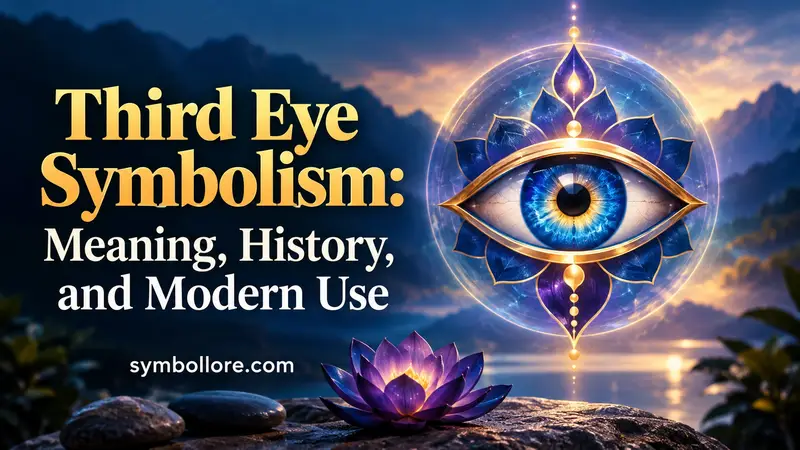
Third eye symbolism centers on inner wisdom, intuition, awareness, and the ability to look beyond surface appearances. The image has deep roots in Indian religious traditions, especially Hinduism, but its meaning has expanded through art, meditation, and modern spirituality.
Today, people may encounter the third eye in yoga classes, tattoos, jewelry, paintings, and discussions about personal growth.
Understanding its origins helps separate traditional religious meanings from newer interpretations. It also explains why one small symbol can represent several different ideas.
Quick Answer: What Does the Third Eye Symbolize?
The third eye symbolizes intuition, inner wisdom, spiritual awareness, and deeper understanding. In Hindu traditions, it is associated with Shiva’s divine insight and the Ajna chakra. Related imagery appears in Buddhist art, although its meanings differ. Today, many people use the third eye as a symbol of self-awareness, reflection, and seeing beyond ordinary appearances.
Key Takeaways
- The third eye represents inner vision rather than ordinary physical sight.
- Hindu traditions connect it with wisdom, transformation, and the Ajna chakra.
- Buddhist forehead imagery has its own history and should not automatically be treated as the same symbol.
- Modern spiritual communities often associate the third eye with intuition and personal growth.
- Claims that the third eye grants supernatural abilities have not been scientifically established.
What Is Third Eye Symbolism?
Third eye symbolism refers to the idea of an inner form of sight that reveals what ordinary vision cannot.
Unlike the two physical eyes, the third eye is generally understood as a spiritual or symbolic concept. It represents insight, awareness, and the ability to look beyond immediate appearances.
Artists often place the symbol in the center of the forehead, slightly above or between the eyebrows.
Its appearance varies. Some images feature a realistic eye, while others use a dot, light, or a decorative design.
The meaning depends on the cultural setting.
In Hindu religious art, a third eye may represent divine knowledge and transformative power. In modern spiritual settings, it often represents intuition and self-discovery.
These meanings overlap, but they are not identical.
The Spiritual Meaning and Importance of the Third Eye
The spiritual meaning of the third eye centers on understanding.
Physical eyes help people observe the world around them. The symbolic third eye represents the ability to reflect on what those observations mean.
For example, someone may recognize that a friendly appearance does not always reveal a person’s intentions. Another person may realize that fear has shaped an important decision.
Such moments can be described as gaining insight.
In spiritual traditions, however, the third eye may carry a deeper meaning connected to religious understanding or liberation.
For modern readers, the symbol often raises a practical question: Are we paying attention only to what we see, or are we trying to understand what lies beneath the surface?
That question helps explain the symbol’s lasting appeal.
7 Powerful Meanings of Third Eye Symbolism
Although interpretations vary, seven themes appear frequently in traditional teachings and modern symbolic discussions.
1. Intuition and Inner Knowing
Intuition is one of the most recognizable modern meanings of the third eye.
It describes the sense that something deserves attention even before a person has fully explained why.
For example, someone might notice small changes in a friend’s behavior and sense that something is wrong.
The third eye can symbolize paying attention to those subtle clues.
However, intuition is not always accurate. Personal experience, emotions, and expectations can influence judgment.
The symbol is most useful when it encourages thoughtful awareness rather than blind trust in every feeling.
2. Wisdom and Clear Understanding
The third eye often represents wisdom that goes beyond collecting information.
Knowledge involves learning facts. Wisdom involves understanding how to apply them.
A person may know that anger can damage relationships but still struggle to respond calmly during an argument.
Recognizing that difference requires self-awareness.
In this sense, the third eye symbolizes the effort to move from knowing something to understanding its deeper meaning.
This interpretation connects well with the symbol’s role in religious traditions that value insight and disciplined awareness.
3. Spiritual Awakening
In modern spiritual language, the third eye frequently represents awakening.
This usually refers to a change in how someone understands themselves, their beliefs, or their place in the world.
A person might begin questioning old habits, paying closer attention to emotional patterns, or exploring a religious practice.
Some spiritual communities describe such changes as the third eye opening.
That description expresses a belief or personal interpretation. It does not establish that a hidden physical organ has become active.
As a symbol, awakening represents a shift from unexamined habits toward greater awareness.
4. Truth and Seeing Beyond Illusion
A major symbolic theme is the difference between appearance and reality.
People often judge situations using limited information.
They may misunderstand someone, overlook their own motives, or accept a familiar idea without examining it.
The third eye can represent the willingness to question those first impressions.
In Hindu religious contexts, insight may involve recognizing spiritual truth beyond ordinary perception.
In everyday language, this becomes a reminder to think carefully before accepting something as true.
5. Self-Awareness and Emotional Understanding
The third eye can symbolize looking inward.
Self-awareness means recognizing personal thoughts, feelings, motivations, and habits.
For example, a person might discover that criticism feels especially painful because of an earlier experience.
That realization can help explain their emotional response.
Modern interpretations often use the third eye to represent this kind of reflection.
It does not need to involve supernatural experiences.
Instead, the image can serve as a reminder to notice what is happening within the mind.
6. Transformation and Personal Change
The third eye also represents transformation.
In Hindu imagery, Shiva’s third eye is connected with divine power that can destroy what stands in the way of spiritual truth.
This meaning is different from the gentle image of intuition found in some modern explanations.
Transformation can involve challenging old attachments, confronting harmful behavior, or letting go of ideas that no longer serve a useful purpose.
The symbolic connection is especially meaningful because personal change is not always comfortable.
Sometimes growth begins with recognizing something difficult.
7. Higher Consciousness and Spiritual Insight
Higher consciousness is another common third eye meaning.
In spiritual settings, the phrase may describe an expanded sense of awareness or a deeper connection with religious truth.
Different traditions explain this idea in different ways.
Some associate it with meditation and disciplined attention. Others connect it with spiritual liberation or divine understanding.
Modern spiritual communities may interpret higher consciousness as feeling connected to something greater than individual concerns.
These are religious and philosophical interpretations rather than scientifically measured states of supernatural awareness.
The central symbolic idea is that understanding can extend beyond immediate personal desires.
Third Eye Symbolism in Hinduism
Hinduism provides some of the third eye’s most important religious and historical contexts.
However, Hindu traditions are diverse. The symbol does not have one fixed meaning across every school of thought.
Two especially important associations involve Shiva and the Ajna chakra.
Shiva’s Third Eye: Knowledge and Destructive Power
Shiva is frequently depicted with a third eye on his forehead.
This eye represents more than ordinary perception.
It is associated with divine knowledge and the power to destroy or transform.
One famous myth describes Kamadeva, the god of desire, disturbing Shiva’s meditation. Shiva opens his third eye, and its fire reduces Kamadeva to ashes.
The story has several religious interpretations.
A common symbolic reading connects the event with the power of spiritual discipline over distracting desire.
Shiva’s third eye also shows why the symbol should not always be reduced to calm intuition.
In this context, insight can be fierce and transformative.
Ajna Chakra: The Sixth Chakra
The Ajna chakra is often called the third eye chakra or brow chakra.
In commonly taught chakra systems, Ajna is the sixth major energy center.
It is symbolically located around the space between the eyebrows.
The Sanskrit term Ajna is commonly translated as command or authority.
Within yogic and tantric traditions, this center is associated with inner awareness, concentration, and spiritual understanding.
It belongs to a subtle-body framework used in particular religious and philosophical teachings.
That framework should not be confused with a medically identified organ.
Does the Bindi Always Represent the Third Eye?
No. A bindi is not automatically a third eye symbol.
The forehead mark appears in several South Asian religious and cultural settings. Its meanings vary according to tradition, community, personal choice, and context.
Some interpretations connect the forehead area with spiritual awareness or Ajna.
Other uses relate to identity, devotion, marriage customs, fashion, or cultural expression.
Reducing every bindi to a third eye overlooks these differences.
Third Eye Symbolism in Buddhism
Buddhist traditions also contain important imagery connected with wisdom and spiritual perception.
However, the Buddhist context differs from the Hindu Ajna chakra framework.
The Urna and the Buddha’s Forehead
Many Buddhist sculptures show a small mark between the Buddha’s eyebrows.
This mark is called the urna.
Traditional Buddhist descriptions identify it as one of the Buddha’s special physical marks.
Artists may represent it as a small raised dot, curl, or decorative feature.
In Buddhist art, it helps identify the Buddha and is associated with his exceptional status and insight.
Modern viewers sometimes describe the urna as a third eye because of its position.
Yet the urna and Ajna chakra are not simply different names for the same religious concept.
Wisdom and Enlightenment
Buddhist teachings place great importance on insight into the nature of experience.
Wisdom involves understanding suffering, impermanence, and the causes of attachment.
Because of this emphasis, the idea of inner vision can provide a useful comparison with third eye symbolism.
Still, Buddhist paths to enlightenment involve specific teachings and practices.
They cannot be accurately reduced to the idea of activating a hidden eye.
The strongest interpretation respects the tradition’s own understanding of wisdom rather than applying a general modern spiritual meaning to every Buddhist image.
How Is the Third Eye Symbol Used in Meditation?
In some yoga and contemporary meditation practices, the forehead area serves as a point of concentration.
Practitioners may focus attention near the space between the eyebrows while breathing slowly or visualizing light.
The exact purpose depends on the tradition.
For some, this practice supports spiritual discipline. Others use it as a personal reminder to remain attentive.
A simple reflection exercise might involve the following steps:
- Sit comfortably in a quiet place.
- Breathe naturally without forcing a particular rhythm.
- Relax your face, shoulders, and jaw.
- Gently direct attention toward the space between your eyebrows, without straining your eyes.
- Notice thoughts as they appear, then return attention to your breathing.
- Finish by reflecting on something you want to understand more clearly.
This is a basic attention exercise, not a traditional initiation or a proven method of awakening supernatural abilities.
The symbolic value comes from the intention to observe thoughts more carefully.
There is no need to create pressure, discomfort, or unusual physical sensations.
Third Eye Symbolism in Tattoos, Jewelry, and Modern Art
The third eye has become a recognizable design in contemporary spiritual and artistic settings.
Its meaning often depends on the wearer’s beliefs and the other symbols included in the design.
Third Eye Tattoo Meaning
A third eye tattoo commonly represents intuition, wisdom, personal growth, or spiritual awareness.
Some people choose it to mark a period of self-discovery.
Others appreciate its connection with Hindu religious imagery or meditation.
A tattoo showing a realistic eye on the forehead may emphasize perception and awareness.
More decorative versions can communicate mystery, transformation, or a personal spiritual identity.
Because the image has religious connections, it helps to understand the traditions behind a chosen design.
Third Eye With a Lotus Flower
In modern artwork, the third eye sometimes appears inside a lotus flower.
The lotus has important meanings in several Asian religious traditions, including purity and spiritual growth.
When artists combine these images, they may intend to represent wisdom developing through difficult experiences.
This combination can be visually meaningful, but it should not be assumed to have one universal traditional meaning.
The specific symbolism depends on the artistic or religious context.
Third Eye Jewelry and Wall Art
Necklaces, pendants, and decorative artwork often feature a third eye surrounded by geometric patterns.
In contemporary use, people may choose these items as reminders of mindfulness, self-awareness, or spiritual interests.
Some designs include mandalas, stars, moons, or chakra imagery.
These combinations often reflect modern artistic interpretations rather than a single ancient design tradition.
Third Eye Symbolism Chart: Meanings Across Contexts
| Symbol or Context | Main Meaning | Important Distinction |
|---|---|---|
| Shiva’s third eye | Divine insight and transformation | Also represents destructive divine power |
| Ajna chakra | Spiritual awareness and concentration | Part of subtle-body teachings |
| Buddhist urna | Auspicious mark and Buddhahood | Not identical to Ajna chakra |
| Modern spiritual third eye | Intuition and personal awakening | Interpretations vary widely |
| Third eye tattoo | Wisdom and self-discovery | Meaning depends on the wearer |
| Third eye with lotus | Inner growth and spiritual understanding | Often a modern artistic combination |
| Third eye in meditation | Focus and inward attention | Does not establish supernatural abilities |
Third Eye vs. Eye of Horus vs. All-Seeing Eye
Several famous symbols feature an eye, but they do not share the same cultural origin or meaning.
Third Eye vs. Eye of Horus
The ancient Egyptian Eye of Horus is strongly connected with protection, restoration, and well-being.
Its traditional meaning comes from Egyptian religious mythology.
The third eye, especially in Hindu contexts, relates more directly to spiritual insight and divine awareness.
Modern illustrations sometimes place the symbols together because both involve eyes and perception.
However, visual similarity does not establish a shared historical origin.
Third Eye vs. All-Seeing Eye
The All-Seeing Eye, often called the Eye of Providence, appears in Western religious and artistic traditions.
It commonly represents divine watchfulness.
In contrast, third eye symbolism often concerns inward vision or spiritual understanding.
The distinction is useful:
- Third eye: Seeing inward or beyond ordinary appearances.
- Eye of Horus: Protection, restoration, and well-being.
- Eye of Providence: Divine knowledge and watchfulness.
These are broad comparisons. Their meanings still depend on the particular artwork and historical setting.
Is the Third Eye Connected to the Pineal Gland?
Modern spiritual discussions often connect the third eye with the pineal gland.
The pineal gland is a small endocrine gland located deep within the brain.
Its established biological function involves producing melatonin, a hormone that helps regulate the body’s sleep-wake cycle.
The gland also has a long history of philosophical speculation.
In the seventeenth century, philosopher René Descartes proposed that it played a special role in the connection between the mind and body.
Over time, religious and esoteric writers developed additional interpretations.
Today, some people describe the pineal gland as a physical third eye.
However, science has not established that the human pineal gland produces psychic vision, reads minds, or provides access to supernatural knowledge.
The spiritual third eye and the biological pineal gland should therefore be understood as different concepts, even when modern beliefs connect them.
Common Misconceptions About Third Eye Symbolism
Misconception 1: Everyone Has a Hidden Physical Third Eye
The spiritual third eye is generally a symbolic or subtle-body concept.
It is not an additional human eyeball that medical science has discovered.
The meaning of the symbol comes from religious teachings and interpretations of awareness.
Misconception 2: Opening the Third Eye Guarantees Psychic Powers
Some contemporary spiritual communities associate third eye awakening with clairvoyance, visions, or other unusual abilities.
These claims have not been established through reliable scientific evidence.
A person may find meditation personally meaningful without gaining supernatural powers.
Misconception 3: Every Forehead Mark Has the Same Meaning
Shiva’s third eye, the Buddhist urna, and a South Asian bindi may all appear around the forehead.
However, they belong to different cultural and religious settings.
Their positions alone do not make them interchangeable.
Misconception 4: Third Eye Symbolism Is Always Peaceful
Modern artwork often presents the third eye as a gentle symbol of calmness.
Yet Shiva’s third eye also has associations with fierce power, destruction, and transformation.
Understanding this contrast reveals the symbol’s greater depth.
Misconception 5: Seeing Colors During Meditation Proves Awakening
People sometimes notice colors, patterns, or flashes of light when their eyes are closed.
Such experiences do not prove that a spiritual third eye has opened.
Visual sensations can have ordinary explanations. Persistent or concerning visual changes should not be dismissed as spiritual signs.
Important Historical and Cultural Insights
The Third Eye Does Not Have One Universal Origin Story
The third eye is closely connected with Indian religious thought, but its different forms developed within complex traditions.
Shiva’s divine eye, yogic chakra teachings, and Buddhist forehead imagery should not be merged into one supposedly identical ancient practice.
Each has its own setting and meaning.
Symbolism Changes When It Moves Between Cultures
A symbol used in religious worship may take on a different meaning when it appears in modern jewelry or tattoos.
For example, a person might wear a third eye pendant to express an interest in self-awareness without following a Hindu spiritual tradition.
This illustrates how symbols acquire new meanings through cultural exchange.
However, recognizing the original religious context helps prevent oversimplification.
Inner Vision Does Not Mean Ignoring Evidence
One useful modern interpretation of third eye symbolism involves combining reflection with critical thinking.
Intuition may encourage someone to examine a situation more closely.
Evidence helps determine whether that first impression is accurate.
The symbol becomes more practical when it encourages curiosity rather than certainty without proof.
People Also Ask About Third Eye Symbolism
What does the third eye mean spiritually?
Spiritually, the third eye represents inner wisdom, awareness, and the search for deeper truth. In Hindu traditions, related imagery can involve divine insight or the Ajna chakra. Modern interpretations often emphasize intuition and personal growth.
What does Shiva’s third eye represent?
Shiva’s third eye represents divine knowledge and transformative power. Hindu mythology connects it with the destruction of desire or obstacles through spiritual fire. It is not simply a symbol of calmness or intuition.
Is the third eye good or bad?
The third eye is not inherently good or bad. Its meaning depends on the tradition and context. It may represent wisdom, awareness, or divine transformation. Some stories also connect it with powerful destruction, but that does not automatically make the symbol evil.
What does a third eye tattoo symbolize?
A third eye tattoo commonly represents self-awareness, wisdom, spiritual growth, or the desire to understand life more deeply. The exact meaning depends on the design and the person’s intentions.
Frequently Asked Questions
The main meaning of third eye symbolism is inner vision or understanding beyond ordinary physical sight. It is associated with wisdom, intuition, and spiritual awareness. In Hindu contexts, the meaning can also include divine knowledge and transformation. Modern interpretations often focus on self-discovery and personal growth.
An open third eye often symbolizes awakening, greater self-awareness, or a new understanding of life. Some spiritual communities believe it represents access to deeper forms of consciousness. These are symbolic and religious interpretations. There is no established scientific test that confirms a supernatural third eye has opened.
Indigo is commonly associated with the third eye chakra in popular modern chakra charts. Purple or violet sometimes appears in related artwork. However, color systems vary among traditions, and contemporary chakra colors should not automatically be described as universal ancient rules.
Protection is not the third eye’s main traditional meaning. The symbol more commonly represents insight, wisdom, and awareness. Some people interpret spiritual understanding as a form of personal guidance, but that does not make the third eye equivalent to protective symbols such as the Eye of Horus or the evil-eye amulet.
Yes. People use third eye imagery in modern art, tattoos, jewelry, and personal reflection. However, some designs carry specific Hindu religious meanings. Understanding those associations and treating sacred imagery respectfully can help people make informed choices about how they use the symbol.
The Bible does not describe the Hindu Ajna chakra or the third eye as a spiritual energy center. Some readers draw comparisons with biblical language about spiritual sight or understanding. Those comparisons are interpretations, not evidence that the traditions describe the same religious concept.
A dream about a third eye may symbolize curiosity, self-reflection, intuition, or a desire to understand something more clearly. Its meaning depends on the dreamer’s experiences and beliefs. Dreams do not have scientifically established universal symbolic meanings, so the dream’s emotions and personal context matter.
Conclusion: What Does the Third Eye Really Symbolize?
Third eye symbolism represents the human desire for wisdom, understanding, and awareness beyond immediate appearances.
Its deepest religious meanings come from traditions that connect inner vision with spiritual insight, divine power, or liberation.
In modern settings, the symbol often serves as a reminder to reflect, question assumptions, and understand personal experiences more carefully.
Whether it appears in religious art, meditation, or a tattoo, the third eye invites a familiar question: Are we simply looking at the world, or are we trying to understand it?