
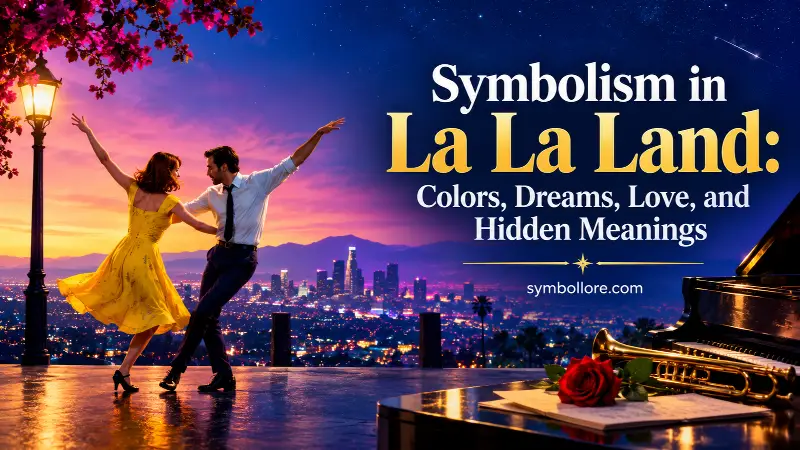
La La Land looks like a cheerful Hollywood musical, but its colorful scenes tell a deeper story. Behind the dancing, jazz music, and beautiful Los Angeles sunsets lies a moving exploration of love, ambition, and sacrifice.
The symbolism in La La Land helps explain why Mia and Sebastian fall in love, what pulls them apart, and why their final meeting feels so emotional.
Director Damien Chazelle uses colors, music, seasons, and dreamlike settings to show the difference between what people imagine and what life actually brings. Understanding these details reveals a story about chasing dreams while accepting that some relationships may not last.
Quick Answer: What Does La La Land Symbolize?
The symbolism in La La Land represents the conflict between romantic love and personal ambition. Bright colors suggest hope and fantasy, jazz reflects passion and artistic identity, and the changing seasons follow the couple’s relationship. The Griffith Observatory represents their dreamlike romance, while the bittersweet ending explores lost possibilities, personal growth, and the emotional cost of success.
Key Takeaways
- Dreams vs. reality: The film explores how imagined futures differ from real-life choices.
- Color symbolism: Bright and muted colors help express romance, emotion, and maturity.
- Jazz music: Sebastian’s passion for jazz reflects artistic freedom, identity, and tradition.
- Seasons: The changing seasons mirror the development and decline of Mia and Sebastian’s relationship.
- The ending: Their final shared glance suggests that love can remain meaningful even after two people choose different lives.
What Is Symbolism in La La Land?
Symbolism in La La Land means using visual details, music, places, and repeated images to communicate ideas beyond the dialogue.
Released in 2016, the film follows Mia Dolan, an aspiring actress played by Emma Stone, and Sebastian Wilder, a jazz pianist played by Ryan Gosling. Both struggle to achieve their creative goals in Los Angeles.
As their relationship grows, they encourage each other to pursue those dreams. Yet their ambitions eventually lead them toward different futures.
Rather than explaining every emotion through conversation, the film often relies on its surroundings.
A bright dress can express excitement. A quiet piano melody can recall an important memory. A beautiful sunset can turn an ordinary moment into something unforgettable.
The movie’s title also carries meaning. “La La Land” is a nickname associated with Los Angeles, but it can also describe a dreamlike state disconnected from everyday reality.
This double meaning captures the film’s central question: Can people hold on to their dreams without losing something important along the way?
The Deeper Meaning and Importance of La La Land
At its heart, La La Land explores the complicated relationship between love and ambition.
Mia wants to become a successful actress. Sebastian dreams of opening his own jazz club, where he can perform the music he loves.
Initially, their goals bring them closer.
Sebastian encourages Mia to create her own stage production. Meanwhile, Mia supports his desire to build a career around jazz.
Their relationship becomes a source of confidence.
However, professional success also creates pressure. Sebastian joins a successful touring band, and Mia grows frustrated with the distance between them.
Eventually, their paths separate.
This development challenges the usual Hollywood romance in which love solves every problem.
Instead, La La Land suggests that two people can genuinely love each other without building a lasting relationship.
The story also questions the meaning of success. Achieving a dream may bring happiness, but it does not erase every sacrifice made along the way.
Color Symbolism in La La Land
Colors create emotional connections between fantasy, romance, conflict, and personal growth.
Color is one of the film’s most recognizable storytelling techniques.
The bright costumes and colorful lighting recall classic Hollywood musicals. As the relationship changes, the visual style changes with it.
Although individual colors invite different interpretations, they do not follow a strict one-color, one-meaning code.
Blue Symbolism: Dreams, Identity, and Longing
Blue appears throughout La La Land in clothing, night skies, and lighting.
It often creates a feeling of distance, imagination, or quiet reflection.
Mia’s blue clothing early in the film can suggest her artistic hopes and her uncertain place in Hollywood. Blue lighting also gives several nighttime scenes a romantic, almost unreal quality.
However, blue does not always symbolize sadness.
At times, it suggests beauty, creative possibility, or emotional calm.
By the film’s conclusion, cooler shades can also reflect the more settled lives of the characters.
This changing meaning makes blue especially important. Its emotional effect depends on the scene rather than one universal rule.
Yellow Symbolism: Joy, Hope, and Possibility
Yellow plays a major role during Mia and Sebastian’s famous hilltop dance.
Mia wears a striking yellow dress against the purple-blue evening sky.
The contrast makes her stand out and gives the moment a lively, romantic atmosphere.
Yellow can suggest optimism, warmth, and excitement.
During this scene, it also highlights the possibility of a new relationship.
The characters begin with playful disagreement, yet their movements reveal a growing connection.
The beautiful setting makes an ordinary encounter feel like the beginning of something extraordinary.
Purple Symbolism: Romance and Imagination
Purple and violet tones appear in several memorable romantic scenes.
These shades often blend the warmth of red with the calmness of blue.
As a result, viewers may associate them with attraction, creativity, or emotional possibility.
The purple sunset during the hilltop dance helps turn Los Angeles into a romantic fantasy.
Meanwhile, the dreamy atmosphere surrounding the Griffith Observatory strengthens this association.
Purple does not have one official meaning throughout the movie. Still, its repeated connection with magical settings makes romance and imagination convincing interpretations.
Red Symbolism: Passion, Energy, and Conflict
Red appears in costumes, interiors, and dramatic lighting.
Its emotional meaning changes with the scene.
In some moments, red suggests attraction and excitement. Elsewhere, intense lighting can add pressure or discomfort.
This flexibility matters because La La Land is not simply a celebration of romance.
The relationship includes passion, disappointment, and difficult choices.
Red can support these feelings without automatically representing anger or heartbreak.
Green Symbolism: Change and Uncertainty
Green lighting appears in several scenes involving Sebastian.
His apartment, for example, receives a noticeable green glow.
The unusual light gives an otherwise ordinary room a more romantic, artificial atmosphere.
Some viewers interpret green as a sign of change, uncertainty, or creative possibility.
However, green should not be treated as a fixed warning that the relationship will fail.
Its strongest role is visual. It helps transform everyday spaces into places where reality feels slightly altered.
Color Symbolism at a Glance
| Color | Possible meaning | Film connection |
|---|---|---|
| Blue | Dreams, reflection, longing | Night scenes and costumes |
| Yellow | Hope, joy, attraction | Mia’s hilltop dance dress |
| Purple | Romance, imagination | Sunset and dreamlike scenes |
| Red | Passion, tension, energy | Costumes and dramatic lighting |
| Green | Change, uncertainty, fantasy | Sebastian’s apartment lighting |
These meanings are interpretations supported by the film’s visual patterns, not an official color dictionary.
Major Symbols in La La Land and What They Mean
Beyond color, several objects, locations, and creative traditions carry important symbolic weight.
1. The Griffith Observatory: Love Beyond Reality
The Griffith Observatory hosts one of the film’s most magical sequences.
After visiting the movie theater, Mia and Sebastian explore the observatory together. Their romantic connection eventually turns into a dance among the stars.
Gravity seems to disappear.
For a brief moment, ordinary physical rules no longer control them.
The scene can symbolize the overwhelming feeling of falling in love. Their emotional connection becomes so powerful that the world around them seems to change.
The stars also reflect the film’s wider interest in dreams.
Mia wants to become a Hollywood star, while Sebastian dreams of making a meaningful artistic career.
Their floating dance captures a moment when everything appears possible.
However, its impossible setting also reminds viewers that romantic fantasy cannot last forever.
2. Jazz Music: Artistic Identity and Freedom
Jazz represents much more than Sebastian’s favorite music.
For him, it is a personal calling.
He values its history, improvisation, and emotional expression. His dream of opening a jazz club reflects his desire to protect a tradition he deeply respects.
Jazz can also symbolize freedom.
Improvisation allows musicians to respond creatively to one another instead of following every detail of a fixed plan.
This offers a useful comparison with Mia and Sebastian’s relationship.
Their romance begins spontaneously, but their future requires difficult decisions.
Sebastian’s work with Keith’s band creates another important contrast.
The band gives him financial stability and professional opportunity, but its musical direction differs from his original dream.
The conflict is not simply between good and bad music. It is about compromise and the struggle to remain true to one’s artistic identity.
3. The Piano: Memory and Emotional Connection
Sebastian’s piano becomes one of the film’s strongest emotional symbols.
Music often expresses feelings that the characters cannot explain in words.
The recurring melody associated with Mia and Sebastian’s relationship creates a connection between different stages of their lives.
At the end, Sebastian plays that familiar theme in his club.
The performance brings back memories of their relationship and leads into an imagined version of their shared past.
The piano therefore represents emotional memory.
Even after their lives have changed, music allows them to revisit what they once meant to each other.
4. Los Angeles: The City of Dreams
Los Angeles serves as more than the film’s setting.
Its streets, theaters, studios, and hills reflect the promise of artistic success.
For Mia, the city represents the chance to become an actress. For Sebastian, it offers opportunities to perform and build a jazz club.
Yet Los Angeles also creates disappointment.
Mia faces repeated rejection at auditions. Sebastian struggles financially while trying to preserve his musical ambitions.
The city symbolizes both opportunity and uncertainty.
Its beautiful sunsets make the characters’ dreams feel possible, while its competitive professional world reminds them how difficult those dreams can be.
This contrast captures the film’s dream-versus-reality theme.
5. Seb’s Jazz Club: Dreams That Finally Come True
Sebastian eventually opens the jazz club he wanted for years.
Its name, Seb’s, comes from an idea Mia suggested earlier.
That detail matters because Mia continues to influence his life even after their relationship ends.
The club symbolizes professional achievement, independence, and the lasting effects of love.
Sebastian has created a place that reflects his artistic values.
At the same time, Mia is no longer his partner.
The club therefore holds two feelings at once: satisfaction with the present and remembrance of the past.
The Four Seasons and Their Symbolic Meaning
La La Land organizes its central story around the changing seasons, then returns to winter five years later.
This structure helps viewers understand the relationship as something that develops over time.
Winter: Frustration and New Beginnings
The film begins during winter in Los Angeles.
Mia and Sebastian struggle with their careers and personal lives.
Their first interactions are awkward rather than romantic.
Winter sets up a period of frustration before their relationship begins to grow.
Spring: Attraction and Possibility
Spring brings the excitement of a new romantic connection.
Mia and Sebastian spend more time together and discover their shared artistic interests.
Their relationship becomes a source of encouragement.
Like spring growth, their romance feels full of promise.
Summer: Passion and Growing Pressure
Summer brings increased closeness, but it also introduces professional challenges.
Mia works on her stage production, while Sebastian becomes involved with Keith’s band.
Both pursue opportunities that could change their futures.
The season’s warmth can reflect romance, while its mounting tensions suggest that happiness may not remain simple.
Fall: Disappointment and Separation
Fall marks the relationship’s emotional decline.
Professional demands and personal disappointments create distance between Mia and Sebastian.
Mia’s unsuccessful play performance leaves her discouraged.
Their romance eventually breaks down, even though their feelings remain significant.
The season can symbolize change, loss, and the end of an important chapter.
Winter Again: Success and Acceptance
Five years later, Mia has become a successful actress, and Sebastian owns his jazz club.
Both have reached their professional goals.
Yet they have separate lives.
The return to winter completes the cycle and shows how much the characters have changed.
Their dreams have come true, but not in the form they once imagined.
Examples of Symbolism in La La Land’s Most Important Scenes
The Opening Traffic Jam: Dreams Hidden Inside Ordinary Life
The film begins on a crowded Los Angeles freeway.
Drivers appear stuck in the frustration of everyday traffic.
Suddenly, people leave their cars and perform an energetic musical number.
The transformation contrasts ordinary life with artistic imagination.
A traffic jam normally represents delay and frustration. Here, it becomes an opportunity for movement, music, and self-expression.
The opening also introduces a central idea: people can imagine a more exciting life even while facing everyday obstacles.
The Hilltop Dance: Romance as a Beautiful Possibility
During A Lovely Night, Mia and Sebastian dance above Los Angeles.
Their playful words suggest that they are not interested in each other.
Their movements, however, tell a different story.
The dance reveals an emotional connection before either character openly accepts it.
The sunset adds a temporary quality to the scene.
Just as daylight slowly disappears, the romantic moment cannot last forever.
This creates a subtle contrast between the joy of new love and the passing nature of time.
The Planetarium Dance: Escaping Reality Through Love
At the Griffith Observatory, Mia and Sebastian appear to float among the stars.
The scene removes the ordinary limits of space and gravity.
Their love temporarily makes the impossible feel natural.
This moment illustrates how romantic emotion can transform someone’s perception of the world.
However, the fantasy also contrasts with the practical decisions that later challenge their relationship.
The Dinner Argument: When Dreams Become Complicated
Mia and Sebastian’s dinner argument marks an important turning point.
Sebastian believes his work with Keith’s band provides the stability he needs.
Mia questions whether he truly enjoys the direction his career has taken.
Their disagreement reveals the emotional cost of compromise.
Earlier, artistic ambition brought them together. Now, different expectations about success create tension.
The scene symbolizes the gap between supporting someone’s dream and understanding the choices required to achieve it.
The Final Fantasy: A Life That Never Happened
Near the ending, Mia visits Sebastian’s jazz club with her husband.
When Sebastian sees her, he begins playing their familiar piano melody.
The film then enters an extended fantasy.
In this imagined version, Mia and Sebastian remain together while pursuing their creative ambitions.
Their relationship unfolds differently, and painful events appear to change.
This sequence symbolizes the human tendency to imagine alternate lives.
People often wonder what might have happened if they had made different decisions.
The fantasy makes that feeling visible.
Yet the film ultimately returns to the real present.
Mia and Sebastian do not reunite. Instead, they share a quiet smile that suggests recognition, affection, and acceptance.
The Meaning of City of Stars
The song City of Stars is closely connected to the film’s themes.
Its title refers to Los Angeles, a city associated with performers, fame, and artistic ambition.
However, the word “stars” can also represent distant hopes.
Stars are beautiful and visible, but reaching them is impossible in a literal sense.
That distance creates a useful metaphor for difficult dreams.
Sebastian’s solo performance captures uncertainty about love and success. Later, the duet with Mia expresses a shared sense of hope.
As the story develops, the song gains emotional weight.
Its gentle melody reminds viewers that dreams can feel both exciting and fragile.
The song also connects the characters’ romantic hopes to their professional ambitions.
For a time, they believe those dreams can exist together.
Their eventual separation challenges that belief without making their earlier happiness meaningless.
Dreams vs. Reality in La La Land
One of the film’s most important contrasts is the difference between imagined happiness and actual experience.
| Dream or fantasy | Reality |
|---|---|
| Love feels effortless during musical numbers | Relationships require compromise |
| Artistic success appears exciting and beautiful | Creative careers involve rejection |
| The planetarium removes physical limits | Everyday life brings practical responsibilities |
| The final fantasy imagines a shared future | Mia and Sebastian have separate lives |
| Romantic settings make time seem suspended | Seasons pass and circumstances change |
The film does not suggest that dreams are foolish.
Instead, it shows why dreams matter, even when they cannot come true exactly as imagined.
Mia and Sebastian influence each other’s development.
Their relationship helps them become more confident artists.
Although they do not remain together, their shared experiences continue to shape their lives.
That idea gives the story its emotional complexity.
Common Misconceptions About La La Land’s Symbolism
Does every color have one exact meaning?
No. Colors work through context, contrast, and repetition.
Blue can suggest longing in one scene and romantic wonder in another.
Does Sebastian’s career compromise mean he abandons jazz?
No. His work with Keith’s band creates tension with his original goals, but he remains a dedicated musician.
His decision reflects financial pressure and professional uncertainty, not a complete rejection of jazz.
Does the ending prove that love and success cannot coexist?
No. The film tells the story of two specific people whose circumstances lead them apart.
It does not establish a universal rule that successful people must sacrifice romantic relationships.
Is the final fantasy an event that actually happened?
No. The sequence imagines a different version of Mia and Sebastian’s lives.
It is not a hidden account of their real past or a literal second ending.
Expert Insights: How Filmmaking Strengthens the Symbolism
The film’s symbolism becomes especially effective because several creative techniques work together.
Its cinematography draws inspiration from classic Hollywood musicals, while its Los Angeles setting remains recognizable.
Cinematographer Linus Sandgren used vivid lighting and carefully selected locations to create a romantic version of the city.
Costume designer Mary Zophres contributed to the visual storytelling through bold clothing choices.
As Mia and Sebastian mature, their appearance and surroundings also shift.
Music supports this change. Repeated melodies connect moments of early excitement with later reflection.
Meanwhile, the film’s long camera movements make dance scenes feel continuous and immersive.
These artistic choices allow reality and fantasy to exist within the same story.
The result is a film that can feel magical without losing sight of disappointment, uncertainty, and ordinary human experience.
People Also Ask About Symbolism in La La Land
What is the main message of La La Land?
The main message is that pursuing a dream often involves difficult choices. Mia and Sebastian help each other grow, but their lives eventually take different directions. Their story suggests that meaningful love can change someone permanently, even when the relationship does not last.
Why is La La Land so colorful?
The film uses vivid colors to create a romantic, heightened version of Los Angeles. Its visual style also draws inspiration from classic Hollywood musicals. Changing costumes, lighting, and backgrounds help viewers recognize emotional shifts without relying entirely on dialogue.
What does the ending of La La Land symbolize?
The ending symbolizes acceptance, memory, and the lives people imagine but never experience. Mia and Sebastian have achieved their professional dreams, yet their romantic relationship belongs to the past. Their final smile suggests that they can value their shared history without returning to it.
Why do Mia and Sebastian look at each other at the end?
Their final glance acknowledges the importance of their former relationship. They recognize how much they once meant to each other and the role they played in each other’s success. The scene expresses affection and closure without requiring a spoken explanation.
Frequently Asked Questions
Stars symbolize artistic ambition, romance, and possibilities that seem beyond reach. They connect Hollywood’s promise of fame with the private dreams of Mia and Sebastian. During the planetarium scene, the stars also create a magical setting that reflects the excitement of their developing relationship.
Mia’s yellow dress during the hilltop dance can symbolize optimism, excitement, and romantic possibility. Its bright color contrasts with the purple-blue evening sky, making the scene visually memorable. The dress also reflects the film’s playful use of classic musical imagery.
Jazz represents Sebastian’s artistic identity, his respect for musical history, and his desire for creative independence. His dream of opening a jazz club reflects his commitment to those values. Music also connects him emotionally with Mia, especially during their final encounter.
The Griffith Observatory represents romance, imagination, and the feeling that love can overcome ordinary limits. When Mia and Sebastian float among the stars, the scene turns their emotional excitement into a visual fantasy. Its impossible movements also highlight the difference between romantic dreams and everyday reality.
La La Land refers to Los Angeles and the idea of living in a dreamlike state. Both meanings fit the film. Los Angeles offers opportunities for artistic achievement, while its romantic musical sequences create a world where ordinary reality often gives way to imagination.
The ending is bittersweet. Mia and Sebastian achieve their professional goals, which makes their story hopeful. However, they do not remain together, and the final fantasy shows the life they might have shared. Their last smile balances sadness with gratitude and acceptance.
There is no single official answer. However, the recurring piano melody is especially important because it connects romance, memory, and the passage of time. The Griffith Observatory, changing seasons, and colorful lighting also help communicate the film’s central themes.
Conclusion: What Does La La Land Really Mean?
The symbolism in La La Land reveals a story about the beauty of dreams and the difficulty of turning them into reality.
Through colors, jazz, changing seasons, and magical dance sequences, the film explores romance, artistic ambition, and personal sacrifice.
Mia and Sebastian do not share the future they once imagined. However, their relationship helps them discover the courage to pursue their goals.
Ultimately, La La Land suggests that love does not have to last forever to remain meaningful. Some people change our lives, even when they cannot stay in them.