

Puma symbolism often centers on quiet strength. This wild cat stalks its prey, usually lives alone, and can move through landscapes without drawing much attention. Those traits help explain modern associations with patience, independence, and decisive action.
But the puma does not carry one meaning across the Americas. A recorded Cherokee story gives a panther the ability to move in darkness. Research into Mapuche and local Chilean accounts finds respect, fear, and spiritual importance together. In Los Angeles, one mountain lion became a symbol of wildlife conservation. These examples tell us more than a universal “spirit animal” list: the puma’s meaning depends on who is telling the story and why.
Quick Answer
Puma symbolism can suggest strength, stealth, independence, vigilance, or respect for wild places. Its solitary, ambush-hunting behavior helps explain those modern associations. Specific cultural meanings differ: a recorded Cherokee story links a panther with night vision, while research into Mapuche accounts finds both reverence and fear. No sighting, dream, or image delivers one guaranteed message.
Puma Meanings at a Glance
| Setting | Possible meaning | Basis for the reading | Important limit |
|---|---|---|---|
| Puma stalking in wildlife footage | Patience and precise action | The animal hunts by stalking and ambush | A human interpretation of observed behavior |
| Solitary puma in a personal design | Independence or self-reliance | Adults generally live alone | Solitude is not proof of a person’s character |
| Panther in a recorded Cherokee story | Wakefulness and power in darkness | The animal remains awake through a seven-night test | Meaning belongs to that story |
| Puma in researched Mapuche accounts | Prestige, feared power, or a mountain presence | Named narratives and interviews give different views | No single account speaks for all Mapuche people |
| P-22 in Los Angeles | Wildlife connection and survival amid development | His documented life drew attention to habitat links | A specific modern U.S. story |
| Puma in a dream or tattoo | A personal idea about strength, fear, or freedom | The dreamer or wearer assigns meaning | Not a prediction or diagnosis |
Puma, Cougar, and Mountain Lion: One Animal, Several Names
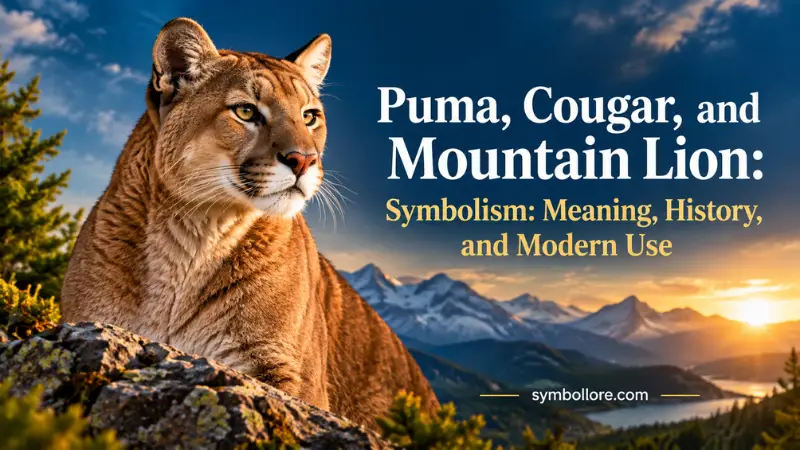
Puma, cougar, and mountain lion commonly name the same species, Puma concolor. Some regions also use catamount or panther.
The National Park Service’s cougar profile
lists these names together and describes an adaptable cat found in many habitats across the Americas.
The names are useful when researching symbolism. A page about “mountain lion meaning” may discuss the same animal as one about “puma meaning.” Yet a panther in a historical text still needs care. That word can be used for different cats, depending on the writer and region. Read the source before treating every historical panther as a certain reference to Puma concolor.
A puma is also not a lion in the zoological sense merely because people call it a mountain lion. Shared names and feline traits do not give both animals identical cultural histories. For a comparison involving another powerful cat, see
Why the Puma Suggests Strength Without Display
The puma’s hunting style gives modern readers a concrete reason to associate it with controlled strength. Yosemite National Park describes mountain lions as shy, solitary predators that stalk and ambush prey. They can be quiet before a sudden, forceful attack. They cannot roar like African lions. These are facts about the animal; “quiet confidence” is an interpretation people draw from them.
That distinction makes the image useful in art. A puma poised on a ledge may suggest power held in reserve. One already leaping may suggest commitment or danger. Neither pose tells us that the animal possesses human wisdom or has chosen a moral lesson for us. The artist selects a real trait and uses it to express an idea.
The interpretation can also turn negative. Stealth may suggest skill in one story and a concealed threat in another. Solitude may look like freedom or isolation. To decide which reading fits, look at what the puma does and how the people in the scene respond.
Solitude and Territory: Independence With Limits
Pumas often live alone, except when mating or when mothers raise young.
The National Park Service’s cougar account
also describes the animal’s use of cover when hunting and the wide variation in its territory. These traits can inspire a modern personal symbol of independence: the ability to travel or act without a group.
Still, a wildlife fact should not become a rule for human life. A solitary puma is meeting its own needs as an animal. It does not prove that people should reject help, avoid relationships, or handle every challenge alone. A puma tattoo could celebrate self-reliance, but that meaning belongs to the wearer.
In fiction, context matters just as much. An unseen puma may create tension. A cat watching from a safe distance may instead signal a character’s wish to be free.
The site’s guide to cat symbolism in literature
offers a way to test such readings against a story rather than a fixed symbol list.
A Panther in a Recorded Cherokee Story
A specific story gives a stronger cultural reading than the claim that “Native Americans saw pumas as guardians.” In a narrative recorded by James Mooney in Myths of the Cherokee, animals and plants must stay awake for seven nights. The owl and panther are among the few that endure. The story gives them the power to see and move in darkness and hunt animals that must sleep.
The digitized text of Mooney’s account
preserves that sequence.
Within this story, the panther’s night ability follows watchfulness and endurance. That is more precise than assigning it generic “leadership.” It is also a recorded account from a particular collector and period, not a statement about every Cherokee belief today or any other Native nation.
The Smithsonian’s National Museum of the American Indian cautions that Native communities have their own distinct relationships with animals. It advises against turning those relationships into a generic, non-Native “spirit animal” exercise or copying community imagery without context.
Its guide to honoring animal relatives
is helpful when choosing respectful language.
Mapuche Accounts: Respect, Fear, and the Mountains
A puma need not be either a kindly protector or a frightening predator. It can occupy both roles in stories told near its habitat. A study in the Journal of Ethnobiology and Ethnomedicine examined local accounts, Mapuche narratives, and interviews in Chile’s Araucanía region. Researchers found varied responses to the puma, including spiritual respect, fear, and concern about harm to livestock.
Their published study of puma and kodkod narratives
describes some accounts in which the puma is linked with prestige or portrayed as a powerful presence in the mountains.
This research has a clear scope. It examines collected material from particular places and people; it does not establish a single Mapuche doctrine. In one account, the puma can carry authority and demand respect. In another, its ability to take livestock makes it a real source of fear. Reading both responses together preserves the relationship between lived experience and symbolic meaning.
The contrast also explains a common error in symbolism writing. Describing a predator only as a wise guardian removes the conflict that helped shape the stories in the first place.
P-22 and a Modern American Conservation Meaning
In the United States, a puma can represent more than personal courage. P-22, the mountain lion that lived in Los Angeles’s Griffith Park, became a public reminder that wildlife needs room to move through a built-up landscape. The National Park Service called him an ambassador for wildlife connectivity after his death in 2022.
describes his small, isolated home range and the highways separating the park from the Santa Monica Mountains.
This is a documented modern association, not an ancient puma meaning projected onto Los Angeles. P-22’s story gave people a particular animal to remember while discussing habitat and coexistence. In an artwork about him, the puma might suggest persistence, but the city and its barriers are essential to the message.
That reading can sit beside the older image of the puma as a powerful hunter. Symbols change when people’s relationships with the animal change. A conservation poster, a wildlife camera image, and a hunter’s tale need not ask the viewer to feel the same thing.
Dreams, Sightings, and Tattoos: What Can You Reasonably Infer?
A puma dream may give someone a way to think about fear, privacy, strength, or a decision. Its meaning depends on the dreamer’s experience: Was the cat threatening, distant, trapped, or calm? Those details can support personal reflection. They cannot establish that an event will happen or that the animal has sent instructions.
A real sighting is different again. First treat the puma as wildlife, not as a sign. Give it space and follow local wildlife guidance.
The National Park Service’s mountain lion information
describes both the cat’s behavior and precautions for visitors. Someone may later find personal meaning in the encounter, but that feeling should not replace attention to safety.
A puma tattoo can express independence, respect for wilderness, a family memory, or identification with an animal’s strength. Pose and surrounding details change the result. A mother with young may place care at the center of the design; a stalking cat may emphasize focus. Ask the wearer before claiming to know their reason.
Three Claims About Puma Symbolism That Need Care
First, there is no single Indigenous puma meaning. A Cherokee narrative and Mapuche accounts come from distinct communities and cannot be merged into one “Native American” belief.
Second, a puma’s behavior does not prove a spiritual message. Its stealth and solitary habits are observable. Human lessons drawn from them are interpretations, not zoological findings.
Third, a popular historical claim is not settled merely because many sites repeat it. Some pages state without qualification that Cusco was deliberately laid out in the shape of a puma. That proposed reading has been debated, so it should not serve as the simple proof of what pumas meant throughout the Inca world. This article does not rely on the city-plan claim.
For a comparison of how a different powerful animal can suggest protection or threat depending on context, see
FAQs
In modern personal imagery, a puma often suggests strength, independence, stealth, and patience. Those meanings draw on the animal’s observed habits. A specific cultural story or artwork can give it a different meaning, so check the source before treating that short list as universal.
Yes. All three names commonly refer to Puma concolor. The names vary by place and context, which is why symbolism articles may discuss the same animal under different headings. Be more careful with “panther,” a name that historical and modern sources may use less precisely.
There is no one spiritual meaning. A person may choose the puma as a private symbol of courage or independence. Named communities may also have their own narratives and practices. Those distinct traditions should not be reduced to a claim that every puma sighting carries the same message.
It can in a modern personal design, especially if the artist wants to show confidence or decisive action. Yet a puma is a largely solitary animal, so its behavior does not by itself establish “leadership.” Look for clues in the surrounding image or the creator’s explanation.
A sighting is not reliable evidence of a future event. Some stories attach meaning to the animal, but a real puma is responding to its habitat and circumstances. If you encounter one outdoors, follow wildlife safety guidance first. You can reflect on the experience later without treating it as a prediction.
Sources and Further Reading
- National Park Service: Mountain Lions in Yosemite
- James Mooney: Myths of the Cherokee
- Journal of Ethnobiology and Ethnomedicine: Puma and Kodkod Narratives
- National Museum of the American Indian: Honoring Animal Relatives
- National Park Service: Statement on P-22
Conclusion
Puma symbolism is compelling because the animal combines strength with an ability to move quietly. Its solitary hunting can inspire modern ideas of patience and independence, but behavior alone cannot tell us what every image means. A Cherokee narrative, Mapuche accounts, and the life of Los Angeles mountain lion P-22 each give the cat a more specific role.
To read a puma symbol well, identify the story, community, artist, or event behind it. Respect what the evidence says, and leave room for a personal meaning when the image is someone’s own. The puma is one animal, but it has never belonged to just one story.


