Ocean symbolism commonly represents freedom, deep emotion, mystery, change, and the hidden parts of life. Because the sea can appear peaceful one moment and powerful the next, it also symbolizes the balance between calmness and danger.
People have depended on the ocean for food, travel, trade, and discovery for thousands of years. At the same time, its great depth and unpredictable waves have inspired myths, religious stories, poems, paintings, and personal symbols.
Quick Answer: What Does the Ocean Symbolize?
In modern American culture, the ocean mainly symbolizes freedom, emotional depth, mystery, change, and a connection with nature. Historically, many cultures also viewed the sea as a source of life, a dangerous boundary, a path between worlds, and a force greater than human control.
TL;DR
- The ocean represents freedom because it appears open and limitless.
- Its great depth symbolizes hidden emotions, secrets, and the unknown.
- Moving waves represent change, life cycles, and emotional movement.
- Calm water can suggest peace, healing, and emotional balance.
- Stormy seas often symbolize fear, conflict, danger, or uncertainty.
- The ocean may represent life, death, renewal, or spiritual cleansing.
- Its meaning changes according to the culture, artwork, dream, or personal experience.
Ocean Symbolism at a Glance
| Ocean image or context | Common symbolic meaning | Modern U.S. interpretation |
|---|---|---|
| Calm ocean | Peace and balance | Emotional rest, healing, or clarity |
| Deep water | Mystery and the unknown | Hidden feelings or unanswered questions |
| Strong waves | Change and power | Life challenges or intense emotions |
| Open horizon | Freedom and possibility | A fresh start, adventure, or independence |
| Stormy sea | Danger and conflict | Stress, fear, or loss of control |
| Sunrise over the ocean | Renewal and hope | Recovery, personal growth, or a new chapter |
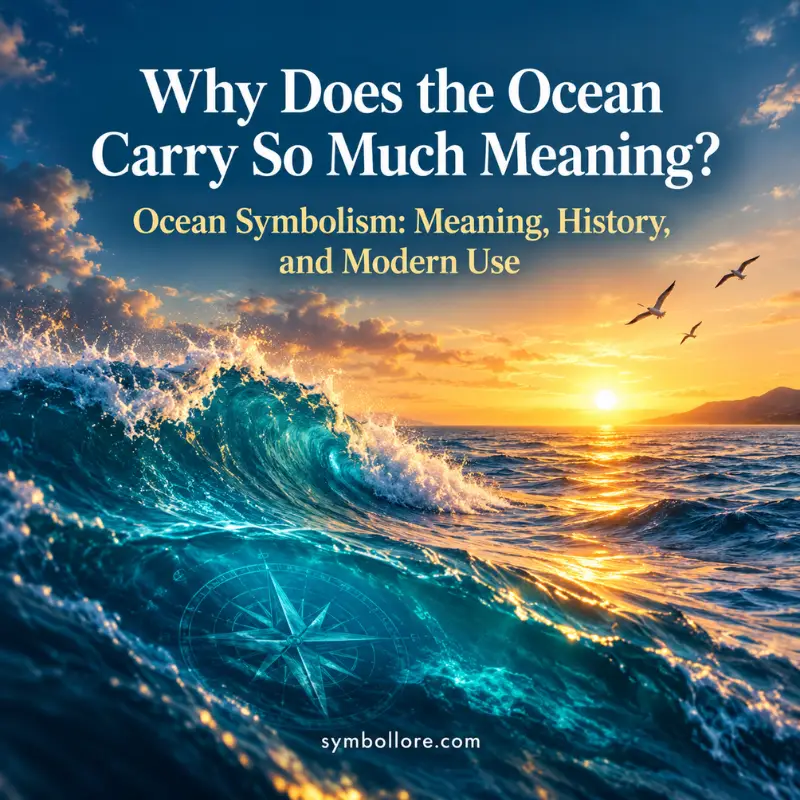
Why Does the Ocean Carry So Much Meaning?
The ocean covers about 71% of Earth’s surface and contains more than 97% of the planet’s water, according to the
National Oceanic and Atmospheric Administration.
Its size alone makes it feel endless from the shore.
Humans can see the surface, but they cannot easily see what lies below it. This contrast between the visible surface and hidden depth gives the sea much of its symbolic power.
The ocean also has opposite qualities. It can feed communities, carry travelers, and provide peaceful places to rest. However, it can also create storms, destroy ships, and separate people from home. Therefore, it can represent life and death, comfort and fear, or opportunity and risk at the same time.
1. Freedom and Limitless Possibility
The ocean often symbolizes freedom because it has no visible walls. From a beach, the horizon appears wide, open, and almost endless.
For many people, looking across the water creates a sense that life can become larger than its current limits. This is why ocean images often appear in stories about escape, travel, independence, and personal reinvention.
In American culture, a road may symbolize freedom on land, while the open sea expresses an even greater form of freedom. It suggests leaving familiar places behind and moving toward something unknown.
However, freedom at sea also requires courage. A person who sails away gains new possibilities but gives up some safety and control.
2. Mystery and the Unknown
Deep water hides most of what it contains. As a result, the ocean has become a natural symbol of secrets, mystery, and unexplored knowledge.
Humans have mapped and studied large parts of the sea, yet much remains difficult to observe directly. NOAA describes the ocean as the planet’s largest livable space, with an average depth of about 2.3 miles. Its darkness, pressure, and enormous scale help explain why people connect it with the unknown.
In stories, a character who enters the sea may also enter a hidden world. Sea monsters, sunken cities, lost ships, mermaids, and buried treasure all build on the same idea: something powerful may exist beneath the surface.
This meaning can also apply to people. Someone may look calm on the outside while carrying deep feelings, memories, or fears within.
3. Deep Emotions and the Inner Mind
The sea commonly represents human emotion because both feelings and water constantly move. Gentle waves can reflect peace, while rough waves may suggest anger, grief, fear, or emotional pressure.
Writers and artists often compare a person’s visible behavior to the ocean’s surface. What others see may reveal only a small part of what exists underneath.
For this reason, deep water can represent:
- Feelings a person has not expressed
- Memories that remain emotionally powerful
- Fears that are difficult to understand
- Intuition or inner knowledge
- Parts of the self that are still developing
This is a symbolic interpretation, not a psychological diagnosis. The meaning depends on the person, situation, and surrounding details.
4. Change and the Flow of Life
The ocean never remains completely still. Tides rise and fall, waves approach and disappear, and coastlines slowly change over time.
These movements make the sea a strong symbol of change. It reminds people that no feeling, problem, success, or stage of life lasts forever.
A wave can represent a single life event. It forms, grows, reaches its highest point, and then returns to the larger body of water. This pattern may symbolize birth, growth, decline, death, and renewal.
The tides add another meaning: change often follows a rhythm. Some changes arrive suddenly, while others return in familiar cycles.
5. Life, Creation, and Motherhood
Water makes life possible, and the earliest life on Earth developed in water. Therefore, many traditions connect the ocean with beginnings, fertility, birth, and creation.
Its ability to hold and support countless living creatures can give it a mother-like meaning. The sea may appear as a great source that feeds, protects, and surrounds life.
This symbolism is not always soft or comforting. Birth and creation can involve struggle, danger, and uncertainty. In the same way, the sea can nurture life while remaining powerful and unpredictable.
Ocean imagery may represent motherhood when it appears with shells, pearls, rounded waves, protective bays, or images of a person floating safely in water.
6. Power, Danger, and Loss of Control
The ocean does not only symbolize peace. Its storms, currents, and waves can quickly overpower human plans.
A rough sea often represents:
- A crisis that feels too large to control
- Emotional conflict
- Fear of the future
- Social disorder
- A difficult journey
- The power of nature
Sailors have long respected the sea because skill cannot remove every risk. This gives the ocean a humbling meaning. It reminds people that human knowledge and technology have limits.
In paintings and movies, a small boat surrounded by huge waves makes this message clear. The person or vessel appears fragile, while nature fills most of the scene.
7. Peace, Healing, and Emotional Renewal
A calm ocean can symbolize rest, healing, and mental clarity. Repeating waves create a steady rhythm, while the open horizon gives the eyes a simple place to rest.
Many Americans associate the beach with vacations, family memories, and time away from daily pressure. Because of these experiences, ocean scenes often appear in wellness spaces, meditation videos, bedrooms, and relaxing artwork.
The water may also symbolize emotional release. A person standing at the shore can imagine worries leaving with the outgoing tide or hope arriving with the next wave.
This interpretation does not mean the sea provides medical treatment. Instead, it shows how people use natural settings as personal symbols of comfort and recovery.
8. Eternity and Timelessness
From the shore, the ocean appears to continue beyond sight. Its waves existed before any living person was born and will continue after individual lives end.
This scale makes the sea a symbol of eternity. It can represent time without a clear beginning or end, as well as the lasting movement of life across generations.
Shells strengthen this connection with deep time. The Metropolitan Museum of Art notes that people across different cultures have valued shells for thousands of years. Shells bring a small piece of the ocean into human hands and can represent memory, endurance, and the ancient natural world.
For some people, scattering a loved one’s ashes at sea expresses a return to something larger and lasting. The ocean then becomes a symbol of remembrance, release, and continuity.
9. Connection, Travel, and Human Exchange
Maps sometimes make oceans look like empty spaces separating continents. In practice, seas have also connected communities through travel, migration, trade, fishing, and the exchange of ideas.
For many Pacific Island cultures, the ocean is not simply a barrier between islands. It is a pathway that joins people through navigation, ancestry, and shared knowledge. The Metropolitan Museum of Art describes the ocean in Oceania as a highway that connects rather than divides island communities.
This cultural meaning deserves care. Pacific traditions are diverse, and their relationships with the ocean should not be reduced to a single vague “spiritual” idea.
In a broader modern sense, the sea may symbolize:
- Family connections across distance
- Immigration and cultural exchange
- Trade between nations
- Journeys to a new home
- Shared responsibility for the planet
10. Cleansing, Rebirth, and Spiritual Renewal
Water commonly represents cleansing because people use it to wash the body and remove dirt. Religious traditions have extended this physical action into a symbol of moral or spiritual renewal.
The ocean can represent a larger form of cleansing. Entering the water may suggest releasing the past, while coming back to shore may symbolize beginning again.
However, ocean water and fresh water do not carry identical meanings in every faith. Baptism, ritual washing, sacred rivers, and ceremonial seas belong to specific traditions. Their meanings should be explained within their own religious and cultural settings.
In modern nonreligious use, walking into the sea may simply mark a personal turning point. It can represent leaving behind grief, fear, guilt, or an old identity.
11. Environmental Responsibility
Today, the ocean has also become a symbol of Earth’s health. Images of coral bleaching, plastic pollution, injured wildlife, and rising seas often stand for the wider environmental crisis.
This meaning has grown because the ocean affects climate, weather, food systems, and human communities. NOAA explains that global ocean conditions strongly influence weather and the environment.
In conservation campaigns, a healthy blue ocean may symbolize balance and a shared future. A polluted shore can symbolize neglect, overconsumption, and the damage caused when people treat nature as limitless.
The modern ocean symbol therefore carries responsibility as well as beauty. It asks whether humans will protect the natural systems that support life.
Ocean Symbolism in Ancient Myths
Ancient cultures did not share one universal view of the sea. Each community developed meanings shaped by its location, religion, economy, and experience with water.
Ancient Greece
In ancient Greek religion, Poseidon ruled the sea and was linked with its power and instability. Coastal sanctuaries honored him, including the Temple of Poseidon at Sounion, which overlooks water on three sides.
The Metropolitan Museum of Art
Greek myths filled the sea with gods, monsters, heroes, and dangerous journeys. As a result, it could represent divine power, punishment, adventure, and the uncertain path of fate.
Biblical Traditions
In many biblical passages, the sea represents danger, disorder, distance, or a force that only God can control. Stories involving floods, storms, and divided waters use the sea to show human weakness beside divine authority.
Yet biblical water imagery can also point toward rescue, cleansing, and new life. The context matters because the Bible does not use every body of water in the same way.
Pacific Island Cultures
Across the Pacific, the ocean has supported navigation, food, ancestry, exchange, and community life. Skilled navigators learned to read stars, waves, winds, wildlife, and other natural signs.
It would be inaccurate to treat all Pacific peoples as one culture. Still, many island traditions understand the sea as a lived space of relationship and movement, not merely an empty gap between lands.
What Does the Ocean Symbolize in Literature?
In literature, the ocean often places characters against something larger than themselves. It creates room for travel, danger, self-discovery, isolation, and moral testing.
American readers may recognize this pattern in sea stories such as Herman Melville’s Moby-Dick. The ocean provides the setting, but it also reflects obsession, uncertainty, nature’s power, and the limits of human understanding.
Common literary uses include:
- A voyage representing personal growth
- A storm reflecting inner conflict
- A distant shore representing a goal
- A shipwreck symbolizing failed plans
- Deep water suggesting secrets or fear
- Returning home by sea marking transformation
Writers rarely depend on the ocean alone. The weather, color, time of day, direction of travel, and character’s reaction help reveal the intended meaning.
What Does the Ocean Mean in Dreams?
In popular dream interpretation, the ocean often represents a person’s emotional state or feelings about uncertainty. A peaceful sea may reflect calmness, while dark or violent water may mirror stress.
Possible interpretations include:
- Calm water: peace, confidence, or emotional balance
- Large waves: pressure, sudden change, or intense feelings
- Drowning: feeling overwhelmed or unable to cope
- Swimming: moving through an emotional situation
- Standing on shore: observing a change before entering it
- Clear blue water: hope, honesty, or emotional clarity
- Dark water: fear, confusion, or an unknown outcome
Dreams do not predict the future, and no image has one fixed meaning. Personal memories usually matter more than a general dream dictionary.
Ocean Tattoo Meaning
An ocean tattoo can represent freedom, adventure, resilience, emotional depth, or love for the coast. Some people choose it to remember a major journey, a loved one, or a difficult period they survived.
Different designs can adjust the message:
- Single wave: change, energy, or adaptability
- Calm sea: peace and emotional control
- Storm waves: survival and inner strength
- Ocean with a sunrise: hope and a new beginning
- Ocean with a moon: intuition, cycles, and reflection
- Boat at sea: a personal journey or life direction
- Lighthouse and ocean: guidance during uncertainty
- Sea turtle: endurance, travel, and connection with nature
Anyone using a design connected to a living culture should first learn its specific history. Traditional Polynesian tattoo patterns, for example, carry cultural meanings that go far beyond general ocean imagery.
Ocean Colors and Their Symbolic Meanings
Color can change how people understand an ocean image.
Light blue water usually suggests peace, openness, safety, and clear thought. It often appears in travel ads and calming designs.
Deep blue water can represent wisdom, emotional depth, mystery, or seriousness. It feels less playful than bright turquoise.
Turquoise water often symbolizes joy, escape, tropical beauty, and refreshment in modern American media.
Gray water may suggest sadness, isolation, coldness, or uncertainty. It commonly appears in serious films and storm scenes.
Black water often represents fear, danger, grief, or something hidden. However, it can also create a feeling of elegance or dramatic power.
Green ocean water may represent nature, renewal, and life. In darker settings, it can instead feel strange, unhealthy, or threatening.
Calm Ocean vs. Stormy Ocean Meaning
A calm ocean and a stormy ocean can symbolize two sides of the same life.
Calm water suggests control, rest, trust, and emotional balance. A person who sees a calm sea may feel that the future is open and manageable.
A stormy sea suggests conflict, uncertainty, and forces that cannot be controlled. Yet it may also represent courage. A boat that continues through a storm can symbolize resilience and determination.
When both calm and stormy water appear in one image, they may express transition. The message could be that trouble is approaching, a crisis is ending, or peace and difficulty naturally exist within the same life.
Is the Ocean a Positive or Negative Symbol?
The ocean is usually a mixed symbol rather than purely positive or negative.
Its positive meanings include freedom, peace, life, adventure, connection, and renewal. Its negative meanings include danger, grief, isolation, fear, and loss of control.
Context reveals which meaning is strongest. Consider these questions:
- Is the water calm or violent?
- Is the scene bright or dark?
- Is someone entering or leaving the sea?
- Does the person feel safe, excited, or frightened?
- Are there boats, animals, storms, or distant land?
- What cultural or religious tradition shapes the image?
The same wave can feel joyful to a surfer and frightening to someone caught in a storm. Personal experience always affects symbolic meaning.
FAQs
The ocean mainly symbolizes freedom, emotional depth, mystery, and change. Its exact meaning depends on whether the water appears calm, deep, dark, open, or stormy.
A calm ocean commonly represents peace, healing, confidence, and emotional balance. It may also suggest that a difficult period has ended.
Waves symbolize movement, change, energy, and the repeating cycles of life. Large waves can also represent intense emotions or problems that feel difficult to control.
Spiritually, the ocean may represent creation, cleansing, renewal, eternity, or a power greater than the individual. Religious meanings differ, so the specific tradition and story should guide the interpretation.
Yes, the ocean can symbolize deep, lasting, or overwhelming love. Its tides and waves may also represent the way love changes while continuing to return.
In popular dream interpretation, the ocean often reflects emotions or uncertainty. Calm water may suggest peace, while a stormy sea may reflect fear, stress, or emotional conflict.
An ocean sunset usually symbolizes closure, reflection, beauty, and the peaceful end of a life chapter. It can also express hope because one ending creates space for another beginning.
Conclusion
Ocean symbolism brings together freedom, mystery, emotional depth, change, danger, healing, and renewal. The sea can appear comforting or frightening because it reflects both the beauty of life and the limits of human control.
Its meaning depends on the scene and the person viewing it. Calm waves may offer peace, while a violent storm may represent conflict or survival. Across myths, literature, dreams, tattoos, and modern environmental art, the ocean remains a powerful image of everything vast, changing, and partly unknown.


