
Elephant trunk up symbolism is commonly associated with good luck, prosperity, strength, and positive fortune. The raised trunk is especially popular in modern elephant statues, jewelry, artwork, and home decor. However, the meaning is more nuanced than the simple idea that an upward trunk automatically “brings luck.”
Elephants have deep cultural associations with wisdom, power, protection, leadership, and auspicious beginnings. In Hinduism, the elephant-headed Ganesha is revered as a remover of obstacles and a deity of new beginnings, while elephant imagery also has important roles in Buddhist art, African traditions, and Thai culture.
Quick Answer
Elephant trunk up symbolism usually represents good fortune, prosperity, celebration, strength, and an optimistic outlook. The raised pose is widely used as a lucky decorative symbol, but it does not have one universal meaning across all cultures. Its interpretation depends on the tradition, artwork, placement, and purpose behind the elephant image.
Key Takeaways
- A raised elephant trunk commonly symbolizes good luck and prosperity.
- Ganesha connects elephant imagery with wisdom and overcoming obstacles.
- Buddhist art gives elephants important religious and symbolic roles.
- African traditions associate elephants with leadership, power, and community.
- Feng Shui and Vastu give trunk direction different interpretations.
- A trunk-down elephant is not automatically a symbol of bad luck.
Elephant Trunk Up Symbolism at a Glance
| Context | Common Meaning | Important Distinction |
|---|---|---|
| Modern decor | Good luck, prosperity | Popular folklore rather than a universal rule |
| Hindu symbolism | Wisdom, auspicious beginnings, obstacle removal | Especially connected with Ganesha |
| Buddhist art | Strength, virtue, spiritual associations | Meaning depends on the specific Buddhist image |
| African art | Leadership, authority, transformation | Meanings vary among communities |
| Thai culture | Auspiciousness, royal prestige, strength | White elephants have especially important status |
| Feng Shui | Luck, protection, positive symbolism | Interpretations vary among practitioners |
| Vastu | Prosperity, strength, auspiciousness | Placement advice varies by tradition |
| Trunk down | Grounding, stability, endurance | Not inherently unlucky |
What Does an Elephant Trunk Up Symbolize?
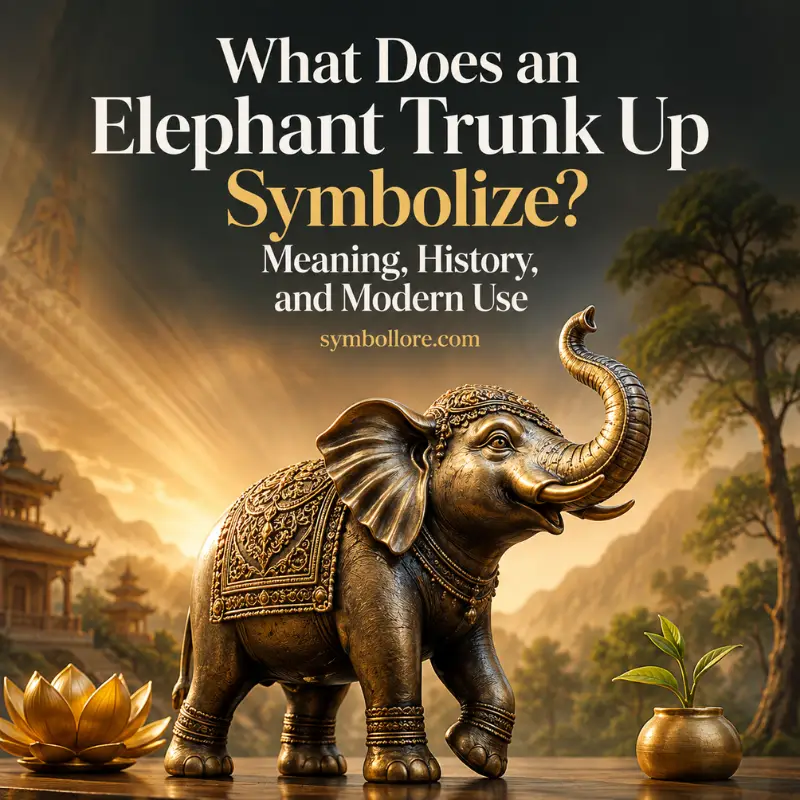
The most common interpretation is good fortune. A raised trunk is visually associated with an elephant trumpeting, greeting, celebrating, or directing its energy upward. Modern symbolic traditions therefore often read the pose as an expression of optimism, success, abundance, and forward movement.
The elephant itself adds another layer. Its physical strength supports associations with resilience and protection, while its social behavior and long life have helped make it a symbol of stability and endurance. In African art, for example, elephant imagery can represent leadership and authority rather than simply luck. The Smithsonian’s National Museum of African Art documents elephant imagery connected with leadership, transformation, ritual, and community life.
That distinction matters because the raised trunk is not a universal symbolic language. A decorative elephant purchased as a lucky charm may carry a very different intention from an elephant appearing in a religious sculpture or ceremonial artwork.
Why Is the Raised Trunk Linked With Good Fortune?
The idea that a raised trunk signals luck is widespread in modern decorative culture. Many contemporary symbolism guides describe it as a gesture that “showers” or welcomes fortune, prosperity, and positive energy.
There is, however, an important historical caution. A University of Southern California Digital Folklore Archives entry discusses the American spread of the lucky-elephant belief and cites folklore research suggesting that the specific trunk-up = luck rule may not have originated as an ancient universal rule in India, Africa, or Southeast Asia. The entry instead describes a process of cultural diffusion in which elephant imagery and Western good-luck folklore became intertwined.
This makes the modern belief interesting in its own right. Rather than assuming that every raised elephant trunk has meant “luck” for thousands of years, it is more accurate to say that the pose has become strongly associated with luck through a mixture of religious imagery, folklore, decorative traditions, and cultural exchange.
Ganesha and Hindu Symbolism
Ganesha is one of the most important reasons elephants carry such strong symbolic associations in Hindu contexts. The Smithsonian’s National Museum of Asian Art identifies Ganesha as the elephant-headed god, the son of Shiva and Parvati, and specifically describes him as the remover of obstacles and deity of new beginnings.
Ganesha’s elephant head is traditionally connected with qualities such as strength and the ability to overcome barriers. His worship is also associated with beginning new endeavors, and devotees may seek his help before important undertakings. The Metropolitan Museum of Art similarly explains that Hindus associate Ganesha with wisdom, strength, loyalty, good fortune, and the removal of obstacles.
The important point is that Ganesha symbolism should not be reduced to trunk direction. Ganesha’s iconography contains many features, including his posture, hands, attributes, vehicle, and trunk orientation. Therefore, seeing any elephant with an upward trunk does not automatically mean that it represents Ganesha.
For readers interested in the religious history behind elephant imagery, the Smithsonian’s detailed object page is particularly useful because it connects Ganesha’s iconography with Hindu worship, new beginnings, overcoming obstacles, and historical Indian sculpture.
Smithsonian National Museum of Asian Art: Seated Ganesha
Elephants in Buddhism and Asian Art
Elephants also have important roles in Buddhist traditions, although their meanings differ from the popular lucky-elephant decor found today. Buddhist art uses elephants in stories, religious imagery, and representations of important figures.
The Metropolitan Museum of Art records a Buddhist image in which the bodhisattva Fugen, or Samantabhadra, rides a white elephant. In that context, the elephant is part of a larger religious iconographic system rather than simply a generic charm for financial prosperity.
Another important Buddhist association appears in representations of the Buddha’s conception. The Met describes a second-century Gandharan sculpture in which Queen Maya dreams of a six-tusked elephant descending from heaven before entering her womb. The image represents the miraculous conception of the Buddha.
These examples show why it is risky to say that Buddhism simply teaches that a trunk-up elephant brings luck. Buddhist elephant imagery can communicate religious narratives, virtue, practice, spiritual significance, or sacred events depending on the work.
African Art and Thai Culture
Elephant symbolism is especially rich across Africa, but it should never be treated as one single African belief. Different societies have used elephant imagery in distinct ceremonial, political, and artistic contexts.
The Smithsonian National Museum of African Art notes that elephant masks in the Cameroon Grassfields can emphasize leadership, while elephant imagery among other communities can relate to transformation, ritual, life and death, or social identity.
Thailand provides another important example. Thai government material describes the elephant as a revered national symbol associated with auspiciousness and prestige, as well as longevity, strength, and wisdom. White elephants have historically held a particularly elevated place in Thai royal tradition.
The Thai Fine Arts Department’s Royal Elephant National Museum likewise describes auspicious elephants as connected with glory, prosperity, and peace for the land.
These traditions support a broader conclusion: elephants can symbolize power, auspiciousness, leadership, protection, and prosperity without requiring the specific modern rule that “trunk up always equals luck.”
For additional cultural context, the Thai Ministry of Foreign Affairs provides a useful official explanation of the elephant’s historical role as a national symbol and its associations with longevity, strength, wisdom, auspiciousness, and prestige.
Thailand Ministry of Foreign Affairs: Elephant Sculpture and Cultural Significance
Feng Shui and Vastu Shastra
In modern home decor, Feng Shui and Vastu Shastra are frequently mentioned when people ask about elephant statue placement. Contemporary guides commonly associate a trunk-up elephant with prosperity, welcoming good fortune, and an uplifting atmosphere.
Vastu-oriented sources similarly distinguish between raised and lowered trunks. A trunk-up figure is commonly linked with rising luck and prosperity, while a trunk-down figure may be associated with grounding, patience, fertility, or stability.
These interpretations should be described as traditional or contemporary belief systems, not as scientifically established mechanisms. An elephant statue cannot be shown to physically attract money, alter invisible energy, or guarantee success.
Still, symbolic objects can have genuine personal value. A person may place an elephant near an entrance as a reminder of prosperity, resilience, protection, or a new beginning. In that sense, the object can influence meaning and intention even without making a supernatural claim.
Elephant Trunk Up vs. Trunk Down
The raised and lowered trunk are often presented as opposites, but the distinction is not as absolute as many online articles suggest.
A trunk-up elephant is commonly associated with:
- Good fortune
- Prosperity
- Celebration
- Success
- Optimism
- Blessings
- Forward movement
A trunk-down elephant is often associated in modern decorative interpretations with:
- Grounding
- Stability
- Patience
- Protection
- Longevity
- Quiet strength
The key correction is that trunk down does not automatically mean bad luck. Several contemporary sources explicitly make this point, while others describe the downward position as grounded or protective.
There is also a practical reason not to treat trunk direction as a rigid rule. In real elephant behavior, the trunk can be raised, lowered, curled, extended, or positioned in many ways for communication and physical tasks. Symbolic interpretations are therefore cultural readings of an animal’s pose, not fixed biological meanings.
How to Choose and Display One
If you want an elephant statue for symbolic reasons, start with the meaning you want it to express rather than assuming there is one universally correct position.
Choose a trunk-up elephant when you want a symbol of:
- Good fortune or optimism
- Success and achievement
- New opportunities
- Celebration
- Prosperity
Choose a trunk-down elephant when you prefer symbolism connected with:
- Grounding
- Stability
- Patience
- Protection
- Endurance
If the object is specifically religious, follow the conventions of the tradition it represents instead of applying generic home-decor rules. A Ganesha figure, for example, has an established iconographic context that is more meaningful than simply treating it as a “lucky elephant.”
For ordinary decorative use, the best placement is ultimately the one that makes sense for the room and the intention behind the object. The symbolic meaning can be personal without requiring a claim that the statue produces measurable supernatural effects.
What the Symbol Does Not Prove
Elephant symbolism can be meaningful without being a guarantee.
A trunk-up elephant does not scientifically demonstrate that money will arrive, problems will disappear, or a particular room will become more prosperous. Those are matters of belief and interpretation rather than established physical effects.
Likewise, it would be misleading to describe the raised trunk as having one identical meaning in Hinduism, Buddhism, African art, Thai culture, Feng Shui, Vastu Shastra, and modern Western folklore. The sources show something more interesting: elephants repeatedly acquire positive associations, but those associations develop differently within different cultural settings.
That distinction makes the symbol more useful, not less. Instead of treating the elephant as a universal superstition, you can understand it as a flexible cultural image associated with strength, wisdom, auspiciousness, protection, leadership, and good fortune.
FAQs
Yes, in modern popular symbolism, a raised trunk is widely considered a sign of good luck, prosperity, and positive fortune. However, this is a cultural belief rather than a scientifically established effect, and the meaning varies by tradition.
It commonly symbolizes good fortune, strength, optimism, blessings, and overcoming obstacles. Spiritual interpretations vary, so the meaning should be connected to the specific religious or cultural tradition rather than treated as universal.
Not necessarily. Ganesha is an elephant-headed Hindu deity associated with new beginnings and removing obstacles, but an ordinary elephant statue with a raised trunk does not automatically represent Ganesha.
No. That is a popular misconception. Many modern interpretations associate a downward trunk with grounding, stability, patience, protection, or longevity instead.
People commonly place trunk-up elephant figures near entrances, in living rooms, or in offices when using them as symbols of good fortune or prosperity. Placement recommendations belong to particular decorative traditions, so they should not be treated as universal religious rules.
Elephants have deep historical and cultural significance in Thailand. They are associated with auspiciousness, prestige, strength, wisdom, longevity, and royal tradition, with white elephants holding especially important symbolic status.
No. Elephant symbolism changes across communities and historical settings. African art, Hindu imagery, Buddhist art, Thai royal tradition, and modern home-decor folklore all use elephants differently, even when they share ideas such as strength or auspiciousness.
Conclusion
Elephant trunk up symbolism is most commonly understood today as a sign of good luck, prosperity, strength, celebration, and positive fortune. Yet its meaning is richer than a simple lucky-charm rule. Hindu Ganesha imagery, Buddhist art, African traditions, Thai culture, and modern Feng Shui or Vastu practices each contribute different layers of meaning.
The safest interpretation is therefore contextual: a raised trunk can represent good fortune, but it does not have one universal meaning or guarantee a supernatural result. Understanding the cultural setting makes this familiar symbol far more meaningful.


