Fire symbolism centers on transformation, energy, passion, purification, sacred presence, and destruction. These meanings come from the flame’s physical nature: it warms and illuminates, yet it also consumes and permanently changes whatever it touches.
The setting determines which meaning matters. A hearth suggests home and continuity, while a wildfire may convey chaos or loss. A candle can express prayer, remembrance, or hope. Therefore, fire has no single universal message. Its meaning emerges from its form, use, cultural setting, and degree of control.
Quick Answer
Fire symbolism usually represents transformation, passion, power, purification, illumination, or destruction. A controlled flame often suggests life, guidance, creativity, and sacred presence. By contrast, uncontrolled fire can represent anger, judgment, danger, or social collapse. The correct meaning depends on who uses the symbol, what the fire does, and what changes around it.
Key Takeaways
- Fire represents change because it permanently transforms matter.
- Controlled flames suggest warmth, purpose, protection, or sacred presence.
- Uncontrolled fire often signals danger, anger, destruction, or lost authority.
- Religious meanings differ and should not be treated as interchangeable.
- Rebirth is one possible interpretation, not an automatic rule.
- Context determines whether fire creates, cleanses, reveals, or destroys.
Fire Meanings at a Glance
| Form or Context | Common Meaning | Key Distinction |
|---|---|---|
| Hearth fire | Home, kinship, continuity | Sustained and shared |
| Candle or lamp | Hope, prayer, guidance | Small light within darkness |
| Forge or kiln | Discipline, creation, transformation | Heat produces a new form |
| Wildfire | Chaos, danger, judgment, loss | Spreads beyond human control |
| Ritual flame | Offering, purity, divine presence | Meaning belongs to a specific tradition |
| Eternal flame | Memory, duty, enduring life | Kept burning across time |
| Phoenix fire | Death followed by renewal | Rebirth depends on the full narrative |
| Signal fire | Hope, communication, rescue | Flame makes people visible |
Why Fire Carries Opposing Meanings
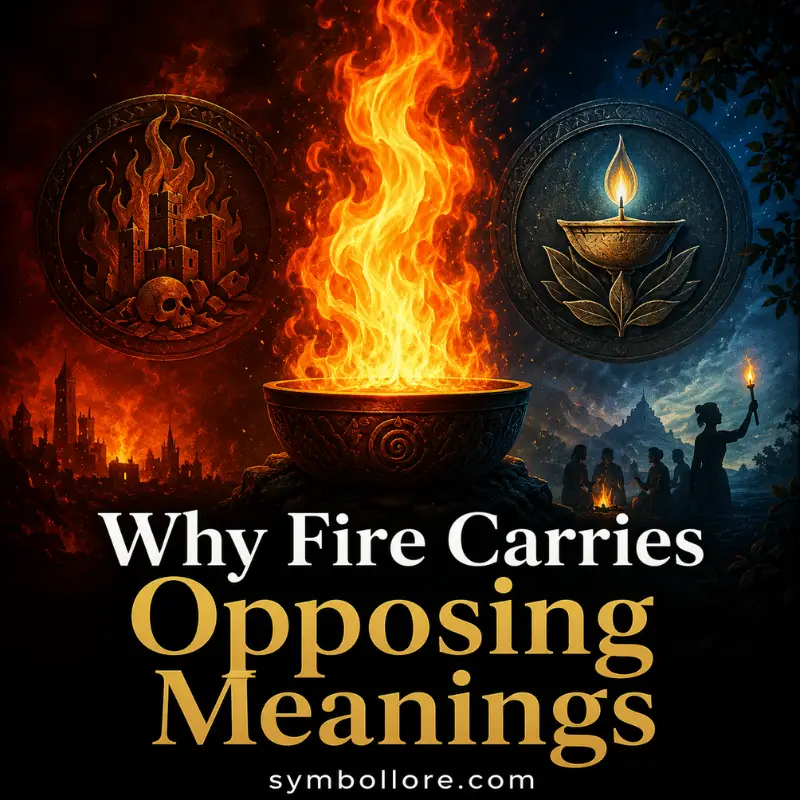
Fire represents opposites because people experience it as both a life-supporting tool and a lethal force. Its light makes hidden things visible. Its heat cooks food and protects a home. However, the same flame can injure, destroy shelter, or consume an entire landscape.
Four physical qualities shape most symbolic interpretations:
- Light produces meanings such as truth, knowledge, revelation, and guidance.
- Heat suggests life, desire, anger, vitality, or emotional intensity.
- Consumption creates associations with death, punishment, sacrifice, and release.
- Transformation connects fire with cooking, metalworking, purification, renewal, and irreversible change.
Control matters as much as the flame itself. A fire contained within a lamp communicates something different from flames spreading through a city. For that reason, symbolic analysis should begin with the fire’s behavior rather than a memorized definition.
Transformation, Renewal, and Rebirth
Fire symbolizes transformation because it converts one material state into another. Wood becomes ash, raw food becomes cooked food, and ore becomes workable metal. The original form cannot simply return. Consequently, fire often appears at moments when a character, community, or identity changes permanently.
Renewal can follow destruction, but the two ideas are not identical.
The National Park Service’s account of fire and forest health
explains that some fires remove accumulated plant material and support new growth. That ecological process helps explain why artists and storytellers use burned landscapes to represent recovery.
Still, not every fire produces healthy renewal. Severe fires can devastate communities and ecosystems. Symbolically, rebirth should be read only when the story shows new life, insight, or social order emerging after the loss.
Purification, Sacrifice, and the Sacred
Fire suggests purification because heat can separate, refine, or remove material. Metalworking provides a clear model: intense heat allows unwanted material to be separated from useful metal. Religious and literary language extends that visible process into a metaphor for moral testing, spiritual discipline, or release.
Sacrificial fire carries another meaning. When an offering is burned, it moves from a visible object into smoke, heat, and ash. That change can represent transfer from the human realm to a sacred one. However, the purpose and theology of an offering vary widely.
Purification should not be confused with moral superiority or permission to destroy. In symbolic language, it usually means refinement or transition. In real history, people have also used claims of “cleansing” to justify violence. Responsible interpretation must preserve that difference.
Fire Symbolism Across Religions
Religious fire does not have one shared meaning. Similar-looking flames may serve different theological and ritual purposes.
In the Hebrew Bible, the burning bush signals divine presence without ordinary consumption. A pillar of fire provides guidance during the Exodus. In Christianity, flames associated with Pentecost represent the Holy Spirit, while other passages use fire for judgment or testing. Thus, even one scriptural tradition can give fire several meanings.
In Hindu traditions, Agni is both fire and a divine mediator associated with offerings. Sacred flame remains important in rites including yajna and many wedding ceremonies. It can represent witness, communication, purity, and transformation.
Zoroastrian sacred fire is treated with reverence as a visible focus for truth, order, and divine light. Describing Zoroastrians as simple “fire worshippers” is misleading because the flame points beyond itself within a larger theology.
Buddhist texts may use fire differently. The Ādittapariyāya Sutta, often called the Fire Sermon, compares sensory experience with burning through craving, aversion, and delusion. Here, fire describes attachment and suffering rather than a generic promise of spiritual power.
Fire in Mythology
Fire myths frequently ask who controls transformative knowledge and whether humans should possess it. In Greek tradition, Prometheus brings divine fire to humanity and suffers punishment. The story makes flame a sign of technology, civilization, rebellion, and the cost of crossing divine limits.
The Smithsonian’s description of Prometheus
preserves this familiar image of stolen fire as a gift to mortals.
Agni plays a different role in Vedic tradition. Rather than stealing a forbidden power, Agni conveys offerings and connects worshippers with deities. Grouping Agni and Prometheus together as generic “fire gods” would erase that important distinction.
The phoenix adds another pattern. It is destroyed or dies in connection with flame and later appears renewed. Modern culture often uses the phoenix for recovery after hardship. Yet phoenix imagery represents rebirth because of its particular story, not because every flame automatically promises a fresh beginning.
Passion, Anger, Creativity, and Power
Fire represents strong emotion because heat, movement, and rapid expansion resemble physical arousal. English expressions such as “burning desire,” “fiery temper,” and “spark of inspiration” preserve this connection. Each phrase describes intensity, but the direction of that energy changes its meaning.
Passion directs heat toward a person, purpose, or ambition. Anger turns it toward conflict or harm. Creativity begins with a spark and grows when someone supplies attention and effort. Power appears when a person can generate, contain, or direct the flame.
Control again provides the main clue. A steady fire can represent commitment and disciplined motivation. A flash or explosion suggests sudden emotion. Flames that consume their source may warn that ambition, resentment, or desire has become self-destructive.
The Hearth, Eternal Flame, and Memory
The hearth symbolizes home because it once organized everyday domestic life. People gathered around it for food, warmth, work, conversation, and storytelling. A tended household fire could therefore represent family continuity, hospitality, protection, and shared responsibility.
An eternal flame changes domestic continuity into public memory. Its uninterrupted burning suggests that a person, event, or duty remains present despite the passage of time. In the United States, eternal flames appear at memorials and places of civic remembrance. Their meaning depends less on destruction than on endurance.
A candle used after a death works on a smaller scale. Its vulnerable light acknowledges loss while maintaining attention and care. The flame does not prove a supernatural presence. Instead, it gives mourners a visible action through which memory can be expressed.
Fire Symbolism in Literature and Art
In literature, fire often marks the point where ordinary life can no longer continue unchanged. It may destroy evidence, expose truth, free a character, punish wrongdoing, or reveal that an institution has lost control. The surrounding narrative decides which reading fits.
Use four questions when interpreting a scene:
- Who starts or controls the fire? Control may indicate authority, skill, rebellion, or responsibility.
- What does it consume? A home, book, forest, letter, or body carries a different meaning.
- Who receives warmth and who faces danger? The same flame can protect one group while threatening another.
- What remains afterward? Ash, new growth, knowledge, trauma, or social change completes the symbol.
Ray Bradbury’s Fahrenheit 451, for example, changes the meaning of fire across the novel. It first supports censorship and destruction, yet later offers warmth, community, and the possibility of rebuilding. The contrast matters more than any isolated flame.
Modern American Meanings of Fire
Modern American culture uses fire as a quick visual sign for intensity. Sports teams and brands use flames to suggest speed, energy, competitiveness, or popularity. Online, the fire emoji commonly praises something as exciting, attractive, impressive, or culturally current.
Fire tattoos can represent survival, transformation, passion, independence, or controlled aggression. A phoenix, candle, match, wildfire, and campfire do not communicate the same story. The surrounding design and the wearer’s explanation matter more than a fixed tattoo dictionary.
Protest imagery also uses flame to express resistance, urgency, rage, or the collapse of an old order. In news photographs, however, real fire may document human loss rather than function as a decorative metaphor. Readers should avoid romanticizing destruction when the image concerns an actual disaster.
What Fire Does Not Always Mean
Fire does not always mean rebirth. That interpretation requires evidence of renewal, return, or reconstructed identity. If a story ends with devastation, the flame may represent irreversible loss instead.
It does not always indicate evil, either. Sacred lamps, hearths, signal fires, and memorial candles carry protective or sustaining meanings. Likewise, religious fire should not automatically be interpreted as hell or punishment.
Dreams involving fire have no scientifically fixed symbolic translation. A dream may reflect recent experiences, fear, stress, memory, or personal associations. A person who survived a house fire may respond differently from someone who associates campfires with safety.
Finally, similar symbols do not prove that separate cultures share one belief. Human beings encounter the same physical flame, but communities interpret and ritualize it through distinct histories.
How to Interpret Fire Respectfully
Begin with context, not a universal symbolism list. Identify whether the flame is domestic, sacred, ecological, artistic, memorial, or destructive. Then examine who created it, how it behaves, and what outcome follows.
For a religious or Indigenous practice, use the community’s own terminology whenever reliable sources provide it. Avoid treating “Native American belief,” “African religion,” or “Eastern spirituality” as single systems. These labels cover many nations, languages, and traditions.
Distinguish symbolic discussion from real-world safety. Burning letters, walking on coals, lighting outdoor fires, or copying ceremonies can cause injury, violate local rules, or appropriate a sacred practice. A symbolic release exercise does not require an actual flame. Writing, drawing, or another nonburning action can express the same personal intention safely.
FAQs
Fire can be positive, negative, or deliberately ambiguous. A hearth may represent care, while a wildfire represents danger. A ritual flame can suggest sacred presence, yet another religious passage may use fire for judgment. Its control, purpose, and consequences determine the strongest reading.
Fire visibly and permanently changes materials. It cooks food, turns wood into ash, hardens clay, and helps shape metal. Because the original material cannot simply return to its former state, fire became a natural metaphor for life changes that alter identity, knowledge, or social order.
A flame may represent divine presence, prayer, purification, awareness, or communication with the sacred. However, its meaning belongs to a particular religion or personal practice. It should not be presented as a single spiritual message shared by every tradition.
Biblical fire can signify God’s presence, guidance, judgment, holiness, testing, or the Holy Spirit. The burning bush, pillar of fire, refining imagery, and Pentecost do not perform identical symbolic roles. Readers should interpret each passage within its own literary and theological setting.
No. Fire may destroy without producing renewal, and it may illuminate without destroying anything. Rebirth becomes the strongest meaning when a narrative includes return, recovery, new growth, or reconstruction. Without that second stage, loss or transformation may be more accurate.
A fire tattoo commonly represents passion, survival, transformation, confidence, anger, or energetic power. Its exact meaning depends on the design. A candle may honor memory, a phoenix may show recovery, and spreading flames may emphasize danger, speed, or defiance.
A controlled fire often symbolizes discipline, useful power, protection, creativity, or sustained commitment. Containment shows that intense energy has a purpose. In contrast, flames that escape their boundaries often represent anger, disorder, danger, or authority that has failed.
Conclusion
Fire symbolism reflects humanity’s experience of a force that can sustain life and destroy it. Light supports meanings of knowledge and guidance, while heat suggests passion and vitality. Consumption can signify sacrifice or loss, and transformation can lead toward creation, purification, or renewal.
The most reliable interpretation comes from context. Consider the flame’s form, controller, purpose, cultural setting, and aftermath. Fire is powerful precisely because it does not deliver one simple message: it shows how warmth and danger, creation and destruction, can exist within the same element.