Fertility symbolism represents the power to create, nourish, reproduce, and sustain life. Although it often relates to pregnancy or childbirth, its meaning can also include productive land, plentiful crops, family continuity, prosperity, artistic creation, and renewal.
No single object has represented fertility everywhere. A fruit, animal, deity, or bodily form gains meaning through a particular culture’s environment, religion, stories, and rituals. Understanding that context prevents a rich symbolic tradition from becoming a misleading list of supposedly universal signs.
Quick Answer
Fertility symbolism expresses the creation and continuation of life through people, animals, plants, land, or ideas. Common signs include seeds, eggs, water, grain, flowering trees, and highly reproductive animals. However, their meanings vary by culture: one motif may represent pregnancy, while another signifies harvests, prosperity, ancestry, or spiritual renewal.
Key Takeaways
- Fertility can describe reproduction, crops, prosperity, lineage, or creativity.
- Natural forms suggest fertility through growth, multiplication, and seasonal return.
- A symbol’s original cultural setting determines its most accurate meaning.
- Ancient artifacts do not always reveal their purpose with certainty.
- Symbolic objects offer meaning and comfort, not medical results.
- Respectful interpretation separates shared themes from culture-specific traditions.
Fertility Symbols at a Glance
| Symbol | Common Association | Why It Suggests Fertility | Important Context |
|---|---|---|---|
| Seeds and grain | Potential, crops, future generations | One small source produces abundant growth | Common in farming societies and harvest religion |
| Egg | Birth, possibility, protected life | It visibly contains developing life | Also connected with spring and resurrection |
| Water | Nourishment, conception, renewal | Plants, animals, and people depend on it | Meanings differ among river, rain, and ocean cultures |
| Pomegranate | Procreation, marriage, abundance | Its interior holds many seeds | Important in several Mediterranean and Asian traditions |
| Hare or rabbit | Reproduction, spring, new life | These animals reproduce quickly | Strong in European seasonal imagery |
| Lotus | Emergence, generation, sacred creation | It rises and blooms from water | Has specific meanings within South Asian religions |
| Cornucopia | Harvest, prosperity, plenty | The overflowing vessel displays surplus food | Rooted in Greek and Roman visual culture |
| Tree of Life | Continuity, kinship, regeneration | Roots, branches, fruit, and seeds suggest generations | Appears in many traditions with different meanings |
What Fertility Symbolism Really Means
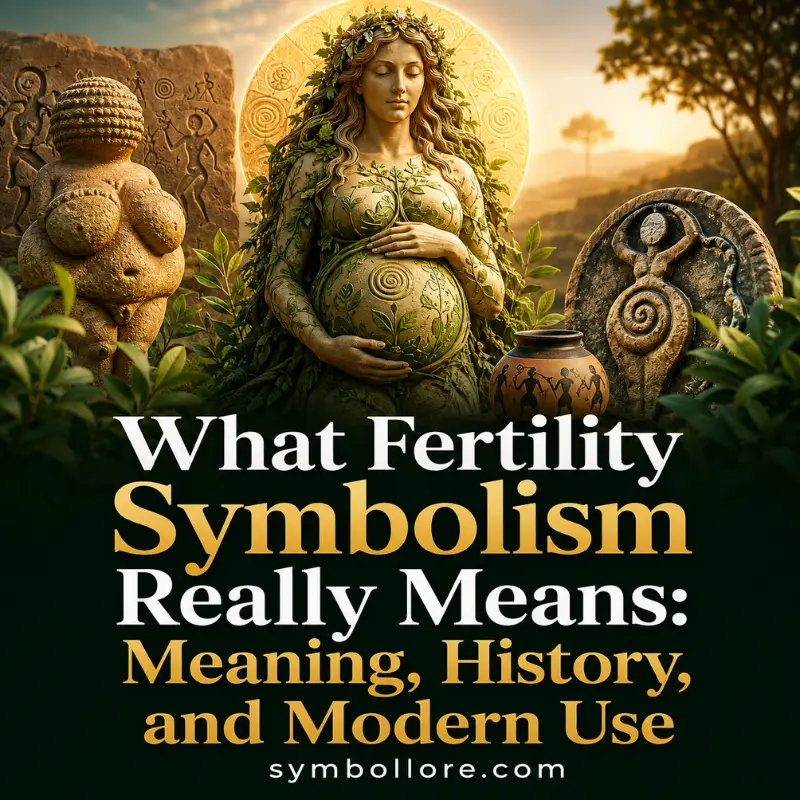
Fertility has a wider symbolic range than the ability to conceive. At least five related ideas may appear under the same label:
- Human fertility: conception, pregnancy, childbirth, sexuality, and family formation.
- Agricultural fertility: rain, rich soil, healthy livestock, crops, and harvest.
- Communal continuity: descendants, ancestors, inheritance, and survival of a people.
- Spiritual generation: creation, regeneration, sacred union, or cosmic renewal.
- Creative fertility: productive imagination, artistic work, and promising new projects.
These meanings often overlap because earlier communities depended closely on land, animals, weather, and successful births. A drought could threaten crops, herds, and families at once. Consequently, rainmaking, marriage, seasonal rites, and harvest celebrations could share the language of abundance without meaning exactly the same thing.
Why Nature Became the Main Symbolic Language
Nature supplied the clearest images of life multiplying. A single seed became a field of grain. Dormant plants returned in spring, rain revived dry land, and fruit concealed the beginnings of future plants. People could observe these processes long before they could explain reproduction scientifically.
Natural symbols therefore work through visible analogy. Eggs contain developing life, flowering plants announce a new growing season, and water enables growth. Animals such as the hare gained similar associations because people noticed their reproductive behavior.
A 2016 historical review hosted by the
found that natural elements, including earth and water, recur in the fertility mythology of multiple ancient civilizations. That pattern supports a shared human observation, but it does not prove that every culture assigned those elements identical meanings.
Ancient Fertility Symbols and Historical Evidence
Ancient art can suggest fertility, but archaeologists cannot always prove what an object meant to its maker. Rounded bodies, emphasized sexual features, animals, or plant forms may relate to reproduction. Yet they can also express protection, status, identity, nourishment, ancestors, or religious power.
This caution is especially important for prehistoric figurines. Modern viewers have often called female figures “fertility goddesses” based mainly on their bodies. Without writing, a known ritual setting, or other supporting evidence, that label remains an interpretation rather than a confirmed identity.
Context strengthens an interpretation. Archaeologists look at where an object was found, how it was used, what appeared beside it, and whether later texts or continuing traditions offer a reliable comparison. Fertility symbolism becomes more convincing when several forms of evidence point toward birth, crops, marriage, or regeneration.
Fertility Goddesses, Gods, and Sacred Powers
A fertility goddess or god does not necessarily govern pregnancy alone. Such deities may oversee grain, rain, sexuality, animals, marriage, infants, or the seasonal renewal of vegetation.
In ancient Greek tradition, Demeter’s primary sphere was grain and cultivated land. Her daughter Persephone became associated with seasonal loss and return. The surviving myth connects agricultural growth, maternal grief, marriage, death, and renewal rather than offering a simple pregnancy symbol.
The World History Encyclopedia’s account of Persephone
also notes that grain and torches were associated with the Eleusinian Mysteries.
Roman Ceres similarly represented agriculture and harvest. Her customary attributes included grain, a sickle, and the cornucopia. These objects show how a deity’s symbols communicate function: ripened grain means successful cultivation, while an overflowing vessel conveys prosperity.
Other religious traditions have their own concepts, names, and sacred relationships. They should not be reduced to interchangeable versions of one universal mother figure.
Pomegranates, Eggs, Hares, and Other Common Motifs
The pomegranate conveys abundance because its hard exterior opens to reveal many seeds. It has appeared in Mediterranean, Middle Eastern, and Asian art, but its specific associations include marriage, posterity, death, and seasonal return. Its role in the Persephone story also makes it more complex than a simple sign of birth.
The egg represents contained possibility. It can suggest creation, new life, spring, protection, or resurrection, depending on its setting. Likewise, the hare became connected with reproduction partly because of its breeding behavior. European seasonal customs later brought hares and eggs into Easter imagery.
A University of Southern California history of Easter hare traditions
explains that hares had ritual importance in Europe long before the modern Easter Bunny. The evidence supports a long symbolic history, but popular claims that one forgotten pagan festival directly produced every modern Easter custom remain too simple.
The lotus, fish, flowering vines, and fruit-bearing trees also express generation. However, their religious meanings require more cultural context than their biological features alone provide.
Fertility Symbolism in Living Cultural Traditions
Living traditions deserve more care than generalized “ancient symbol” lists provide. For example, Akua’ba figures belong to Akan cultural history in Ghana. Traditionally, these stylized wooden figures were associated with hopes for conception and healthy children. Their form, use, and community history matter more than a viewer’s first visual impression.
Smarthistory’s discussion of the Akua’ba female figure
identifies such figures as historical fertility aids among Akan-speaking peoples. That specific attribution is more accurate than calling every African wooden figure a fertility doll.
In Indian art, fish, flowering circles, trees, water vessels, and wedding-room paintings can express prosperity, marriage, rainfall, or family continuity. Their meanings differ by region, art form, language, and religious setting. Similarly, the lotus may signify purity, cosmic emergence, spiritual realization, abundance, or divine power—not merely reproduction.
Modern Fertility Symbolism in the United States
Modern Americans encounter these meanings in holiday decorations, wedding designs, tattoos, jewelry, gardens, family art, and spiritual practices. Some people choose seeds, trees, flowers, or crescent forms to honor pregnancy, parenthood, ancestry, or personal renewal.
The pineapple has also developed a newer association within infertility and fertility-treatment communities. It commonly represents hope, resilience, mutual recognition, and support during in vitro fertilization or other treatment experiences. That use is largely social and emotional rather than an ancient universal tradition.
Modern symbolism can be personal without pretending to be historical. Someone may select a flowering plant to mark recovery or a tree to celebrate an expanding family. The meaning is valid as a personal association when it is described honestly and does not overwrite a sacred cultural use.
What Fertility Symbols Cannot Do
A symbol cannot increase the biological chance of conception. Crystals, charms, foods, colors, affirmations, and ritual objects may offer comfort, focus, identity, or community, but they are not substitutes for medical evaluation or evidence-based treatment.
This boundary matters because fertility concerns can make people vulnerable to expensive or unsafe claims. A ritual may have emotional or religious value while lacking clinical effectiveness. Those two statements can both be true.
In the United States, people with questions about conception can consult
the American College of Obstetricians and Gynecologists’ guidance on evaluating infertility.
Medical care should address biological questions, while symbolic practices can remain a voluntary source of personal meaning.
How to Interpret or Choose a Fertility Symbol
A responsible interpretation begins with three questions:
- Where does the symbol come from? Identify its community, religion, period, and artistic setting.
- What kind of fertility does it represent? Decide whether the context concerns children, crops, rain, livestock, prosperity, ancestry, or creative work.
- How strong is the evidence? Separate documented ritual use from scholarly interpretation, popular folklore, and recent personal meaning.
Next, examine the symbol’s physical logic. Multiplying seeds suggest abundance, flowing water suggests nourishment, and seasonal plants suggest regeneration. This visual reasoning can explain an association, but it cannot replace cultural evidence.
For a tattoo, gift, or artwork, write down the intended message first. A tree may suit family continuity, while germinating seeds may better represent potential. Choosing by meaning is more reliable than selecting a visually attractive motif and assigning it a history afterward.
Using Fertility Symbols Respectfully
Respectful use begins with accurate naming. If a motif belongs to a living religion or a particular Indigenous or ethnic community, learn its name, function, and restrictions before wearing, selling, or permanently reproducing it.
Also avoid assuming that fertility defines womanhood. Not every woman wants children, not every person who becomes pregnant identifies as a woman, and infertility does not reduce anyone’s value. Symbolic language should make room for adoption, chosen family, creative work, cultural continuity, and relationships with land.
A practical checklist helps:
- Identify the original community and meaning.
- Prefer museum, university, or community-led information.
- Do not claim sacred imagery as a generic personal invention.
- Avoid promises of conception, healing, or guaranteed luck.
- Explain when your interpretation is modern or personal.
- Consider how the design may affect someone experiencing pregnancy loss or infertility.
FAQs
There is no single universal symbol. Seeds and eggs are among the clearest broad examples because they visibly contain the potential for new life. However, cultures have also used water, grain, fruit, animals, bodily forms, trees, deities, and ritual vessels for different kinds of fertility.
No. It may represent productive soil, livestock, rainfall, family continuity, wealth, spiritual creation, or artistic potential. Pregnancy is one major meaning, but interpreting every fertility-related object as a pregnancy sign can erase its agricultural, religious, or communal context.
Its many seeds make it a natural image of multiplication, posterity, and abundance. Various Mediterranean and Asian traditions incorporated it into art, marriage imagery, myth, and religious symbolism. Its exact meaning may include fertility, prosperity, death, renewal, or family continuity.
Both had associations with reproduction, spring, or new life before many modern Easter customs developed. However, Easter traditions formed through several historical and religious influences. Describing every rabbit or egg custom as a direct survival from one pagan festival goes beyond the available evidence.
The pineapple commonly expresses hope, strength, and solidarity among people experiencing infertility or assisted reproductive treatment. It is a modern community emblem rather than a medically effective object. Its value comes from recognition and emotional support, not an ability to cause pregnancy.
Yes. A person may use one to represent creativity, renewal, family roots, a thriving garden, or personal growth. The wearer should understand whether the design has a sacred or community-specific meaning and describe a personal interpretation as personal.
No reliable evidence shows that a crystal or charm improves fertility. Such objects may support reflection, cultural practice, or emotional comfort, but they should not replace medical advice. Sellers who promise pregnancy or guaranteed treatment success are making claims that require strong clinical evidence.
Conclusion
Fertility symbolism expresses life’s capacity to begin, multiply, recover, and continue. Seeds, water, fruit, animals, trees, and sacred figures can represent childbirth, harvests, prosperity, ancestry, or creativity, but their meanings depend on cultural context.
The most thoughtful interpretation asks where a symbol came from, what kind of flourishing it represents, and how firmly its meaning is documented. That approach preserves both its emotional power and the history of the people who gave it meaning.


