
Eye tattoo symbolism usually centers on awareness, protection, truth, intuition, or the feeling of being watched. However, an ordinary human eye, an Eye of Horus, an evil eye amulet, and an eye inside a triangle do not carry identical histories.
The final meaning comes from the specific motif, surrounding elements, and the wearer’s intention. Understanding those distinctions matters because a design that looks similar at first glance may communicate religious faith, cultural protection, personal grief, or modern suspicion.
Quick Answer
Eye tattoo symbolism most often represents perception, vigilance, protection, truth, or inner awareness. A realistic eye may honor someone or express emotion, while the Eye of Horus, nazar, third eye, and Eye of Providence come from different cultural traditions. Color, added objects, placement, and personal intention can further change how viewers understand the tattoo.
Key Takeaways
- Eye tattoos commonly represent awareness, protection, truth, or intuition.
- Individual eye symbols have different religious and cultural histories.
- Added tears, animals, flowers, or clocks reshape the interpretation.
- Placement affects visibility more reliably than symbolic meaning.
- Personal intention matters, but public interpretations still deserve consideration.
- Safe tattooing requires sterile practices and careful aftercare.
Eye Tattoo Meanings at a Glance
| Design | Common Meaning | Important Distinction |
|---|---|---|
| Realistic human eye | Memory, emotional connection, truth | May reproduce a loved one’s eye |
| Single stylized eye | Awareness, observation, self-knowledge | Meaning depends heavily on context |
| Eye of Providence | Divine oversight, guidance, moral accountability | Later gained Masonic and conspiracy associations |
| Eye of Horus | Healing, restoration, protection | Originates in ancient Egyptian religion |
| Eye of Ra | Solar power, authority, defense | Related to but distinct from Horus’s restored eye |
| Nazar or protective eye | Defense against the evil eye | Represents the protection, not the harmful gaze |
| Third eye | Intuition, inward awareness, spiritual insight | Draws from South Asian religious concepts |
| Eye with a tear | Grief, empathy, pain, remembrance | Should not automatically be read as a prison teardrop |
What Eye Tattoo Symbolism Usually Represents
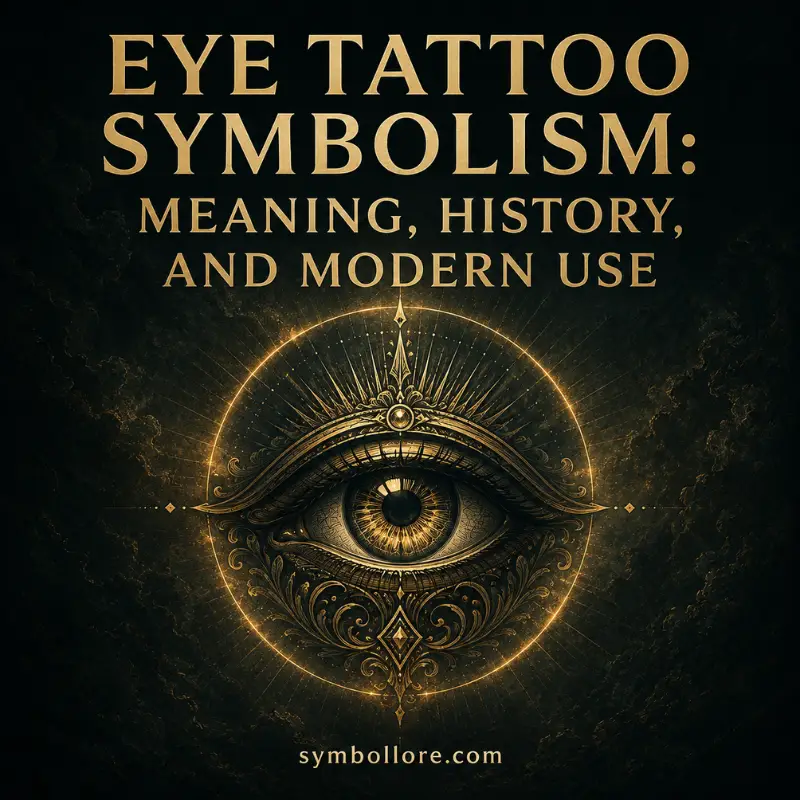
An eye tattoo usually communicates the act of seeing rather than eyesight alone. It can suggest awareness, careful observation, honesty, discernment, or the ability to recognize what others overlook. A forward-facing eye can also feel protective because its gaze appears alert.
The same image can have a less comforting meaning. An unblinking eye may evoke judgment, surveillance, secrecy, or lost privacy. This tension makes the motif powerful: an eye can protect the wearer while also reminding viewers that someone is watching.
Therefore, there is no single universal interpretation. The artwork might represent self-awareness for one person, a deceased relative for another, and divine guardianship for someone else.
Why the Eye Became Such a Powerful Symbol
Eyes naturally suggest knowledge because vision helps people identify danger, read emotion, and understand their surroundings. An eye can therefore serve as a compact visual metaphor for consciousness and perception.
Gaze also creates a relationship. A tattooed eye may look outward like a guardian, inward like a symbol of self-examination, or directly at the viewer like a warning. Artists can change that emotional effect through the pupil, eyelids, shadows, and direction of the gaze.
An open eye often conveys alertness or awakening. In contrast, a closed eye may suggest rest, trust, meditation, blindness to a problem, or a decision to look inward. These are modern artistic readings rather than fixed rules.
All-Seeing Eye and Eye of Providence Meaning
An eye inside a triangle is commonly called the Eye of Providence. Historically, it represents divine providence—the idea that God observes and guides humanity. Rays surrounding the triangle often suggest sacred light or divine presence.
Americans frequently recognize the design from the reverse of the Great Seal on the one-dollar bill. The National Archives explains that the unfinished pyramid signifies strength and duration, while the eye and motto above it refer to providence favoring the American cause. The official symbolism is therefore different from later claims that the seal proves control by a hidden organization.
Freemasonry also adopted all-seeing-eye imagery, which helped create its modern association with secret societies. A tattoo may consequently express faith, moral accountability, protection, mystery, institutional power, or criticism of surveillance. The surrounding design usually reveals which meaning the wearer intends.
Eye of Horus and Eye of Ra Tattoos
The Eye of Horus is a restored eye from ancient Egyptian religious tradition. It became associated with healing, protection, regeneration, and renewed wholeness after injury.
The Metropolitan Museum of Art describes the wedjat eye as the healed eye of Horus. Its name conveys being sound or whole again, while surviving amulets show its protective and regenerative role. This evidence makes restoration—not simply vague “mystical vision”—one of the strongest historical meanings behind an
The Eye of Ra has overlapping imagery but a different emphasis. Ra’s eye relates more closely to the sun god’s authority, fierce defensive energy, and destructive power against enemies. Modern tattoo art sometimes labels either Egyptian-looking eye incorrectly, so compare the exact shape and intended story before choosing one.
Evil Eye Tattoo Symbolism
An evil eye tattoo usually depicts protection from the evil eye rather than support for a harmful curse. The underlying belief holds that an envious or hostile gaze can cause misfortune. Protective eye-shaped objects developed as a response to that feared gaze.
The familiar blue-and-white nazar is one such amulet. It has strong associations with Turkey and appears across the Mediterranean, Middle East, Central Asia, and neighboring regions. Similar beliefs and protective customs also exist far beyond any single country or religion.
A tattoo of the nazar may represent protection, vigilance, family tradition, or resistance to envy. Still, saying that every blue eye color has a fixed spiritual meaning can be misleading. Many internet color charts are modern interpretations rather than consistent historical rules.
Third Eye Tattoo Meaning
A third eye tattoo generally represents intuition, inward perception, spiritual awareness, or knowledge beyond ordinary sight. Modern wearers may also use it as a secular symbol of self-knowledge and open-mindedness.
The idea is closely connected with South Asian religious traditions. In Hindu thought, it is often associated with the area of the ajna chakra between the eyebrows. Images of Shiva’s third eye add themes of spiritual power, insight, and the destruction of illusion.
Buddhist traditions contain several forms of sacred eye imagery, but they should not all be treated as interchangeable with the Hindu third eye. Someone using this motif can show respect by researching the specific religious reference instead of describing every version as a generic mark of “enlightenment.”
Realistic Human and Animal Eye Tattoos
A realistic human eye often carries a personal or emotional meaning. It may reproduce the eye of a parent, partner, child, or deceased loved one. In that setting, the design can preserve memory, affection, grief, or the feeling that the person still watches over the wearer.
An unfamiliar human eye can instead symbolize empathy, truth, vulnerability, or close observation. Its expression matters: widened lids may suggest fear, while a relaxed gaze may communicate calm or trust.
Animal eyes add traits associated with the chosen species. An owl eye may imply attentiveness or wisdom, while a wolf eye can suggest instinct, loyalty, or wilderness. A feline eye may convey independence, patience, or mystery. These meanings come from cultural perceptions of the animal, not from one universal tattoo code.
How Added Elements Change the Meaning
Surrounding elements work like context in a sentence: they tell viewers how to read the eye. The most common combinations include:
- Eye and tear: sorrow, compassion, regret, survival, or remembrance
- Eye and clock: time, mortality, memory, or watching life pass
- Eye and rose: love, beauty, secrecy, grief, or emotional awareness
- Eye and butterfly: transformation, growth, or a changing perspective
- Eye and moon: intuition, cycles, dreams, or the hidden self
- Eye and wings: guardianship, spiritual protection, or freedom
- Eye and triangle: providence, structure, divinity, or secret knowledge
- Eye and broken glass: fractured perception, trauma, or seeing through illusion
An eye with a tear is not automatically the same as a small teardrop tattoo placed beneath the eye. Under-eye teardrops carry varied associations with incarceration, mourning, violence, and popular culture. Design and location are essential to interpretation.
Does Tattoo Placement Change the Meaning?
Placement changes an eye tattoo’s visibility and emotional effect more consistently than its symbolic meaning. There is no universal rule that a wrist eye means protection while a back eye always means someone “watching your back.”
A visible forearm or hand tattoo can present awareness or protection publicly. A chest design may feel private, emotional, or connected to the heart. The back offers space for a guardian-like composition, while the neck creates a bold sense of constant observation.
Small areas such as fingers and ankles limit fine detail. Because eyes rely on clean curves, pupils, and shading, a detailed design may blur as it ages if made too small. Discuss long-term legibility with an artist whose healed portfolio includes similar work.
Cultural Respect and Unintended Interpretations
Cultural respect begins with identifying the symbol accurately. Ask whether it comes from an active religious tradition, a historic civilization, a family practice, or modern tattoo culture. Then learn what its defining details mean.
Consider these questions before finalizing the drawing:
- Does the design reproduce a sacred image or ritual object?
- Have different religious symbols been combined without context?
- Could the motif be confused with a gang, prison, or extremist mark?
- Is an artist inventing historical claims to make the design sound deeper?
- Can you explain your connection to the symbol without stereotyping its culture?
Cultural exchange does not make every borrowed motif automatically disrespectful. Still, accurate naming, research, and thoughtful composition reduce the chance of trivializing a living belief.
Choosing a Meaningful Eye Tattoo Design
Start with the message rather than a random image. Write one sentence explaining what you want the tattoo to represent. For example: “I want a reminder to stay alert without becoming fearful.”
Next, choose the symbolic level:
- Select a realistic eye for a specific person or emotional story.
- Choose a general eye for awareness without a fixed religious reference.
- Use a historic emblem only when its actual tradition fits your intention.
- Add one supporting object that clarifies rather than crowds the message.
Finally, request a custom sketch and view it from several distances. Check whether the symbol remains identifiable, whether it resembles an unintended emblem, and whether the details will suit the proposed size.
Safety Before Getting an Eye Tattoo
A symbolic eye tattoo on ordinary skin is different from tattooing the eyeball, inner eyelid, or waterline. Scleral tattooing involves injecting pigment into the white of the eye and can threaten vision. Do not treat it as a routine extension of decorative skin tattooing.
For a standard tattoo, choose a studio that follows local health requirements and uses sterile, single-use needles. The U.S. Food and Drug Administration warns that contaminated equipment or ink can transmit infection. It also notes that allergic reactions may appear immediately or years later.
Review the agency’s tattoo safety guidance before booking.
Follow the artist’s written aftercare instructions. Seek medical advice for worsening pain, spreading redness, pus, fever, or a persistent rash. The FDA also explains that removal can require multiple treatments and may cause discoloration or scarring, so permanence belongs in the original design decision.
FAQs
An eye tattoo can symbolize protection when it depicts a watchful guardian, nazar, Eye of Horus, or Eye of Providence. However, protection is not automatic. A realistic eye or surveillance-style design may instead represent memory, truth, judgment, or the feeling of being watched.
A single eye commonly represents awareness, observation, intuition, or self-examination. It may also memorialize someone if it reproduces a recognizable eye. Its expression and surrounding objects provide more reliable clues than the number of eyes alone.
Most eye tattoos have no gang meaning. Nevertheless, certain facial placements, teardrop forms, or regional combinations may carry prison or street associations. Ask an experienced local artist to check the complete design because interpretation varies by place and community.
The eye inside a triangle historically represents divine providence and appears in religious, civic, and Masonic settings. Popular culture later tied it to the “Illuminati” and conspiracy theories. A tattoo can evoke that modern association, but it is not the symbol’s only or original meaning.
An Eye of Horus tattoo is not automatically disrespectful. Respectful use requires learning that it is an ancient Egyptian religious symbol associated with restoration, well-being, and protection. Avoid false historical claims or careless combinations that erase its origin.
An eye with tears may represent grief, emotional honesty, empathy, regret, or survival. If placed beneath the real eye as a small teardrop, it can attract additional prison or violence-related interpretations. A larger artistic composition usually makes the intended emotional meaning clearer.
Color can shape mood, but most colors do not have universally fixed meanings. Blue may evoke a traditional nazar, red can intensify danger or passion, and black can create gravity or mystery. The symbol’s cultural form and surrounding imagery matter more than an online color chart.
Conclusion
Eye tattoo symbolism can express protection, insight, memory, faith, vigilance, or unease. The specific design matters: the Eye of Horus, Eye of Providence, nazar, third eye, and realistic human eye each bring different histories and associations.
Choose the motif only after separating documented cultural meaning from modern interpretation. Then confirm that its composition, size, placement, and public associations support your intended message. Careful research and a qualified artist can turn a striking eye into a clear, personal symbol rather than an ambiguous borrowed image.