
Evergreen symbolism centers on life that persists through hardship. Because pine, fir, spruce, and other evergreen plants remain visibly green during winter, people often connect them with endurance, hope, continuity, protection, and eternal life.
However, those meanings are not one universal tradition. A Christmas tree, a Haudenosaunee white pine, a cemetery yew, and a memorial wreath belong to different cultural settings. Their meanings may overlap, but they are not interchangeable. Understanding the symbol therefore requires both observation and context.
Quick Answer
Evergreen symbolism most often represents lasting life, resilience, hope, renewal, and continuity. The meaning comes from the plant’s ability to retain living foliage when much of the surrounding landscape appears dormant. In religious, cultural, and personal settings, evergreens can also signify eternal life, peace, protection, remembrance, or faithfulness.
Key Takeaways
- Green winter foliage makes the evergreen a natural emblem of survival.
- Hope, endurance, and continuity are its most widely understood meanings.
- Christmas symbolism is important but does not explain every evergreen tradition.
- Individual species carry different associations in particular settings.
- Indigenous meanings should always be attributed to specific peoples.
- Context determines whether the symbol feels joyful, sacred, or mournful.
Evergreen Meanings at a Glance
| Context | Likely Meaning | Why It Fits | Important Distinction |
|---|---|---|---|
| Winter landscape | Endurance and hope | Green foliage remains visible through cold weather | Dormancy is not the same as death |
| Christmas tree | Life, celebration, faith, family continuity | The tree stays green and returns each holiday season | Religious and secular readings coexist |
| Wreath | Eternity, welcome, remembrance | Evergreen material combines with a circular form | The circle adds meaning beyond the greenery |
| Funeral or memorial | Lasting memory and continuing love | Green life contrasts with death and loss | Meaning depends on family and faith |
| Wedding greenery | Fidelity, longevity, enduring affection | Persistent color suggests constancy | Often decorative as well as symbolic |
| Pine tattoo | Resilience, independence, personal growth | The tree survives difficult conditions | The wearer’s explanation remains primary |
| Haudenosaunee white pine | Peace and unity | The Tree of Peace belongs to a specific tradition | It is not a generic “Native American” meaning |
What Evergreen Symbolism Means
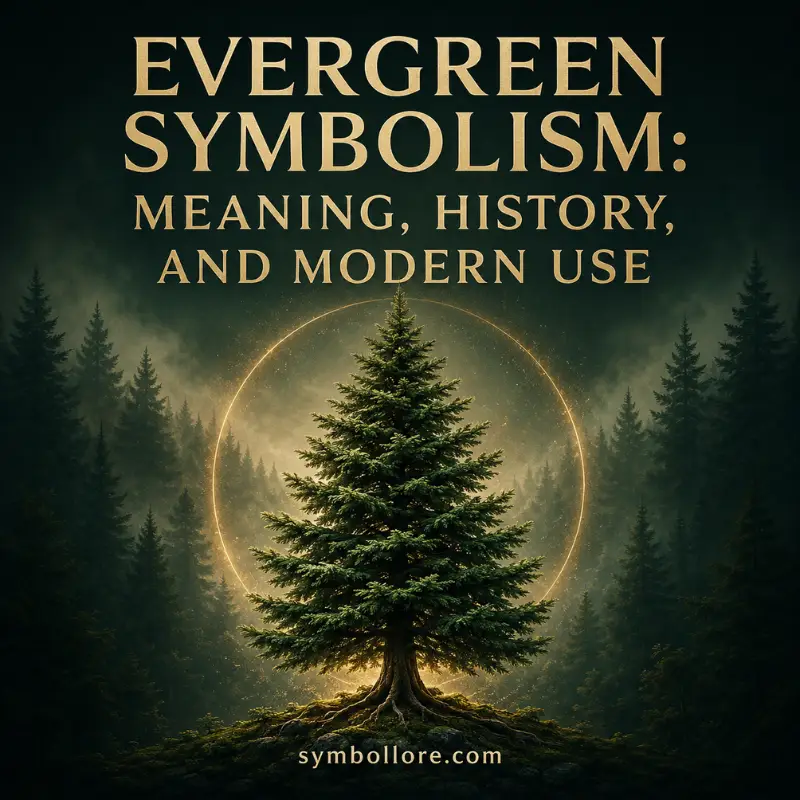
The evergreen primarily symbolizes something valuable that continues when conditions become difficult. Its green color remains visible during seasons associated with cold, scarcity, darkness, and dormancy. As a result, people read the plant as a sign that life has not disappeared.
That visual contrast supports several related meanings:
- Endurance: remaining alive through severe conditions
- Hope: trusting that warmth and growth will return
- Continuity: maintaining identity through change
- Constancy: staying faithful or dependable
- Renewal: anticipating a new growing season
- Eternal life: extending persistence into a religious idea of life beyond death
These ideas overlap, but they are not identical. Endurance concerns surviving a present hardship. Hope looks toward what comes next. Eternal life is a theological or spiritual interpretation, not a botanical fact.
Why Evergreens Came to Represent Life
Evergreen plants seem constant because their foliage does not fall all at once. However, “evergreen” does not mean that every leaf or needle lasts forever. These plants replace foliage gradually, so the crown remains green while older needles eventually fall.
The U.S. Forest Service notes that needle retention varies widely by species. A ponderosa pine may retain needles for four or five years, while some high-elevation pines keep theirs for decades. This gradual replacement explains the appearance of uninterrupted life without turning the plant into a literal symbol of immortality.
The Forest Service’s high-elevation white-pine research
documents these striking differences.
This physical quality is the symbol’s foundation. In a snowy or dormant landscape, visible green foliage supplies a powerful contrast. People then translate that contrast into emotional, religious, and cultural language.
How the Symbol Developed Through History
Evergreen meanings developed in multiple places rather than moving through one neat historical chain. Communities living with strongly marked winters could observe the same natural feature and assign it similar meanings without sharing a single origin.
Winter greenery appeared in several European seasonal customs before the modern Christmas tree. Plants could decorate homes, mark festivals, or express expectations for returning warmth and fertility. Yet a branch used during an older midwinter celebration was not automatically a Christmas tree in its present form.
Evidence for decorated indoor trees becomes clearer in German-speaking Europe during the late medieval and early modern periods. These customs later spread and changed. The familiar family Christmas tree became especially fashionable in the English-speaking world during the nineteenth century.
Therefore, “evergreens existed in pre-Christian winter customs” is reasonable. “The modern Christmas tree is simply an unchanged pagan ritual” is not. Similar materials can be reused, reinterpreted, and combined with newer practices.
Evergreen Symbolism in Christianity and Christmas
In Christian interpretation, evergreen foliage often represents eternal life through Jesus Christ. Its persistent color may also suggest God’s unchanging nature, enduring faith, or hope during spiritual darkness. Lights placed on a Christmas tree can add another layer by representing Christ as light.
The tree itself does not have one official biblical definition. Scripture includes important tree and eternal-life imagery, but it does not prescribe the modern decorated Christmas tree. Its Christian meaning developed through custom, teaching, art, and household practice.
In the United States, the tree also functions as a broad seasonal symbol. Some families understand it devotionally, while others associate it with gifts, childhood, hospitality, or shared tradition. Public displays may therefore be cultural or secular even when the object retains Christian associations for individual viewers.
This mixed meaning helps explain the symbol’s durability. Americans can recognize the same tree while assigning it different degrees of religious significance.
Indigenous Meanings Require Specific Attribution
There is no single Indigenous American meaning for an evergreen tree. Hundreds of distinct Native nations have their own languages, environments, histories, and ceremonial practices. Claims such as “Native Americans believed pine meant wisdom” erase those differences unless a specific people and source are identified.
One well-documented example is the eastern white pine in Haudenosaunee tradition. The Tree of Peace represents the peace and unity associated with the Haudenosaunee Confederacy. Its cultural meaning is much more specific than a general association with endurance.
A U.S. Forest Service research paper explains the white pine’s relationship to the Great Peace and the Tree of Light in Haudenosaunee cosmology.
The Forest Service account of the symbolic white pine
provides historical and cultural context.
When discussing cedar, pine, or another sacred plant, name the relevant nation whenever reliable evidence allows it. Respect also means recognizing that not every ceremonial teaching belongs in a general symbolism guide.
Pine, Fir, Spruce, Cedar, Holly, and Yew
Different evergreen plants can emphasize different ideas, although no species has one fixed meaning everywhere.
Pine
Pine commonly suggests longevity, resilience, independence, or peace. Its ability to grow in exposed or difficult places strengthens the modern association with personal endurance. The eastern white pine has the separate, culturally specific Haudenosaunee meaning discussed above.
Fir and spruce
Fir and spruce are strongly tied to Christmas in the United States. Consequently, they can evoke family continuity, celebration, warmth, childhood memory, and seasonal hope. Their conical shape and dense branches also make them familiar visual shorthand for forests and mountains.
Cedar
“Cedar” can refer to several botanically different trees. Its aromatic wood and long history of practical or ceremonial use contribute to associations with protection, purification, strength, and sacred space. Any specific religious claim needs cultural attribution.
Holly
Holly pairs green leaves with bright red berries, giving it an especially festive appearance. Christian readings may connect its sharp leaves and red berries with Christ’s suffering, while broader seasonal use emphasizes protection, life, and good cheer.
Yew
Because yews are long-lived and often appear in European churchyards, they can signify death, mourning, resurrection, and eternal life. That combination makes the yew more solemn than a decorated fir, even though both remain green.
Death, Grief, and Memorial Meaning
In mourning, an evergreen usually represents memory or love that continues after a death. Its living color does not deny loss. Instead, it places endurance beside grief and expresses the hope that a person’s influence, relationship, or spiritual life persists.
Evergreen wreaths work especially well in memorial settings because the material and shape reinforce one another. The greenery suggests continuing life, while the unbroken circle can express eternity or an enduring bond. Historically, wreaths have also conveyed honor and victory, so a memorial wreath may carry several meanings at once.
A living tree planted for someone can add growth and stewardship to the message. However, species, climate, and mature size matter. A memorial becomes more responsible when the chosen tree suits the site rather than serving only as a symbolic gesture.
Modern Uses of Evergreen Symbolism in American Life
Americans now use the evergreen far beyond formal religious practice. Its meaning changes with the object, occasion, and audience.
- Tattoos: Pine forests and solitary trees can represent survival, independence, home, wilderness, or personal stability.
- Weddings: Evergreen garlands may suggest enduring commitment, especially at winter ceremonies.
- Gifts: Small trees, wreaths, and planted conifers can communicate lasting friendship or remembrance.
- Branding: Outdoor companies use evergreen forms to imply nature, durability, freshness, or environmental responsibility.
- Landscape design: Year-round foliage provides privacy and visual steadiness, which can support feelings of shelter and permanence.
- Holiday décor: Greenery can carry Christian meaning, secular nostalgia, family tradition, or simple seasonal beauty.
Color also contributes to the effect. Deep green often feels calm, grounded, and dependable. However, branding or decoration alone does not prove that a maker intended a spiritual message.
How to Interpret an Evergreen Symbol
Interpret the symbol by moving from evidence to context instead of choosing a meaning from a generic list.
- Identify the plant or form. A cemetery yew, Christmas fir, pine tattoo, and holly wreath invite different readings.
- Notice the setting. A church, wedding, memorial, winter advertisement, and civic emblem shape meaning.
- Consider the creator. Religious identity, cultural background, and stated intent matter more than an online definition.
- Look at nearby symbols. Candles, snow, birds, names, dates, circles, crosses, or ornaments narrow the possibilities.
- Separate shared meaning from specific tradition. Endurance may be broadly understandable, while a Tree of Peace belongs to a named culture.
- Allow more than one meaning. A Christmas tree can represent faith, family memory, and seasonal joy at the same time.
For a personal tattoo or gift, the recipient’s explanation should take priority. Traditional associations can enrich that meaning, but they should not overwrite it.
Common Misconceptions About Evergreen Meaning
The first misconception is that evergreens never shed leaves. They do shed foliage; they simply replace it gradually. The symbol comes from continuous visible greenery, not biological immortality.
A second mistake is treating every evergreen as a pine. Pine, spruce, fir, cedar, yew, and broadleaf evergreens differ botanically and culturally. Their meanings can overlap without becoming identical.
A third misconception claims that Christmas trees are either wholly pagan or wholly Christian. Historical customs usually develop through adaptation, exchange, and reinterpretation. Pre-Christian winter greenery and later Christian trees belong to a connected history, but they are not one unchanged practice.
Finally, symbolic meaning is not a supernatural rule. Seeing an evergreen after a loss may feel deeply significant, but it does not provide objective proof of a message or omen. Symbolism helps people express and organize meaning; it does not predict events.
FAQs
An evergreen tree commonly symbolizes the soul’s endurance, spiritual constancy, hope, or eternal life. The exact interpretation depends on the religion or personal practice involved. Christianity, modern nature spirituality, and family memorial traditions may use similar imagery while understanding it differently.
Evergreens symbolize immortality because they remain visibly green when many surrounding plants lose their leaves or become dormant. People extended that appearance of continuous life into a spiritual metaphor. The trees are not literally immortal, and their individual needles or leaves eventually fall.
No. Evergreens carried seasonal, ceremonial, and cultural meanings before the modern Christmas tree developed. They also appear in memorials, weddings, civic traditions, tattoos, Indigenous teachings, landscape design, and art. Christmas is now their most familiar American context, but it is not the only one.
An evergreen wreath often represents enduring life, hope, welcome, remembrance, or faith. Its circular form can add the idea of eternity because it has no visible beginning or end. At Christmas it may feel celebratory, while at a funeral it conveys honor and continuing memory.
A pine tree can symbolize strength, especially resilience under harsh weather or difficult growing conditions. In tattoos and modern artwork, it may also express independence, longevity, or connection to wilderness. These are common associations rather than fixed meanings shared by every culture.
Evergreen plants appeared in some pre-Christian seasonal customs, but calling them simply “a pagan symbol” is too broad. Different communities used greenery for different reasons. Christian Europeans later gave evergreen trees additional meanings, and modern American use can be Christian, secular, personal, or mixed.
An evergreen gift can communicate lasting friendship, loyalty, hope, remembrance, or wishes for a long life. Occasion and species refine the message. A holiday wreath feels festive, while a memorial tree emphasizes continuing love and the responsibility of caring for something living.
Conclusion
Evergreen symbolism begins with an unmistakable natural image: green life continuing through winter. That image supports enduring associations with hope, resilience, constancy, remembrance, and eternal life.
Still, context remains essential. A Christmas fir, memorial wreath, pine tattoo, cemetery yew, and Haudenosaunee Tree of Peace do not carry identical histories. The most respectful interpretation starts with the specific plant, setting, culture, and creator. In that context, the evergreen becomes more than a general emblem of survival; it shows how people find continuity without denying change.