

Dead grasshopper symbolism usually centers on an ending, interrupted momentum, or the need to reconsider your next move. Because a living grasshopper is often associated with energetic leaps and opportunity, its death can reverse that image. It may suggest stillness after movement or the close of an active period.
However, finding one does not predict death, illness, or misfortune. Symbolic meaning depends on your beliefs, circumstances, and emotional response. In many cases, the insect simply died because of age, injury, pesticide exposure, cold weather, or another natural cause.
Quick Answer
Dead grasshopper symbolism commonly represents the end of a cycle, lost momentum, a missed chance, or a pause before choosing a new direction. Some people also read it as a reminder of impermanence and renewal. It is not reliable evidence of bad luck, illness, death, or any specific future event.
Key Takeaways
- A dead grasshopper often represents endings, stillness, or interrupted progress.
- It does not predict tragedy or guarantee bad luck.
- Dreams and physical encounters require different interpretations.
- Location, timing, and emotion can change the personal meaning.
- Seasonal death provides a common biological explanation.
- Symbolism works best as reflection, not fortune-telling.
Dead Grasshopper Meanings at a Glance
| Context | Possible Symbolic Meaning | Grounded Interpretation |
|---|---|---|
| On a path | Interrupted movement or changed direction | Reconsider a plan before proceeding |
| Near a doorway | Transition or a completed chapter | Reflect on what you are leaving behind |
| Inside the house | Stalled energy in private life | Notice an unresolved personal concern |
| In a garden | End of growth or seasonal change | Consider both nature and personal renewal |
| After making a decision | Doubt or fear of a missed chance | Review the decision without assuming failure |
| In a dream | Regret, exhaustion, or fading ambition | Examine the dream’s emotion and storyline |
| After cold weather | Natural seasonal death | No symbolic explanation is required |
The Core Meaning of Dead Grasshopper Symbolism
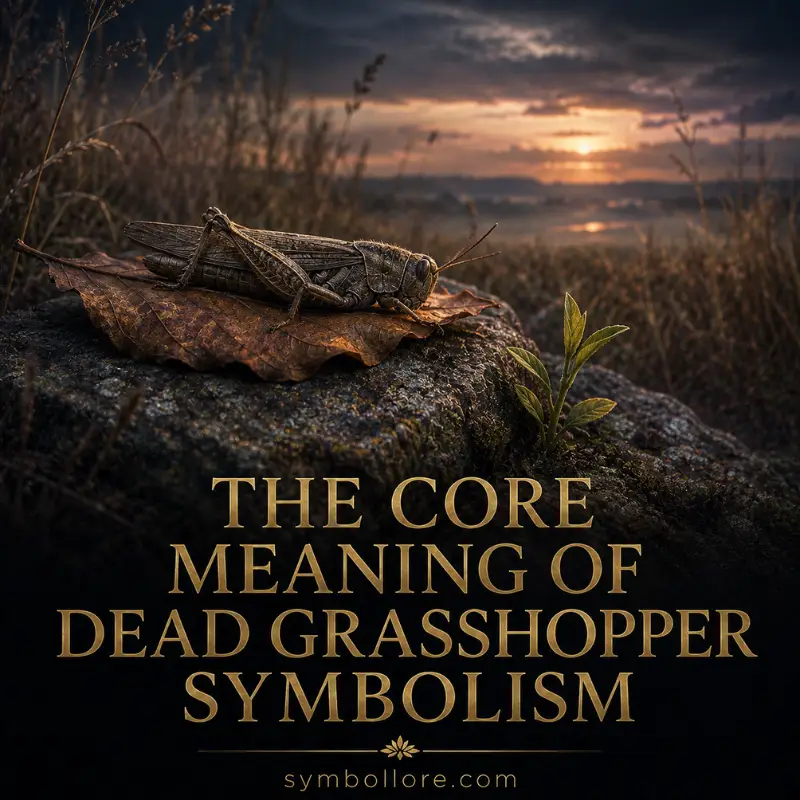
The central meaning comes from contrast. A living grasshopper has powerful hind legs, moves suddenly, and escapes danger through energetic leaps. People therefore connect it with progress, freedom, courage, opportunity, and a leap of faith.
A dead grasshopper removes that motion. Symbolically, the contrast can represent stalled progress, a completed journey, depleted energy, or an opportunity that no longer feels available. It may also suggest that impulsive movement has ended and a more deliberate approach is needed.
Death symbols do not always carry a negative message. An ending can create room for rest, acceptance, or renewal. Therefore, the insect may represent the completion of one phase rather than permanent failure.
Is a Dead Grasshopper a Bad Omen?
A dead grasshopper is not proven to be a bad omen. No scientific evidence connects such an encounter with future illness, financial loss, death, or another misfortune. Claims that it guarantees tragedy belong to superstition, not established fact.
Some modern spiritual websites associate injured or dead insects with bad luck. Other sources give the opposite reading, describing the encounter as a call to honor life, release the past, or accept change. These contradictions show that there is no universal interpretation.
If the sight makes you uneasy, treat that feeling as information about your current concerns. It may reveal anxiety about a decision or transition. It does not reveal the future.
Spiritual Meaning of a Dead Grasshopper
Spiritually, a dead grasshopper may represent the close of an energetic cycle. You might connect it with a goal that has lost its purpose, a habit you have outgrown, or a direction that no longer supports you.
Another possible reading involves impermanence. Even a creature known for quick, powerful movement eventually becomes still. The encounter can therefore serve as a modest reminder that energy, opportunities, and circumstances change.
This interpretation does not require belief in a supernatural messenger. A natural event can become personally meaningful because it causes reflection. The value lies in the honest question it raises, not in proving that the universe sent a coded message.
What the Location May Suggest
Location can shape the metaphor, although it cannot establish a fixed supernatural meaning.
A dead grasshopper on a path may mirror a delay or change in direction. Before treating it as a warning, ask whether you were already uncertain about a project, move, relationship, or decision.
Near a door, the insect may bring transitions to mind. Doorways naturally mark movement between spaces, so the combination can suggest finishing one chapter before entering another.
Inside a home, it may direct your attention toward private life, rest, or unresolved tension. Still, an open door, window, plant, pet, or small crack offers a more immediate explanation for how it arrived.
In a yard or garden, the sight often reflects the ordinary cycle of growth and decline. That natural setting can support a meaning based on acceptance rather than fear.
Dead Grasshopper Dream Meaning
A dead grasshopper in a dream often symbolizes stalled motivation, regret, exhaustion, or a missed opportunity. Because dreams combine memories, emotions, and recent experiences, your reaction matters more than a universal dream dictionary.
Feeling sad may point toward disappointment over something that ended. Relief could suggest freedom from pressure or an impulsive phase. Fear may reflect anxiety about losing momentum, while calmness can indicate acceptance.
Also examine what happened before and after the insect appeared. A dead grasshopper beside a closed door creates a different emotional story from one lying near new plants. Use the full dream narrative rather than isolating one symbol and treating it as a prediction.
Biblical Meaning and the Grasshopper–Locust Distinction
The Bible does not say that finding a dead grasshopper predicts a personal event. Biblical passages use grasshoppers and locusts in several different ways, so no single interpretation covers every reference.
In Isaiah 40:22,
Other passages connect grasshoppers or locusts with crop destruction.
describes crops being given to destructive insects. Meanwhile, Leviticus 11:22 includes certain locusts, crickets, and grasshoppers among permitted foods. These varied uses show why readers should not turn one insect encounter into a biblical prophecy.
A locust is a grasshopper capable of entering a swarming phase under particular conditions. Biblical swarm imagery therefore concerns collective destruction and agricultural loss, not necessarily a single insect found near a home.
Cultural, Historical, and Literary Associations
Grasshopper meanings change across time and place. They have represented luck, ancestry, abundance, music, careless behavior, agricultural destruction, and human smallness. These associations should not be compressed into claims that an entire culture believes one thing.
In ancient Athens, grasshopper ornaments became associated with claims of native Athenian ancestry. Grasshoppers also appear in visual art across several periods. The Metropolitan Museum of Art, for example, holds a Japanese
sword guard decorated with insects and autumn flowers.
In that object, the insect belongs to a seasonal artistic scene rather than a fixed omen.
Western readers may also know the insect from “The Ant and the Grasshopper.” The fable contrasts preparation with carefree living. Through that literary lens, a dead grasshopper might suggest the consequences of poor planning. That is a story-based interpretation, however, not a universal spiritual rule.
Natural Reasons You May Find a Dead Grasshopper
Many sightings have a straightforward biological explanation. Grasshoppers pass through egg, nymph, and adult stages.
According to Utah State University Extension,
most species in Utah produce one generation each year, with eggs commonly surviving winter in the soil.
Adults of many species die toward the end of summer or in fall.
Colorado State University Extension
explains that species overwintering as eggs die out in late summer and early fall. Freezing temperatures can also kill adults.
Other common causes include predators, parasites, disease, dehydration, physical injury, pesticide exposure, and simple old age. If several dead insects appear together, investigate environmental causes before assuming a spiritual pattern.
How to Interpret the Encounter Without Fear
A useful interpretation begins with context rather than a preset meaning.
- Check the natural explanation. Consider the season, recent frost, pest treatment, windows, pets, and nearby plants.
- Name your first emotion. Fear, sadness, curiosity, disgust, and relief point toward different personal concerns.
- Identify your current transition. Ask whether a plan, opportunity, habit, or relationship recently ended or slowed.
- Choose a constructive meaning. Use the encounter to pause, review your direction, or release something completed.
Do not make medical, financial, or relationship decisions because of an insect omen. Instead, rely on evidence, honest communication, and qualified professional advice where appropriate.
What Should You Do With a Dead Grasshopper?
You can remove the insect respectfully without performing a ritual. Use a tissue, paper, or gloves if you prefer not to touch it directly. Place it outdoors, bury it in a suitable area, or dispose of it according to local household practices.
Wash your hands afterward, especially if the insect was found near food. Keep pets from eating it because pesticide exposure or contamination may be unknown.
If many grasshoppers suddenly die in one location, inspect the area for chemicals, extreme weather, or other environmental changes. A large cluster is more likely to need practical investigation than symbolic interpretation.
FAQs
It can symbolize a completed cycle, interrupted progress, lost energy, or the need to reconsider your direction. Some people also view it as a reminder to release the past. These are reflective interpretations, not verified supernatural messages.
No reliable evidence shows that it predicts bad luck. Although some superstitions give it a negative meaning, other interpretations connect it with acceptance, renewal, or the end of difficulty. The encounter itself cannot forecast future events.
A doorway can symbolically represent transition, so the combination may suggest closing one chapter before beginning another. However, outdoor lights, gaps, weather, plants, and ordinary insect movement can explain why it appeared there.
The dream may reflect stalled motivation, regret, exhaustion, or acceptance of an ending. Consider your emotions and the surrounding dream events. A dream image is better understood as part of your personal mental landscape than as a prophecy.
The Bible contains grasshopper and locust imagery, but it does not teach that finding one dead grasshopper predicts a personal event. Scriptural meanings vary by passage and include human smallness, permitted food, agricultural damage, and divine judgment.
Yes. It may represent release, rest, closure, maturity, or the end of a difficult phase. A positive interpretation does not deny loss; instead, it recognizes that endings can create room for a more deliberate beginning.
Seasonal aging, frost, heat, pesticide exposure, predators, dehydration, and accidental entry are common explanations. Check recent weather and pest-control use. If numerous insects are dying, inspect the environment rather than assuming the cause is spiritual.
Conclusion
Dead grasshopper symbolism most often points toward an ending, interrupted momentum, reflection, or a change in direction. It can also represent acceptance and the space that appears after an active phase closes.
Still, the insect is not a dependable warning of death, disease, or bad fortune. Consider the season and physical setting first. If the encounter feels meaningful, use it as a prompt to review your energy, choices, and unfinished concerns—without allowing superstition to replace evidence or sound judgment.


