Day of the Dead symbolism expresses remembrance, hospitality, family continuity, and acceptance of death as part of life. During Día de los Muertos, families honor deceased loved ones with ofrendas, photographs, flowers, candles, food, and meaningful belongings.
These elements are not simply colorful decorations. Each helps identify, welcome, nourish, or remember the dead. However, their meanings are not identical in every household. Customs vary across Mexico, Indigenous communities, regions, religious traditions, and Mexican American families in the United States.
Quick Answer
Day of the Dead symbolism centers on maintaining a loving connection between the living and the dead. Ofrendas hold photographs and personal offerings, while marigolds, candles, incense, food, and water symbolically welcome returning souls. Skulls and skeletons present mortality with humor and affection rather than treating death only as something frightening.
Key Takeaways
- Ofrendas preserve memories through photographs, food, flowers, and personal belongings.
- Marigolds, candles, and incense symbolically guide and welcome returning souls.
- Colorful skulls present death as familiar, shared, and inseparable from life.
- La Catrina combines political satire, mortality, art, and Mexican cultural identity.
- Customs differ across families, regions, communities, and religious traditions.
- Día de los Muertos is distinct from Halloween in purpose and practice.
Day of the Dead Symbols at a Glance
| Symbol or Element | Common Meaning | Role in the Observance | Important Distinction |
|---|---|---|---|
| Ofrenda | Remembrance and welcome | Creates a dedicated place for the honored dead | It means “offering,” though the altar itself is often called an ofrenda |
| Photograph | Identity and memory | Shows whom the altar honors | Not every community follows identical placement rules |
| Cempasúchil | Guidance, warmth, and connection | Its petals, color, and fragrance mark a symbolic path | Meanings can vary by region |
| Candles | Light, faith, and guidance | Illuminate the altar and the imagined route home | Religious interpretations differ |
| Calaveras | Mortality and the sweetness of life | Decorate altars and represent the deceased | They are not simply horror props |
| Pan de muerto | Hospitality and shared remembrance | Serves as an offering and food for the living | Recipes and shapes vary |
| Papel picado | Air, fragility, and celebration | Adds movement and color to the display | “Wind” is one common altar interpretation |
| Personal objects | Individual identity and affection | Recall the person’s interests or daily life | Personal meaning may outweigh standardized symbolism |
What Day of the Dead Symbolism Represents
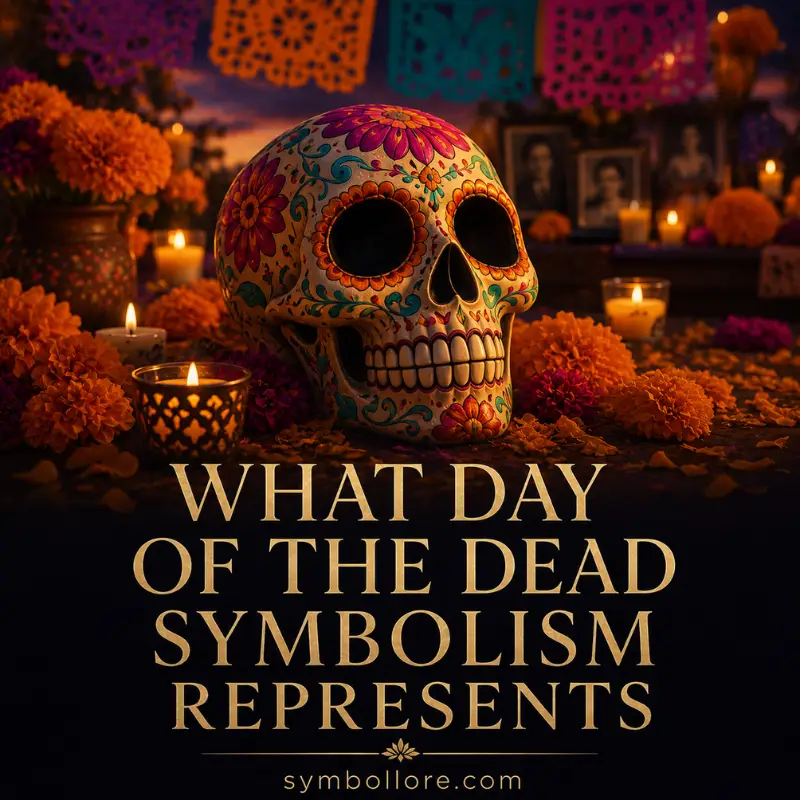
The central meaning is an ongoing relationship built through memory. Día de los Muertos does not suggest that grief disappears. Instead, it gives families a communal way to remember people through their photographs, stories, favorite foods, music, and belongings.
The holiday also brings life and death into the same symbolic space. Flowers bloom beside skulls. Sweet bread appears beside memorial photographs. Joyful skeletons dance, work, marry, play instruments, or share meals. These contrasts show that love, humor, sorrow, and mortality can exist together.
UNESCO describes the observance as commemorating the temporary return of deceased relatives and loved ones. Its account also stresses that practices differ among Mexico’s Indigenous communities.
This UNESCO cultural heritage description
matters because it presents the tradition as a living cultural practice, not a fixed collection of decorative motifs.
The Ofrenda as a Map of Memory
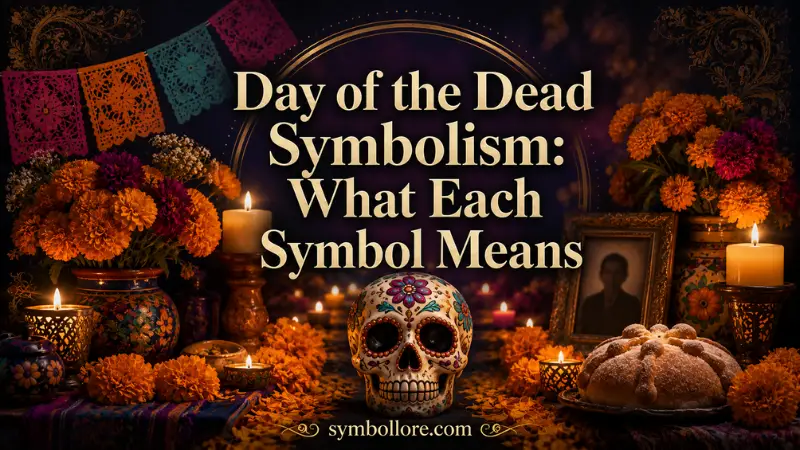
An ofrenda organizes memory through identity, welcome, guidance, hospitality, and affection. Reading it by function makes its symbolism easier to understand.
A photograph or name identifies the person being honored. Marigold petals, candlelight, and incense may mark or purify a symbolic path. Water addresses thirst, while bread and favorite dishes extend hospitality. Personal belongings restore details that death cannot erase: a book, musical instrument, toy, hat, recipe, or familiar drink can recall a distinct personality.
The National Museum of the American Latino’s altar guide
explains a common association with four elements. Water appears as a drink, candles represent fire, food represents earth, and moving papel picado represents wind. This is a helpful framework, but it should not be treated as the only correct altar design.
Marigolds, Candles, and Copal as Guides
Marigolds, candles, and copal engage sight, smell, and movement. Together, they turn the ofrenda into a symbolic place of arrival rather than a static display.
Cempasúchil, commonly identified in English as the Mexican marigold, has a strong fragrance and vivid yellow-orange color. Families may arrange the flowers on an altar, place them on graves, or scatter petals to form a path. In traditional explanations, their color and scent help guide visiting souls.
Candles provide another path through light. Depending on the household, they may also express prayer, faith, hope, or remembrance. Copal resin adds fragrant smoke and may carry ideas of purification, transformation, or communication with the sacred.
These meanings should be described as beliefs and cultural interpretations, not measurable claims about spirits. Their power comes from ritual, family memory, and the sensory experience they create.
Sugar Skulls, Calacas, and the Cycle of Life
Colorful skulls and lively skeletons make mortality visible without presenting it only through terror. A calavera is a skull, while a calaca commonly refers to a skeleton figure associated with Mexican popular art.
Sugar skulls may appear on altars or be given as decorative sweets. Some bear a person’s name on the forehead. Their sweetness, bright icing, and flowers contrast with the skull’s reminder of death. That contrast expresses a key idea: death is serious, but remembrance can remain affectionate, colorful, and full of personality.
Skeleton figures often behave like living people. They dance, eat, work, perform music, or wear elegant clothing. Their ordinary activities reduce the distance between the living and dead. They also remind viewers that mortality crosses divisions of wealth, occupation, status, and age.
La Catrina: From Social Satire to Cultural Icon
La Catrina began as social satire before becoming one of the most recognizable Day of the Dead figures. Mexican printmaker José Guadalupe Posada created an elegantly dressed skeletal woman commonly connected with his Calavera Garbancera. The figure mocked social pretension and people who rejected their Indigenous identity while imitating European fashion.
Diego Rivera later depicted the skeleton in an elaborate dress and feathered hat in his mural Dream of a Sunday Afternoon in Alameda Central. The name La Catrina became closely associated with this refined appearance.
The figure now carries several overlapping meanings. She can represent the equality of all people before death, Mexican artistic identity, humor about mortality, social criticism, and remembrance. Elaborate Catrina makeup may celebrate cultural heritage, but its historical meaning reaches beyond the appearance of a decorative skull face.
Food, Water, Salt, and Personal Offerings
Food and drink express welcome because the dead are remembered as family members and guests. Families may prepare mole, tamales, fruit, chocolate, atole, pan de muerto, or whatever the honored person enjoyed.
Pan de muerto is a sweet seasonal bread with recipes and shapes that differ across Mexico. Its raised decorations are often interpreted as bones, although regional designs carry their own histories. Water commonly symbolizes refreshment after the soul’s journey. Salt may signify purification or preservation in some altar traditions.
The most revealing offerings are often the least standardized. A cup of coffee, favorite candy, cigarette, toy, photograph, tool, or piece of clothing can say more about one person than a general symbol chart could. These objects turn the ofrenda from a cultural display into an intimate portrait.
Papel Picado, Colors, and Temporary Beauty
Papel picado brings movement, delicacy, and public celebration to the observance. Artisans cut detailed patterns into thin sheets of colored tissue paper, often creating flowers, birds, words, or skeleton scenes.
Because the paper moves easily, some altar guides connect it with wind. Its fragile material can also suggest life’s temporary nature, although this interpretation is not a universal doctrine. Like sand carpets, flowers, food, smoke, and candles, it changes or disappears. The temporary artwork suits a celebration centered on presence, absence, and return.
Online color charts often assign one fixed meaning to every shade. Purple may reflect mourning or Catholic observance, while orange and yellow are strongly associated with cempasúchil. However, families also choose colors for beauty, local custom, artistic balance, or personal preference. Context is more reliable than a rigid color dictionary.
Indigenous and Catholic Influences
Día de los Muertos developed through long cultural interaction rather than one unchanged ancient ceremony. Indigenous peoples in Mesoamerica maintained varied beliefs and rituals concerning ancestors, death, seasonal cycles, and offerings. Spanish colonization introduced Roman Catholic observances, especially All Saints’ Day and All Souls’ Day.
Over time, communities adapted, combined, preserved, and reinterpreted practices. Therefore, calling the holiday either entirely Aztec or simply Catholic misses its historical complexity. Mexico also contains many Indigenous nations and regional traditions, so no single origin story explains every present-day observance.
The holiday’s current dates, November 1 and 2, reflect the Catholic calendar. Yet its forms of ancestor remembrance, food offerings, flowers, cemetery vigils, and community participation also carry local and Indigenous histories. The result is not a frozen relic but an evolving Mexican tradition.
Day of the Dead Versus Halloween
Día de los Muertos and Halloween may share skull imagery and nearby calendar dates, but their central purposes differ. Halloween commonly emphasizes costumes, fright, fantasy, entertainment, and trick-or-treating. Day of the Dead focuses on remembering and welcoming deceased loved ones.
The distinction matters because removing skull art from its memorial setting can erase its purpose. A calavera on an altar relates to identity, mortality, affection, and family continuity. The same design sold as a generic spooky decoration may lose that context.
The holidays can still influence each other, especially in the United States and northern Mexico. Traditions change through contact, migration, media, and commerce. However, visual overlap does not make them interchangeable.
Rutgers University’s explanation of the symbolism
highlights this difference by connecting colorful skulls with departed souls and the circle of life rather than Halloween horror.
Day of the Dead Symbolism in the United States
In the United States, the tradition can express remembrance, Mexican heritage, community identity, art, education, and public mourning. Mexican American families have maintained private practices, while cultural organizations, museums, schools, and cities also organize public altars and festivals.
Public observances expanded notably through Chicano arts and civil-rights communities in California during the 1970s. Artists used altars, prints, processions, and performances to honor personal losses while affirming cultural identity. Today, ofrendas may commemorate relatives, community leaders, victims of violence, migrants, or people connected by a shared cause.
This broader use does not eliminate the holiday’s Mexican roots. Instead, it shows how a living tradition can adapt across generations and borders. Respectful adaptation preserves remembrance at the center rather than reducing the observance to merchandise or face paint.
How to Engage With the Symbols Respectfully
Respect begins with understanding that these symbols belong to a memorial tradition. Participation should center the person or community being honored.
- Learn the meaning of an object before using it.
- Credit the holiday’s Mexican and Indigenous cultural roots.
- Follow the guidance of hosts at community events.
- Ask before photographing a private altar, grave, or grieving family.
- Never touch, move, or eat an offering without permission.
- Avoid treating Catrina makeup as a generic frightening costume.
- Use personal objects only when they honor someone truthfully.
- Do not claim that one altar layout represents every Mexican family.
Schools and workplaces can invite cultural educators or Mexican community organizations to guide programs. An altar should have a clear memorial purpose. If no person or community is being honored, an educational display should explain its context instead of imitating a sacred or intimate arrangement without meaning.
FAQs
The ofrenda is the most important unifying symbol because it brings photographs, flowers, candles, food, and personal memories together. Sugar skulls and La Catrina may be more visually recognizable, but the altar most clearly expresses the holiday’s purpose of honoring and welcoming deceased loved ones.
Cempasúchil flowers are traditionally valued for their vivid color and strong fragrance. Their petals may form a path between a grave, doorway, and altar because they are believed to help guide returning souls. They also give memorial spaces warmth, beauty, and a distinct seasonal identity.
Sugar skulls represent mortality, departed people, and the continuing connection between death and life. Their bright decoration and sweetness keep the imagery from being purely frightening. A name written on a skull may identify the deceased person being honored or playfully acknowledge a living recipient.
La Catrina can symbolize mortality, equality before death, social satire, Mexican identity, and artistic celebration. Her roots lie in José Guadalupe Posada’s criticism of social pretension. Later art transformed the elegant female skeleton into a widely recognized Day of the Dead icon.
Day of the Dead includes religious elements, but practices vary. The modern observance reflects Indigenous traditions, Catholic dates and imagery, local customs, and family beliefs. Some participants understand returning souls literally, while others focus on memory, heritage, community, or symbolic connection.
Non-Mexican people can participate respectfully when they understand the tradition, follow community guidance, and keep remembrance at the center. Attending an open event or creating a sincere memorial differs from using sacred or personal imagery as an exotic costume, party theme, or unexplained decoration.
No. Some elaborate altars use two, three, or seven levels with particular symbolic interpretations, but there is no single required design for every household or region. A simple arrangement with a photograph, candle, flowers, water, and meaningful offerings can still serve its memorial purpose.
Conclusion
Day of the Dead symbolism turns memory into something families can see, smell, taste, hear, and share. Photographs identify the loved one, while flowers and candlelight offer guidance. Food extends hospitality, and playful skeletons place death within the continuing rhythm of life.
No single chart can define every object or color. Meanings change across regions, communities, religions, and families. The most reliable interpretation begins with the person being remembered and the relationships expressed through the ofrenda.