
Cecropia moth symbolism centers on transformation, purposeful living, intuition, and the brief beauty of life. These interpretations come largely from the insect’s dramatic metamorphosis, nocturnal behavior, imposing wings, and unusually short adult stage.
The cecropia moth is a real North American species, Hyalophora cecropia, rather than a figure with one fixed spiritual definition. Therefore, its meaning depends on the encounter, the observer, and the cultural setting. Understanding its natural history helps separate thoughtful symbolism from unsupported claims about omens or predictions.
Quick Answer
Cecropia moth symbolism most often represents profound transformation, renewal, focused purpose, and appreciation for life’s temporary beauty. Its cocoon suggests hidden development, while its brief adult life encourages decisive action. A sighting can inspire personal reflection, but it does not predict a specific event or carry one universally accepted spiritual message.
Key Takeaways
- Metamorphosis makes the cecropia moth a natural symbol of personal change.
- Its short adult life represents purpose, urgency, and impermanence.
- Nocturnal behavior inspires associations with intuition and hidden knowledge.
- Bold wings can symbolize confidence, protection, and self-expression.
- A sighting has personal meaning, not a guaranteed supernatural message.
- Respecting the living insect gives the encounter practical value.
Cecropia Moth Meanings at a Glance
| Natural Feature | Common Symbolic Meaning | Practical Interpretation |
|---|---|---|
| Complete metamorphosis | Transformation and renewal | Accept growth that changes your identity |
| Protective cocoon | Rest and inner development | Allow important work to happen privately |
| Short adult stage | Purpose and impermanence | Give attention to what matters now |
| Nocturnal activity | Intuition and mystery | Move carefully when answers remain unclear |
| Large wings | Confidence and freedom | Take up space without unnecessary apology |
| Eyespots and markings | Protection and awareness | Use clear boundaries and stay alert |
| Red, white, and dark colors | Vitality, balance, and depth | Accept contrasting parts of experience |
What Does Cecropia Moth Symbolism Mean?
The cecropia moth commonly represents a major change that develops quietly before becoming visible. Unlike a minor adjustment, its metamorphosis involves a complete shift in form. That striking process explains why people connect the moth with personal growth, reinvention, and new stages of life.
However, these meanings are interpretations rather than scientific facts. Biology can explain what the insect does, but it cannot prove that a moth arrived to deliver a supernatural message. A balanced reading treats the animal as a meaningful prompt for reflection.
Its impressive appearance adds another layer.
The National Wildlife Federation’s cecropia moth profile
identifies it as North America’s largest moth, with a wingspan of roughly five to seven inches. Such scale can inspire wonder, confidence, visibility, and respect for overlooked forms of life.
Transformation, Renewal, and Personal Growth
Transformation is the strongest meaning associated with this giant silk moth. It passes through egg, caterpillar, pupa, and adult stages. Each stage has a different form and task, making its complete metamorphosis a vivid model for change.
The caterpillar suggests preparation. During that period, it feeds and stores the energy that will support its later life. The cocoon then represents an inward phase in which progress remains hidden. Finally, emergence symbolizes a new identity becoming visible.
As a personal symbol, this sequence can fit graduation, recovery, parenthood, a career change, or the end of an old relationship. It also offers an important distinction: renewal does not always mean returning to a previous condition. Sometimes growth produces a different way of living.
The symbolism should not pressure someone to transform quickly. The cocoon stage suggests that rest, uncertainty, and private development can belong to meaningful progress.
Purpose and the Short Adult Life
A mature cecropia moth symbolizes focused purpose because its adult stage is brief and highly specialized. Adult giant silk moths have reduced, nonfunctional mouthparts. They live on energy stored during the caterpillar stage while seeking a mate and continuing the next generation.
This fact creates a modern association with clarity. The moth does not represent endless activity or constant productivity. Instead, it can remind a person to identify what deserves limited time and energy.
According to the University of Florida’s cecropia moth profile,
the female lays eggs on host plants, and the larvae later feed on several kinds of trees. Thus, the life cycle also suggests continuity: one stage prepares for another, and an individual life contributes to something beyond itself.
The lesson is not to rush through life. It is to act with intention while recognizing impermanence.
Intuition, Darkness, and the Search for Light
Because the cecropia moth is active at night, people often associate it with intuition, mystery, dreams, and movement through uncertainty. Darkness becomes a metaphor for any period when a person cannot see the entire path ahead.
In this interpretation, intuition does not mean ignoring evidence. It means noticing subtle feelings, patterns, or concerns while continuing to think carefully. The moth can symbolize the courage to move before every answer becomes available.
Its relationship with light requires nuance. Popular writing often says moths intentionally “follow the light” as a spiritual act. In reality, artificial lights can interfere with insect orientation. Researchers continue to study the mechanisms involved, and porch lights may disorient nocturnal insects.
Therefore, light symbolism works best as metaphor. It can represent truth, hope, knowledge, or a goal. It can also warn against pursuing an attractive idea without checking whether it is safe or worthwhile.
Beauty, Confidence, and Protective Boundaries
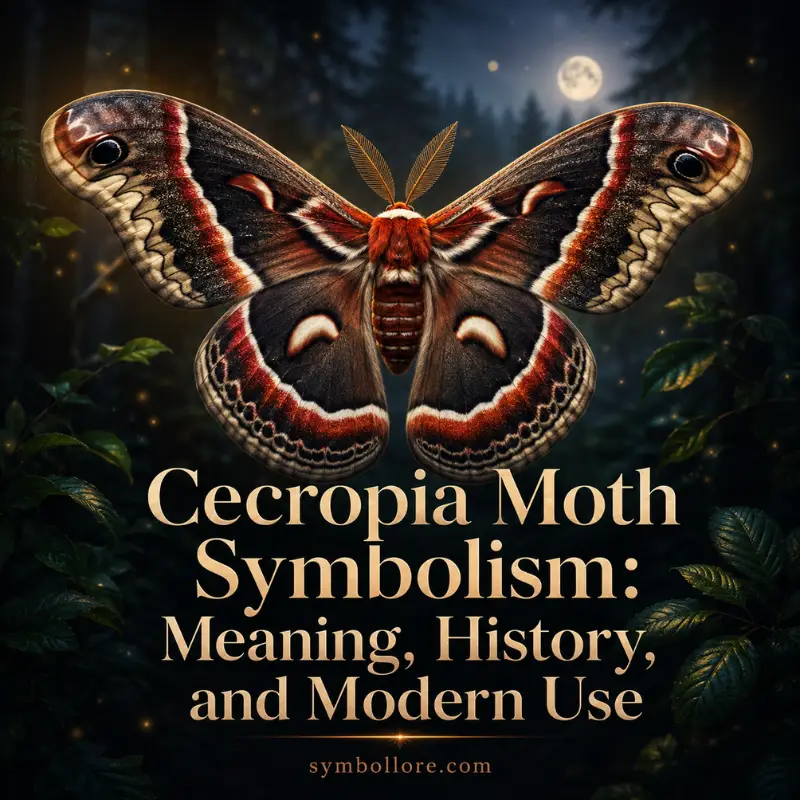
The cecropia moth’s bold appearance supports meanings of confidence, beauty, and self-expression. Adults have reddish bodies and dark wings crossed by white, tan, and red bands. Their scale and color make them difficult to overlook.
Yet their beauty also serves survival. Markings near the wing tips can resemble the head or eyes of a larger animal, potentially making a predator hesitate.
The National Park Service species spotlight
explains how this snake-like impression may help the moth escape.
Symbolically, those markings can represent protective boundaries. A person does not need to become aggressive to communicate strength. Clear limits, alertness, and confident presentation may prevent others from taking advantage.
The creature’s soft body and powerful visual display also join vulnerability with protection. That combination offers a useful lesson: sensitivity and strength can exist together.
Cultural and Historical Context
There is no well-established universal tradition assigning one ancient meaning specifically to the cecropia moth. Most online interpretations combine the insect’s biology with broader moth symbolism and modern spiritual reflection.
This distinction matters. Moths have carried different associations across places and periods, including the soul, mortality, decay, secrecy, renewal, and attraction to light. However, a general belief about moths should not automatically be labeled cecropia folklore.
Even the species’ name does not supply a complete spiritual meaning. “Cecropia” connects with Cecrops, the legendary first king of Athens. The association relates partly to the moth’s markings and their resemblance to a snake-like face. It does not prove that ancient Greeks used this North American species as a spiritual emblem.
A careful interpretation can still feel meaningful. It simply avoids presenting a recent idea as ancient fact or speaking for a culture without reliable evidence.
Meaning of Seeing a Cecropia Moth
Seeing a cecropia moth can serve as a reminder to notice change, use time deliberately, and appreciate an uncommon natural encounter. The meaning depends on what was happening in your life and which feature held your attention.
Consider three questions:
- What is changing? Identify a role, belief, habit, or relationship undergoing transition.
- What needs time? Decide whether the cocoon suggests patience instead of immediate action.
- What deserves focus? Use the short adult stage as a prompt to clarify priorities.
Location can influence the personal reading. A moth resting near a doorway may suggest transition because doors already carry that meaning for many people. A moth near a workplace might bring career change to mind. However, the animal’s presence can also have an ordinary cause, such as nearby host trees, seasonal emergence, or artificial light.
A sighting is not automatically good luck, bad luck, or a warning of death.
Cecropia Moth Dreams and Tattoos
A cecropia moth dream often reflects themes of change, hidden growth, vulnerability, or emerging confidence. The dreamer’s feelings provide more useful clues than a fixed dream dictionary. A calm encounter may suggest readiness, while a trapped or injured moth may express anxiety about change.
The surrounding action also matters. A cocoon may represent waiting or private development. Emergence can suggest a new identity, while flight may express freedom or the desire to move beyond an old limit. These are reflective possibilities, not predictions.
In tattoo symbolism, the species works well for transformation, purposeful living, resilience, and fleeting beauty. A cocoon emphasizes preparation. Fully spread wings highlight confidence and emergence. Crescent-shaped spots can represent awareness or protection, while red accents may suggest vitality.
Before selecting a tattoo, decide which real feature supports your intended message. This approach creates a more personal design than assigning every moth the same generic meaning.
Cecropia Moth vs. Butterfly Symbolism
Cecropia moth and butterfly symbolism overlap because both insects undergo complete metamorphosis. Either can represent growth, rebirth, transition, and freedom.
The difference lies mainly in mood and cultural presentation. Butterflies often symbolize visible renewal, daylight, joy, and graceful social change. Moths more often suggest private transformation, nighttime intuition, vulnerability, and movement through uncertainty.
The cecropia moth adds several species-specific themes. Its great size can represent confident presence. Its protective patterns suggest boundaries, while its brief nonfeeding adult life evokes concentrated purpose and impermanence.
Neither interpretation is inherently deeper or more spiritual. Choose the symbol that matches the experience. A butterfly may suit a joyful public beginning, while a cecropia moth may better express change that began quietly or required endurance in darkness.
How to Respond to an Encounter
The best response to a cecropia moth encounter is to observe it without disturbing it. Avoid touching the wings because handling can damage their delicate scales or place unnecessary stress on the insect.
If the moth is outside, allow it to rest. Adults may remain still for long periods, especially after emerging or during daylight. Keep pets away, and reduce bright outdoor lighting when possible.
If it enters a building, switch off unnecessary lights and open a safe route outside. When relocation becomes necessary, encourage it onto a broad surface rather than grasping its wings. Avoid pesticides.
You can also record the location, date, color, and behavior. A photograph taken from a respectful distance may help with identification. Most importantly, let wonder lead to care. The encounter gains practical meaning when admiration becomes responsible treatment of wildlife.
FAQs
A cecropia moth is not scientifically or universally recognized as a good omen. However, many people interpret the encounter positively because the insect suggests transformation, renewal, beauty, and purposeful action. Treat that meaning as personal reflection rather than a promise that a fortunate event will occur.
The cecropia moth can represent mortality or impermanence because its adult life is brief, but it is not specifically a traditional symbol of death. Its complete life cycle more strongly supports renewal and continuity. Death-related meanings usually come from broader moth folklore or the observer’s personal circumstances.
Spiritually, it commonly represents inner transformation, intuition, trust during uncertainty, and attention to life’s limited time. These meanings arise from the cocoon, nocturnal activity, and short adult stage. No single spiritual tradition controls the interpretation, so context and personal belief matter.
The species is not federally listed as threatened or endangered, but many people rarely see an adult. Adults are nocturnal, seasonal, and short-lived, which limits opportunities for observation. Local abundance can also vary with habitat, host plants, pesticides, parasitoids, and artificial lighting.
A cecropia moth inside a house usually means it entered accidentally or followed environmental cues such as light. Symbolically, someone may connect the visit with transition, privacy, or attention to home life. Still, the location does not prove that a supernatural message has arrived.
The cocoon symbolizes protected development, patience, rest, and change that others cannot yet see. It can represent a period when visible results remain limited even though important internal work continues. Unlike a symbol of inactivity, it suggests preparation for a different stage.
A cecropia moth tattoo can mean transformation, resilience, purposeful living, intuition, or appreciation for temporary beauty. Its large wings may also express confidence, while the eyespots suggest protection. The strongest tattoo meaning comes from connecting a real feature of the moth with the wearer’s experience.
Conclusion
Cecropia moth symbolism draws its power from a remarkable life cycle: growth as a caterpillar, hidden change inside a cocoon, and a brief but striking adult life. Together, these stages represent transformation, patience, purpose, intuition, and impermanence.
No encounter carries a guaranteed prediction or one universal spiritual message. Instead, the moth offers a natural framework for considering what is changing, what requires patience, and where your limited energy belongs. Its most grounded lesson joins personal reflection with wonder and respect for the living world.