
Kite symbolism often connects a flying kite with freedom, hope, childhood, and the bonds that keep us grounded. Its upward movement suggests possibility, while its string makes that freedom depend on a connection below. However, “kite” also names several birds of prey. Their symbolic histories belong to different stories, including ancient Egyptian beliefs about protection and renewed life.
A handmade kite at a family picnic carries a different message from a ceremonial kite or a bird beside Osiris. Even a broken string can suggest welcome release in one picture and painful separation in another. Understanding the symbol starts with identifying the kite, its setting, and the people who give it meaning.
Quick Answer
Kite symbolism commonly suggests freedom, hope, play, and connection because a flying kite rises while remaining attached to its holder. Particular traditions also connect kites with celebration, ancestors, or wishes for good fortune. The kite bird has a separate symbolic history, so its religious and cultural meanings should not be confused with those of the flying object.
TL;DR
- A flying kite combines upward movement with a continuing bond to the ground.
- Its string can suggest support, responsibility, control, or attachment.
- Chinese, Japanese, and Guatemalan kite traditions have distinct cultural meanings.
- In literature, a kite can change meaning as a character’s relationships change.
- The bird called a kite requires its own interpretation, especially in Egyptian imagery.
Kite Meanings at a Glance
| Kite or setting | Possible meaning | What creates the association | Important limit |
|---|---|---|---|
| Flying kite in open sky | Freedom, hope, ambition | Visible movement beyond ground level | A general visual metaphor |
| Kite with a held string | Support, attachment, responsibility | Flight depends on a continuing connection | The holder may also suggest control |
| Decorated Chinese kite | Good wishes and cultural storytelling | Animal forms and traditional motifs | Identify the particular design |
| Japanese festival kite | Celebration and local identity | Seasonal customs and regional craftsmanship | Styles differ across Japan |
| Guatemalan giant kite | Ancestral connection and community memory | Local commemorative traditions | Specific to the communities involved |
| Kite in a novel | A changing emotional bond | Events give the object personal importance | Interpret it within that story |
| Kite bird in the Osiris myth | Protection and renewed life | Isis and Nephthys take bird form | An Egyptian religious association |
What Kite Symbolism Reveals About Freedom
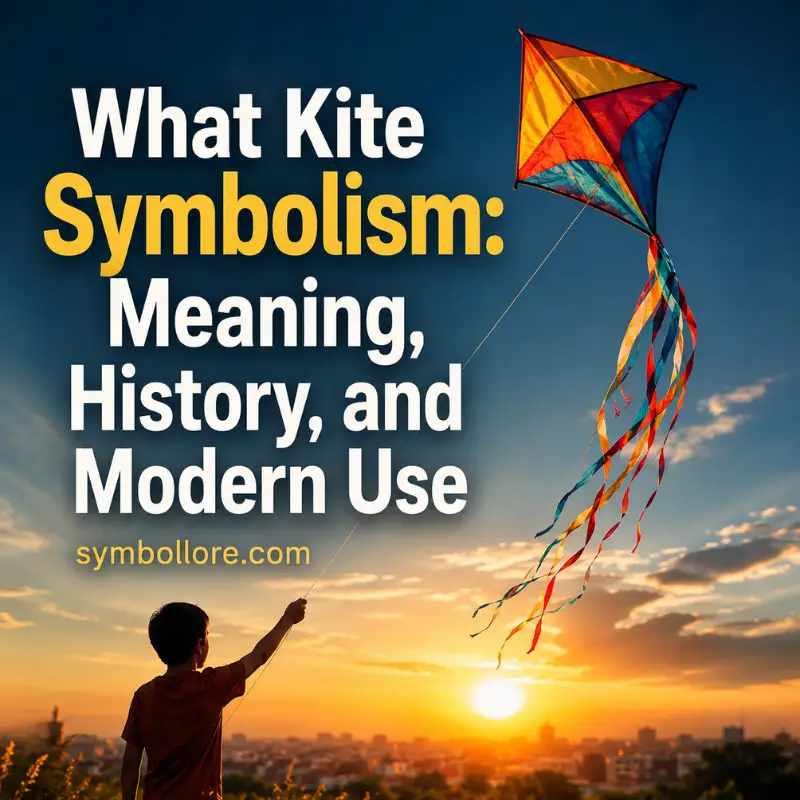
A flying kite offers a distinctive picture of freedom: it moves widely while remaining connected to someone. That combination makes it useful for thinking about independence within a relationship, family, or community.
For example, a picture of a child flying a kite can suggest growing confidence. The child learns to manage movement without controlling the wind. Meanwhile, an adult holding the spool may suggest patient guidance. These are reasonable readings of the scene, rather than meanings inherited from one universal tradition.
Height also changes the impression. A kite near the ground may suggest an attempt just beginning. Far overhead, the same object can suggest ambition or an expanded view. Yet distance can also introduce vulnerability: something cherished may seem almost beyond reach.
Therefore, “freedom” works best as a starting point. Look next at whether the scene emphasizes delight, effort, distance, or the fear of losing contact.
Why the String Matters as Much as the Kite
The string often carries the emotional meaning of a kite image. It connects two places and makes the relationship between them visible.
In a supportive scene, the line can represent trust. Someone provides enough room for movement while remaining available. This makes a kite a useful personal metaphor for parenting, friendship, or encouragement during a major change.
However, the same line can suggest restriction when the holder appears possessive or the kite struggles against the pull. The difference comes from the action around the object. A string alone does not prove that a relationship is healthy or harmful.
A broken line creates another shift. Deliberate release may suggest a chosen farewell, while an accidental break may suggest loss. Similarly, a tangled line can represent competing demands or a bond that needs attention.
This is why cutting the string does not automatically mean “greater freedom.” Within an image, losing support can matter as much as escaping control.
Chinese Kites: History, Good Wishes, and Painted Motifs
Chinese kite traditions show how a flying object can carry an additional layer of meaning through its design. Dragons, swallows, bats, fish, and other figures turn the kite into a moving surface for cultural imagery.
Middlebury College Museum of Art’s exhibition of Chinese kites explains that these animal and mythological forms carry auspicious meanings: associations with favorable outcomes. Its historical account also traces kite flying from early practical uses to a popular pastime by the Tang period. See the museum’s account of
Chinese kites and auspicious imagery.
The distinction matters. “A Chinese kite means good luck” leaves out the design that gives the wish its specific character. A painted bird, an inscription, and a mythological figure require different readings.
For bird-shaped designs, the traditions discussed in
Chinese birds in art and folklore
provide useful context. Still, identify the actual species or motif before assigning a meaning.
Japanese Kites: Seasonal Celebration and Local Identity
Japanese kites can express the pleasure of a new season and pride in a local craft tradition. Their shapes and pictures often connect them with particular places.
The Japan Foundation describes kites as symbols of celebration associated with spring and New Year customs. It also emphasizes regional variety and the passing of folk toys between generations. Its exhibition,
presents these connections through traditional Japanese kite making.
Consequently, a Japanese kite may communicate belonging as well as an individual wish. Its maker, construction, and painted subject can preserve knowledge that a family or community values.
That meaning differs from a general motivational image about chasing dreams. A regional kite carries a craft history, even when someone enjoys it simply as a toy. When interpreting one, begin with its name and place of origin. Then consider what its picture adds to the seasonal or social setting.
Guatemalan Giant Kites: Remembering Ancestors Together
In Santiago Sacatepéquez and Sumpango, Guatemala, giant kites connect community art with ancestral remembrance. These predominantly Maya Kaqchikel communities hold their kite festivals on November 1, All Saints’ Day.
Guatemala’s Ministry of Culture explains that makers understand the kites as a connection with ancestors. Their designs also communicate social, cultural, political, and environmental themes. Some kites fly, while others serve as large displays. The ministry’s account of
giant-kite making and its cultural meaning
describes both uses.
Here, remembrance involves shared work as well as a finished object. People plan images, prepare materials, and bring a large design into public view. As a result, the kite expresses a relationship among makers, neighbors, and previous generations.
These traditions should retain their local identity. They do not establish a universal belief that every kite carries a message to the dead. Nor should they be treated as interchangeable with Mexican Día de los Muertos customs.
Kites in The Kite Runner: Affection, Betrayal, and Repair
In Khaled Hosseini’s The Kite Runner, kites gain meaning through relationships and moral choices. They connect Amir’s childhood pleasure with his desire for his father’s approval and his treatment of Hassan.
The kite competition therefore becomes more than a game. Amir attaches his hopes to winning, but his betrayal of Hassan makes that achievement painful. The object holds both what he wanted and what pursuing it cost.
The publisher’s reader’s guide to the novel
draws attention to the framing scenes: Hassan runs kites for Amir, and later Amir runs one for Hassan’s son, Sohrab.
That reversal supports a reading of the final kite as an attempt at care and repair. Amir’s role changes from receiving another person’s loyalty to offering service himself. The hopeful movement does not erase the harm that came before.
For students, the useful lesson is to track each appearance. A symbol can gather conflicting meanings rather than stand for one fixed idea throughout a book.
The Kite Bird Has a Separate Symbolic History
The bird called a kite belongs to a different interpretive context from a kite made of paper or fabric. Its flight can inspire modern ideas about awareness, agility, or perspective. However, these personal associations should remain separate from documented religious imagery.
Flight as a modern metaphor
An artist may use a kite bird’s spread wings to suggest openness, or a downward gaze to suggest attention. A solitary bird can suggest independence, while several birds together may emphasize shared movement. These readings come from the composition and need support from the surrounding scene.
Those readings also overlap with ideas found in
falcon imagery and its meanings.
Yet shared qualities do not make the birds interchangeable. A drawing should identify the intended bird before borrowing its cultural history.
Isis, Nephthys, and protection
In one Egyptian account of the Osiris myth, Isis and Nephthys become kites. They protect Osiris’s body with their wings and help restore his breath. The Fitzwilliam Museum explains this episode in its account of
Osiris and the two protective kites.
Within that story, the birds belong to a sequence of loss, protection, and renewed life. Calling them simply “death symbols” misses their caring role. Likewise, their presence in a religious story does not make an ordinary bird sighting a prediction about death or recovery.
How Color, Shape, and Condition Change the Message
A kite’s appearance can guide interpretation, but there is no universal chart assigning a fixed meaning to every kite color.
For instance, a bright red kite against a gray sky may draw attention to energy or determination. However, the same red could belong to a national flag, a festival palette, or someone’s favorite toy. A white kite could suggest simplicity in a modern illustration without carrying a religious message.
Shape matters too. A bird-shaped kite adds another recognizable subject. A dragon kite invites questions about the dragon’s cultural setting. Meanwhile, a plain diamond shape may direct attention toward the flyer, string, and surrounding space.
Condition can be even more revealing. A carefully repaired kite may suggest continued care. A torn kite abandoned on the ground can suggest disappointment. These are visual interpretations, so nearby details should support them.
Use a guide to color meanings and context
to compare possibilities. Then check those possibilities against the actual scene rather than treating color as a secret code.
What Kites Can Mean in Modern American Life
For a U.S. reader, a kite can call up a beach trip, a neighborhood park, a school project, or time with family. These memories give the object a personal link with play and shared attention.
Public events provide a broader setting. Washington, D.C.’s
brings kite making, flying, performances, and Japanese cultural programming to the Washington Monument grounds. In this setting, the kite participates in a shared spring celebration.
The emotional appeal also comes from the activity itself. People look up together, respond to changing wind, and notice each other’s creations. A photograph can preserve that moment as a sign of companionship or a welcome break from routine.
Nevertheless, no single American meaning applies to every family. Someone who grew up with competitive kite flying may remember skill and rivalry. Another person may remember a relative who taught them to hold the line. That history can matter more than any broad association with freedom.
Kites in Tattoos, Memorials, and Personal Art
A kite design can express a personal story through a few clear details. The strongest choice depends on the experience someone wants to remember.
For example, a kite with an unbroken string might represent continuing attachment across distance. Two people holding one spool could suggest shared care. A repaired sail might mark a difficult period and the work of rebuilding afterward. These are possible design choices, not established rules for tattoos.
In memorial art, the line can make an ongoing bond visible. It may connect a person on the ground with something moving beyond immediate reach. A name or date gives that interpretation a clear personal basis.
Related floating imagery can carry a different emotional weight, as seen in
black balloons as symbols of remembrance.
Choosing between these objects involves deciding whether the image should emphasize buoyancy, connection, grief, or movement.
When using a specific ceremonial design, retain its cultural context. A generic handmade kite gives more room for a private meaning than a copied sacred motif whose background remains unknown.
Reading a Kite Image Without Overinterpreting It
The most reliable interpretation begins with visible evidence. Identify the object, observe its role, and check whether a particular tradition explains it.
Four questions can help:
- Which kite appears? Separate the flying object from the bird, then identify any distinctive form.
- What is happening? Notice who holds the line, whether it remains intact, and how the scene feels.
- What gives the image context? Look for a named festival, a story, an inscription, or the artist’s explanation.
- What kind of claim are you making? Distinguish documented custom from a possible visual reading or personal belief.
For example, a kite above a cemetery during a named Guatemalan festival has a specific cultural setting. A kite doodle beside a vacation note may simply record a pleasant day. Similar shapes do not require identical meanings.
This approach also helps with spiritual claims. Someone may use kite flying for reflection or prayer. However, that personal practice does not establish an ancient origin, a universal message, or a prediction about the future.
FAQs
A kite can carry good wishes in a particular tradition, especially when its decoration uses auspicious imagery. However, it is not a universal good-luck charm. A recreational kite may have no intended spiritual meaning, and flying one does not guarantee a favorable outcome.
In a story or picture, it may suggest frustration, delayed progress, or a mismatch between effort and circumstances. The surrounding action determines which reading fits. If someone patiently adjusts the kite, the scene may emphasize learning rather than failure.
It can represent release, separation, grief, or a move toward independence. The wearer’s explanation matters most. A deliberate break may express a chosen change, while a drifting kite with an abandoned spool might communicate an unwanted loss of connection.
Seeing a kite bird does not establish that someone or something is protecting you. You may find comfort in its appearance, but that remains a personal interpretation. Historical protective meanings come from specific stories and images, including the Egyptian account discussed above.
There is no single established meaning for a kite dream. You might reflect on whether the experience felt playful, controlled, difficult, or frightening. Those feelings can suggest useful personal questions about freedom or attachment, but the dream does not reliably predict events.
Its movement depends on a visible connection to the ground. That makes it a useful metaphor for independence supported by relationships. However, the same string can suggest restriction if the scene emphasizes force or struggle. Both readings depend on how the connection functions.
Conclusion
Kite symbolism draws much of its power from the relationship between movement and connection. A flying kite can express hope or growing independence, while its string keeps support, responsibility, and attachment in view. Cultural traditions add more specific meanings through craft, celebration, remembrance, and religious stories.
The bird called a kite brings a separate history, including protective roles in Egyptian myth. Therefore, begin with the actual object or species before interpreting the image. The clearest meaning comes from the scene, its cultural setting, and the people involved. A kite becomes most expressive when those details explain why it matters.
Five Related Articles from symbollore.com
- Black Balloon Symbolism: Meaning in Grief, Dreams, and Art — https://symbollore.com/black-balloon-symbolism/
- Chinese Bird Symbolism: Meanings in Art, Folklore, and Life — https://symbollore.com/chinese-bird-symbolism/
- Falcon Symbolism: What This Powerful Bird Represents — https://symbollore.com/falcon-symbolism/
- Color Symbolism Chart: What Different Colors Mean — https://symbollore.com/color-symbolism-chart/
- Day of the Dead Symbolism and the Meaning Behind Its Traditions — https://symbollore.com/day-of-the-dead-symbolism/