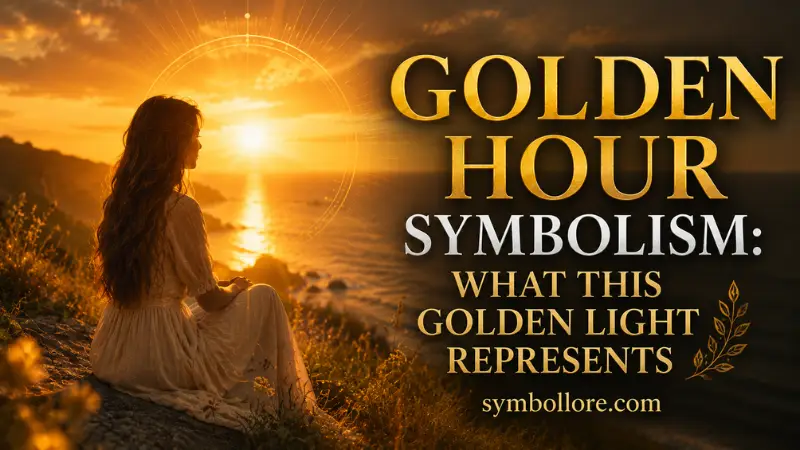
Golden hour symbolism often centers on warmth, beauty, love, reflection, and the fleeting nature of time. The term itself refers to the soft, warm light that appears shortly after sunrise or before sunset, but its symbolic meaning goes beyond photography. Because the light is beautiful yet temporary, it naturally lends itself to ideas about treasured moments, change, memory, and hope.
However, golden hour does not have one universal meaning. A sunrise may suggest beginnings, while evening light may suggest closure or nostalgia. In art, spirituality, relationships, or personal photography, the surrounding context determines which meaning becomes strongest.
Quick Answer
Golden hour symbolism commonly represents warmth, love, peace, nostalgia, hope, transformation, and impermanence. Its soft light can make ordinary scenes feel special, while its short duration reminds us that beautiful moments do not last forever. The meaning changes with context, especially between sunrise and sunset and between cultural, artistic, and personal uses.
TL;DR
- Golden hour symbolizes beauty that exists for a limited time.
- Warm light often suggests love, comfort, and emotional closeness.
- Sunrise golden hour can represent renewal and fresh beginnings.
- Sunset golden hour can suggest reflection, closure, or nostalgia.
- Spiritual meanings vary by tradition and personal belief.
- Context determines whether golden light feels joyful, peaceful, or bittersweet.
Golden Hour Symbolism at a Glance
| Context | Common Symbolic Meaning | Emotional Tone | Important Distinction |
| Sunrise | Renewal and possibility | Hopeful | Associated with beginnings |
| Sunset | Completion and reflection | Bittersweet | Often connected with endings |
| Romance | Love and intimacy | Warm | Emphasizes shared presence |
| Memory | Nostalgia and remembrance | Tender | Focuses on the past |
| Personal growth | Transformation | Encouraging | Highlights change |
| Spiritual art | Illumination or grace | Reverent | Depends on tradition |
| Photography | Beauty and atmosphere | Appreciative | May have no deeper symbolism |
| Life transitions | Impermanence and acceptance | Reflective | Suggests movement between stages |
What Golden Hour Literally Means
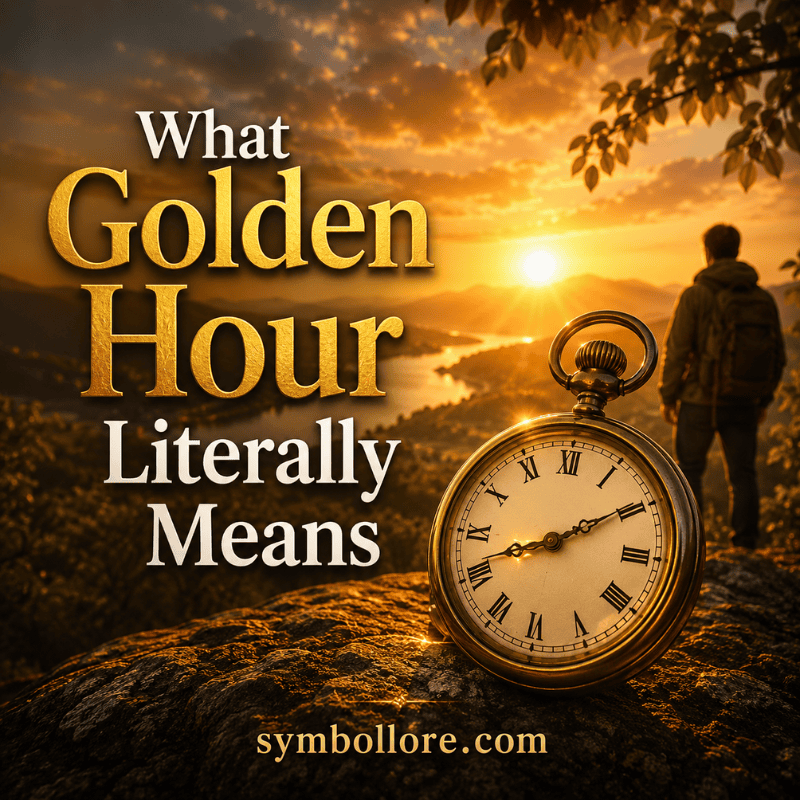
Golden hour is the period around sunrise and sunset when the sun is low in the sky. Photographers value it because the lower angle changes the quality of daylight, producing warmer colors, softer illumination, and longer shadows. The phrase “hour” is also approximate because the duration varies with latitude, season, and other conditions.
The physical effect matters to symbolism. Golden hour does not merely make the world look yellow. It changes how familiar objects appear. Hard edges soften, shadows lengthen, and ordinary landscapes can seem more intimate or dramatic.
That visual transformation helps explain why golden hour became associated with ideas such as beauty, romance, nostalgia, and emotional significance. The world has not actually changed, but the light changes our perception of it. The National Film Institute specifically connects golden-hour imagery with nostalgia, happiness, youth, love, and energy.
Why Golden Hour Feels Symbolic
Golden hour feels symbolic partly because it combines warmth with impermanence. The light is attractive precisely because it is temporary. You can watch the color change within minutes, and the scene gradually moves toward another stage.
This creates a useful symbolic pattern:
ordinary scene → transformed appearance → limited duration → emotional meaning
A familiar street can feel nostalgic. A person’s face can appear softer. A landscape can seem peaceful. A couple photographed in the same light may associate the moment with intimacy.
Art also shows how lighting can carry meaning. The Metropolitan Museum of Art notes that light in visual art can communicate ideas such as divinity, goodness, contemplation, thought, and wisdom, depending on its color and treatment. Gold and golden light have also been used to signify sacred or visionary qualities in some Christian and Renaissance contexts.
So the symbolism does not come from one universal rule. It develops from the interaction between light, context, culture, memory, and human interpretation.
The Most Common Golden Hour Symbolism
1. Warmth and Comfort
Warmth is one of the most immediate associations of golden light. The amber, yellow, and orange tones can make a scene feel inviting and emotionally gentle.
In photography, this effect is often used to create a sense of comfort and closeness. In symbolic language, therefore, golden hour can represent emotional warmth, hospitality, safety, or affection.
This is especially common in family portraits, wedding photography, travel images, and scenes designed to feel intimate.
2. Love and Romance
Golden hour is strongly associated with romantic imagery. Couples often choose the period around sunrise or sunset for engagement, wedding, and relationship photographs because the light creates a soft and warm atmosphere.
The symbolism is deeper than attractive lighting. A limited window of light can represent the idea of treasuring time together.
Research examining metaphorical uses of “Golden Hour” in contemporary music also identifies relationships between light, love, radiance, emotional brightness, and an imagined future.
3. Beauty and Appreciation
Golden hour can symbolize the discovery of beauty in ordinary things. A building, tree, road, or person’s face may look completely different under low evening light.
That transformation encourages a simple idea: beauty can depend on how we see something, not only on what the thing is.
This interpretation works especially well in photography and visual art. The Photographic Angle notes that golden-hour images can acquire a special or “magic” quality because the warm light changes the appearance of the scene.
4. Nostalgia and Memory
Golden hour often feels nostalgic because it resembles remembered experiences: childhood evenings, vacations, summer walks, family gatherings, or quiet moments with someone important.
Nostalgia is not an inherent scientific property of golden light. Instead, warm evening imagery has become a cultural and artistic shorthand for memory.
Literary scholarship provides a useful example. A 2022 article in the Journal of Postcolonial Writing examines “golden hour” as a metaphor for nostalgia and changing urban spaces in two novels.
This makes nostalgia one of the strongest context-dependent meanings of golden hour symbolism.
5. Hope and Renewal
Golden light can also represent hope. This association is especially natural at sunrise, when the appearance of light signals the beginning of another day.
The symbolism becomes stronger when golden hour appears after a period of darkness. In that setting, the light can suggest recovery, possibility, or a new stage of life.
However, hope is an interpretation rather than a universal property of the phenomenon. The same golden light can represent an ending when it appears at sunset.
6. Impermanence
Perhaps the most distinctive meaning is impermanence.
Golden hour changes quickly. The exact appearance of the light cannot be held still, and the moment eventually disappears. That makes it a powerful metaphor for experiences that are precious because they are temporary.
This interpretation connects golden hour with:
- fleeting happiness
- passing seasons
- changing relationships
- aging
- important memories
- life transitions
- appreciating the present
The beauty of golden hour therefore comes with a subtle reminder: what feels perfect may not last forever.
Sunrise vs. Sunset Golden Hour: Does the Meaning Change?
Yes. The difference is not absolute, but the direction of the sun often changes the symbolic emphasis.
Sunrise golden hour naturally leans toward beginnings. It can suggest renewal, possibility, awakening, energy, and a fresh opportunity.
Sunset golden hour more often supports meanings of completion, reflection, nostalgia, release, and closure. Sunset symbolism broadly includes endings and transition while also leaving room for renewal because darkness is followed by another dawn.
This gives the same visual phenomenon two related symbolic directions:
Sunrise → “something is beginning.”
Sunset → “something is changing or ending.”
Neither interpretation is mandatory. A sunset can symbolize hope, while a sunrise can remind someone of a past they miss.
Golden Hour Symbolism in Love and Relationships
In relationships, golden hour commonly symbolizes shared time, emotional warmth, intimacy, and the desire to preserve a meaningful moment.
A photograph of two people walking together at sunset may communicate more than physical closeness. The fading light can suggest that the couple is aware of time passing and wants to remember the experience.
That is why golden-hour imagery works well for:
- engagement photographs
- wedding portraits
- anniversaries
- relationship announcements
- romantic artwork
- travel memories
- love letters and captions
The symbol becomes especially powerful when the image includes an open road, horizon, or distant sun. Those elements can introduce another idea: a relationship moving toward an uncertain but shared future.
Golden Hour, Nostalgia, and Memory
Golden hour can make the present feel connected to the past.
The reason is partly visual. Warm colors, long shadows, and low light can make a modern scene resemble older photographs or remembered places. Yet nostalgia depends heavily on personal association.
For one person, golden light may recall childhood. For another, it may represent a former relationship. Someone else may associate it with travel or a particular season.
This means there is no single golden hour memory meaning. Instead, the light acts as a visual trigger onto which a person attaches their own experience.
That distinction matters. Symbolism can describe common cultural patterns, but it cannot tell you what a particular image must mean to every viewer.
Spiritual and Cultural Meanings
Golden light can carry spiritual meaning in religious art, but those meanings should be tied to specific traditions rather than treated as universal spiritual facts.
In Christian art, light has often been associated with divine presence, goodness, and sacred revelation. The Metropolitan Museum of Art explains that gold leaf and painted golden light could signify divinity or visionary experience in European religious art.
Golden light also appears in Buddhist traditions. The Golden Light Sutra, for example, is an important Mahayana Buddhist text whose imagery connects golden light with Buddhist teaching and protection.
These examples show why “golden light means spirituality” is too broad. A more accurate statement is that golden light has acquired spiritual and sacred associations in particular religious and artistic traditions.
Personal spirituality can add another layer. Someone may see golden-hour light as a sign of gratitude, peace, divine presence, or inner clarity. Those interpretations can be meaningful without needing to be presented as universal facts.
Golden Hour in Art, Photography, and Writing
Golden hour is especially powerful in visual storytelling because light can establish mood before a viewer understands the subject.
Photographers use the period for warm skin tones, soft contrast, directional shadows, and atmospheric landscapes.
Writers can use golden hour as a metaphor for:
- a perfect moment
- the final stage of something
- remembered happiness
- emotional closeness
- a temporary opportunity
- a peaceful transition
- a moment before change
Artists can also use golden light to separate a meaningful figure from its surroundings. The result can suggest importance, grace, memory, or revelation.
The key is context. A golden sky behind a departing character may suggest farewell. The same sky behind newly reunited characters may suggest hope.
When Golden Hour Represents Change or Impermanence
Golden hour is an unusually effective symbol for transition because it exists between clearer states of the day.
At sunrise, darkness gives way to light. At sunset, daylight gives way to darkness. In both cases, the viewer witnesses a state changing rather than simply seeing two fixed conditions.
That makes golden hour useful for representing:
- moving to a new place
- ending a career
- entering adulthood
- leaving a relationship
- recovering from hardship
- accepting aging
- beginning a new chapter
The symbolism is not necessarily sad. Change can involve loss and hope at the same time.
A sunset may therefore represent closure without meaning permanent defeat. A sunrise may represent renewal without erasing what happened before.
How to Interpret a Golden Hour Image
If you are trying to understand the symbolism of a particular golden-hour image, use five questions:
- Is the image taken at sunrise or sunset?
This can suggest beginning or closure. - Who or what is shown in the light?
A couple, solitary person, landscape, or religious figure changes the interpretation. - What is happening in the scene?
Departure suggests a different meaning from reunion. - What emotion does the surrounding context create?
Warmth may suggest comfort, while an empty landscape may create loneliness or nostalgia. - Is there cultural or personal context?
A religious artwork, memorial photograph, wedding image, and travel photograph should not be interpreted in the same way.
This approach prevents one of the biggest mistakes in symbolism: assuming that one visual element always has one fixed definition.
FAQs
Golden hour may symbolize illumination, peace, divine presence, gratitude, or spiritual awareness in some traditions and personal belief systems. These meanings are not universal, so the surrounding religious or cultural context matters.
Yes, golden hour is commonly used to represent romantic warmth, intimacy, shared memories, and appreciation for time together. Its temporary nature can also suggest the desire to preserve a meaningful relationship moment.
It can, particularly when the image shows sunrise. Morning golden hour naturally supports ideas such as renewal, possibility, awakening, and a fresh chapter, although personal context can produce other interpretations.
Golden hour can evoke nostalgia because its warm, soft appearance is often associated with remembered places, childhood evenings, travel, relationships, and past experiences. The association is cultural and personal rather than a universal psychological rule.
Sunset golden hour can symbolize endings, closure, reflection, and transition because it occurs near the close of daylight. However, it can also represent peace, beauty, gratitude, or hope rather than loss.
No. “Golden hour” is an approximate photographic term. Its duration varies according to latitude, season, and the definition being used; the important feature is the sun’s low position and resulting light quality.
Conclusion
Golden hour symbolism is best understood as a meeting point between beauty and impermanence. Its warm light can represent love, comfort, nostalgia, hope, reflection, transformation, or closure, but no single meaning applies in every situation. Sunrise often emphasizes beginnings, while sunset can emphasize completion, yet both can communicate renewal and appreciation.
The strongest interpretation comes from context. Whether golden hour appears in a photograph, painting, spiritual image, relationship memory, or personal reflection, its meaning develops from the light itself and the story surrounding it. That is what makes golden hour such a flexible and enduring symbol.