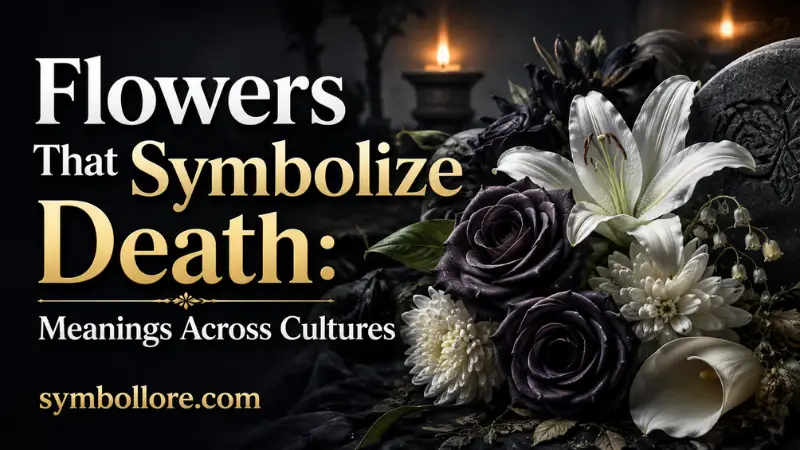
Flowers that symbolize death often express more than death itself. They can represent mourning, remembrance, farewell, spiritual transition, or the belief that love continues after someone dies. The meaning also changes by culture, color, religion, and historical period. A chrysanthemum, for example, can be strongly associated with funerals in some countries but have different meanings elsewhere. Understanding that distinction prevents a symbolic flower from being treated as a universal sign of death.
Quick Answer
The flowers that symbolize death most often include chrysanthemums, lilies, black roses, marigolds, red poppies, red spider lilies, and asphodel. Their meanings are not universal: some represent mourning, while others honor the dead, guide remembrance, or symbolize the afterlife. Context matters more than the flower alone.
Key Takeaways
- Chrysanthemums have strong funeral associations in several cultures.
- White lilies often symbolize purity, restoration, and the soul.
- Marigolds connect strongly with remembrance during Día de los Muertos.
- Red poppies commemorate people who died in war.
- Black roses commonly express grief, farewell, or endings.
- Asphodel has deep roots in ancient Greek ideas about the dead.
Flowers and Their Death-Related Meanings at a Glance
| Flower | Main Association | Cultural or Historical Context | Best Interpretation |
|---|---|---|---|
| Chrysanthemum | Death and mourning | Strong funeral associations in parts of Europe and Asia | Mourning or funeral remembrance |
| White lily | Purity and restored innocence | Western funeral traditions | Spiritual peace and remembrance |
| Black rose | Grief and farewell | Modern Western symbolism | Loss, endings, or mourning |
| Marigold | Remembrance | Día de los Muertos traditions | Honoring departed loved ones |
| Red poppy | Remembrance of war dead | World War I remembrance | Military sacrifice and memory |
| Red spider lily | Death and separation | Japanese cultural symbolism | Farewell and the dead |
| Asphodel | Realm of the dead | Ancient Greek literature | Afterlife imagery |
| Carnation | Love and remembrance | Funeral and sympathy traditions | Continuing affection |
Which Flowers Symbolize Death Most Strongly?
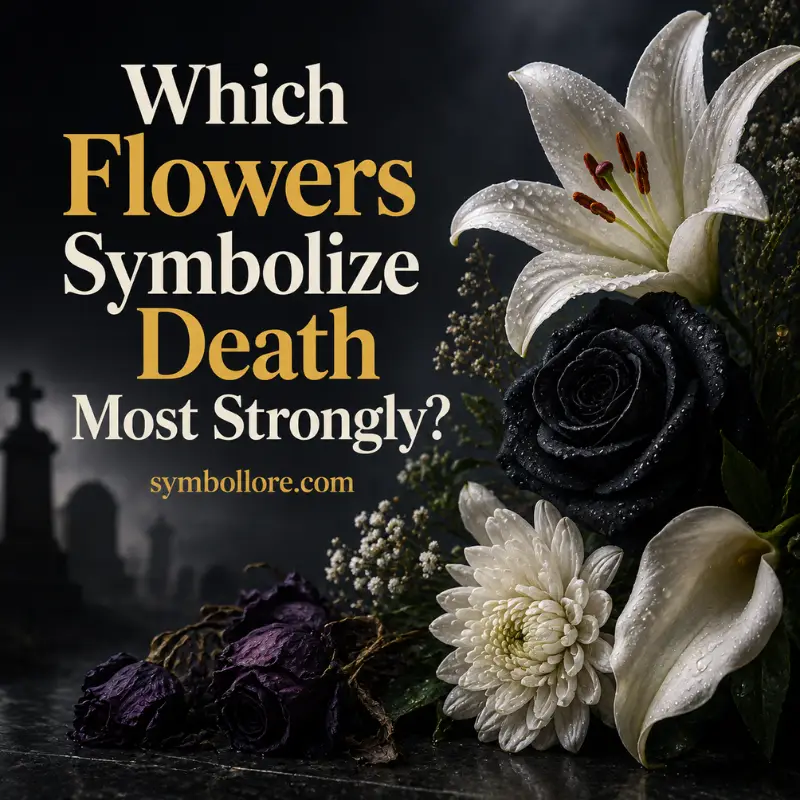
The strongest associations usually come from flowers repeatedly used in funerals, memorial rituals, graves, or stories about the dead. Chrysanthemums, lilies, black roses, marigolds, red poppies, red spider lilies, and asphodel are especially useful examples, but they do not all mean the same thing.
A flower can become associated with death through ritual use. Another may gain the association through mythology, literature, color, or its connection to a particular historical event. That is why saying a flower “means death” can be misleading without explaining the context.
Chrysanthemum
Chrysanthemums have especially strong connections with funerals in several countries. In parts of Europe and Asia, white chrysanthemums can be closely associated with death, graves, and mourning, while the flower has other meanings in the United States and elsewhere.
This makes the chrysanthemum one of the clearest examples of cultural symbolism. The same flower should not automatically be interpreted as a death symbol in every country.
How Chrysanthemums Became Funeral and Mourning Flowers
Chrysanthemums demonstrate why cultural context matters more than a universal flower dictionary. In Japan, chrysanthemums have an important place in national and imperial symbolism, while white chrysanthemums are also associated with funerals and memorial practices. In parts of Europe, chrysanthemums similarly became strongly linked with graves and mourning.
The important point is not that chrysanthemums “always mean death.” Rather, repeated use in funeral traditions can give a flower a powerful association with death within a particular culture.
That distinction is useful when sending a sympathy bouquet. A flower that feels respectful in one country may carry a very different social message somewhere else.
Why White Lilies Are Associated With Death and the Afterlife
White lilies are among the most recognizable funeral flowers in the United States, but their symbolism is more hopeful than the phrase “death flower” suggests. They commonly represent purity, innocence, peace, and spiritual restoration rather than death as a literal event.
In funeral settings, lilies can therefore symbolize the idea that the deceased has returned to a peaceful or purified state. Their use shows how funeral flowers often communicate consolation rather than simply representing mortality.
A white lily may say, in effect, that someone has died while their memory, dignity, or spiritual identity continues.
What Black Roses and Red Spider Lilies Symbolize
Black roses are modern symbolic creations rather than a naturally occurring black rose species. The darkest cultivated roses are usually very deep red or burgundy, yet the visual idea of a black rose has become associated with mourning, endings, grief, mystery, and farewell.
The red spider lily has a different cultural history. Its striking appearance and association with separation and death have made it a powerful symbol in Japanese cultural imagery. However, it should not be treated as a universal “death flower” outside that context.
These examples show two different routes to symbolism: one develops largely through modern visual and literary associations, while the other is rooted more strongly in cultural tradition.
Why Marigolds Represent Remembrance in Día de los Muertos
Marigolds are one of the clearest examples of why death symbolism should not be confused with celebration of death. During Día de los Muertos, or Day of the Dead, marigolds are commonly placed on ofrendas and around graves as part of traditions honoring deceased loved ones.
The Smithsonian explains that cempasúchil, a marigold native to Mexico, is used on ofrendas and around graves. Its strong fragrance and vivid petals are traditionally understood as helping create a path connecting the dead with their families.
Smithsonian: Día de los Muertos and marigolds
The symbolism is therefore closer to remembrance and reunion than to sadness alone. This is an important cultural distinction: a flower associated with the dead can also celebrate family, memory, identity, and continuing relationships.
How Red Poppies Became Symbols of Remembrance
Red poppies represent remembrance of people who died in war, especially through traditions that developed after World War I. The connection became powerful after Canadian physician and soldier John McCrae wrote In Flanders Fields, inspired by poppies growing around wartime graves in Belgium.
The Smithsonian documents how the red poppy became a remembrance symbol after World War I and how Moina Michael helped promote its use in the United States. The flower eventually became connected with commemorating fallen service members rather than representing ordinary death.
Smithsonian: The history of the common poppy as a remembrance symbol
This is a useful example of memorial symbolism developing from a specific historical event. A red poppy does not simply mean “someone died.” It can communicate remembrance, sacrifice, military service, and collective memory.
What Victorian Floriography Says About Mourning
Victorian floriography, or the language of flowers, gave flowers specific symbolic meanings that could be communicated through carefully selected bouquets. The practice became fashionable in Britain and America during the nineteenth century, with books assigning meanings to many familiar plants.
The Royal Horticultural Society traces the popularity of this coded floral language to the nineteenth century and notes the influence of Charlotte de la Tour’s 1819 Le langage des fleurs.
Royal Horticultural Society: The Language of Flowers
Victorian meanings can help explain why modern articles connect certain flowers with grief, farewell, regret, or remembrance. However, they should not be treated as timeless rules. Flower meanings changed across books, regions, periods, and social contexts.
Do Flowers Symbolize Death or Remembrance?
Most flowers associated with death actually symbolize a response to death rather than death itself. They may express grief, love for the deceased, remembrance, spiritual hope, farewell, or the belief that a relationship continues beyond physical life.
A useful way to interpret the symbolism is:
- Death: the flower is directly connected with mortality or the realm of the dead.
- Mourning: it expresses grief after someone has died.
- Remembrance: it keeps the memory of a person or event alive.
- Farewell: it represents separation or the end of a life journey.
- Afterlife: it suggests spiritual continuation, peace, or another realm.
- Rebirth: it focuses on renewal rather than death itself.
This framework explains why lilies, marigolds, and poppies can all appear in discussions of death while carrying very different messages.
How to Choose a Flower for Mourning or Memorial Use
The safest choice is to consider the person, culture, occasion, and local tradition before relying on a flower’s symbolic meaning.
For a U.S. funeral or memorial service, lilies, roses, carnations, and chrysanthemums are familiar choices. Yet the most appropriate flower may be one connected personally with the deceased, such as a favorite garden flower or a bloom associated with a meaningful memory.
For a culturally specific ceremony, follow that community’s traditions rather than assuming a general Western flower meaning applies. A respectful flower choice should support the purpose of the ceremony instead of imposing an unfamiliar symbolism.
If you are unsure, prioritize remembrance and respect over a dramatic “death” meaning. Symbolism works best when it reflects the person being honored.
FAQs
The chrysanthemum has one of the strongest funeral and death associations in several cultures, especially parts of Europe and Asia. However, there is no universally recognized flower that means death everywhere. Cultural tradition determines whether a flower represents death, mourning, remembrance, or another idea.
Chrysanthemums, carnations, roses, and certain darker-colored flowers can express grief or mourning. Their meanings depend on culture and context. In many cases, the symbolism comes from their use in funerals and memorial ceremonies rather than from the flower itself.
White lilies are strongly associated with funerals, but their symbolism is usually more specific than death alone. They can represent purity, innocence, peace, and restoration of the soul, which explains their enduring role in funeral arrangements.
Marigolds are strongly associated with Día de los Muertos because they are used on ofrendas and at graves to honor deceased family members. Their vivid color and fragrance are traditionally connected with guiding or welcoming the spirits of the departed.
The red poppy is a major symbol of remembrance for soldiers who died in war, particularly those connected with World War I. Its association developed from the poppies that grew on battlefields and from the influence of John McCrae’s poem In Flanders Fields.
There is no naturally occurring truly black rose commonly available as a botanical species. Roses described as black are generally extremely dark red, burgundy, or purple. Symbolically, however, the black rose is widely used to suggest grief, farewell, endings, mystery, or loss.
Asphodel has a particularly strong connection with the dead in ancient Greek literature. Homer’s Odyssey describes the meadow of asphodel as a place where the spirits of the dead dwell, giving the plant an enduring association with the afterlife.
Conclusion
Flowers that symbolize death rarely communicate only death itself. Chrysanthemums can signify mourning, lilies can suggest spiritual peace, marigolds can honor departed family members, and red poppies can preserve the memory of people lost in war. Their meanings become clearer when you consider culture, history, color, and ritual use together. The most respectful interpretation is therefore not to ask which flower universally “means death,” but what message that flower carries in the tradition where it is being used.