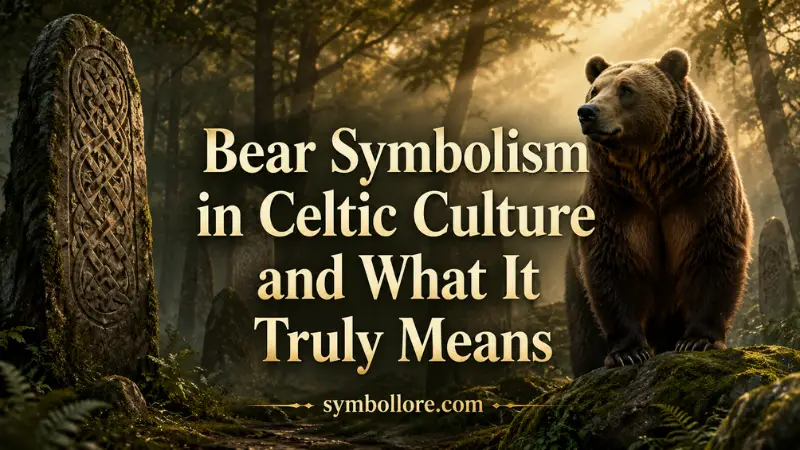
Bear symbolism in Celtic culture centers on formidable strength, protection, wild nature, and the power to provide. Its clearest historical link is Artio, a bear-associated goddess known through inscriptions and a remarkable bronze group found near Bern, Switzerland.
However, no surviving ancient text provides one universal “Celtic bear meaning.” Celtic-speaking communities occupied different regions and periods. Therefore, archaeological objects, ancient names, animal behavior, later folklore, and modern spirituality must not be treated as equally strong evidence.
Quick Answer
Bear symbolism in Celtic culture most strongly represents physical power, protection, the untamed natural world, and possibly abundance. Artio, a Gallo-Roman bear goddess, provides the clearest historical evidence. Modern associations with healing, rebirth, motherhood, and inner wisdom are meaningful interpretations, but not all can be proven as beliefs shared by every ancient Celtic community.
Key Takeaways
- Bears primarily suggest strength, protection, authority, and wild nature.
- Artio provides the clearest archaeological connection to Celtic bear worship.
- Fruit beside Artio may connect the goddess with provision and abundance.
- Hibernation supports modern renewal symbolism but proves no universal ancient doctrine.
- Continental and Insular Celtic traditions should not be treated as identical.
- Many current tattoo meanings combine history with personal interpretation.
Celtic Bear Meanings at a Glance
| Meaning | Basis for the Association | Level of Historical Support |
|---|---|---|
| Strength | The bear’s size, force, and position as a powerful wild animal | Strong natural inference |
| Protection | Defensive behavior, especially around cubs and territory | Plausible interpretation |
| Wild nature | Artio’s bear form and the animal’s woodland habitat | Strong association |
| Abundance | Fruit, grain, and offering imagery in the Muri group | Plausible archaeological reading |
| Sovereignty | Bear-related names and the animal’s commanding status | Possible but not universal |
| Motherhood | The she-bear and Artio’s female form | Plausible interpretation |
| Renewal | Hibernation followed by spring emergence | Mostly later or modern symbolism |
| Inner wisdom | Solitude and seasonal withdrawal | Primarily modern spiritual meaning |
What Did Bears Symbolize in Celtic Culture?
Bears most likely communicated strength, danger, protection, and mastery of the wilderness. People who lived near European brown bears would have recognized both their physical force and their ability to survive changing seasons. Consequently, the animal offered a natural image of endurance and commanding presence.
Still, ancient Celtic peoples left no single handbook explaining animal symbols. Even the term “Celtic” covers many communities across ancient Gaul, Britain, Ireland, Central Europe, and the Iberian Peninsula. Their religious customs varied. It is therefore safer to describe bear meanings as regional associations supported by artifacts, names, and later traditions—not as a fixed symbolic code accepted everywhere.
The bear’s combination of power and restraint also matters. It can forage quietly or defend itself with overwhelming force. That contrast helps explain why the animal now represents controlled strength as well as ferocity.
Why Artio Is Central to Bear Symbolism in Celtic Culture
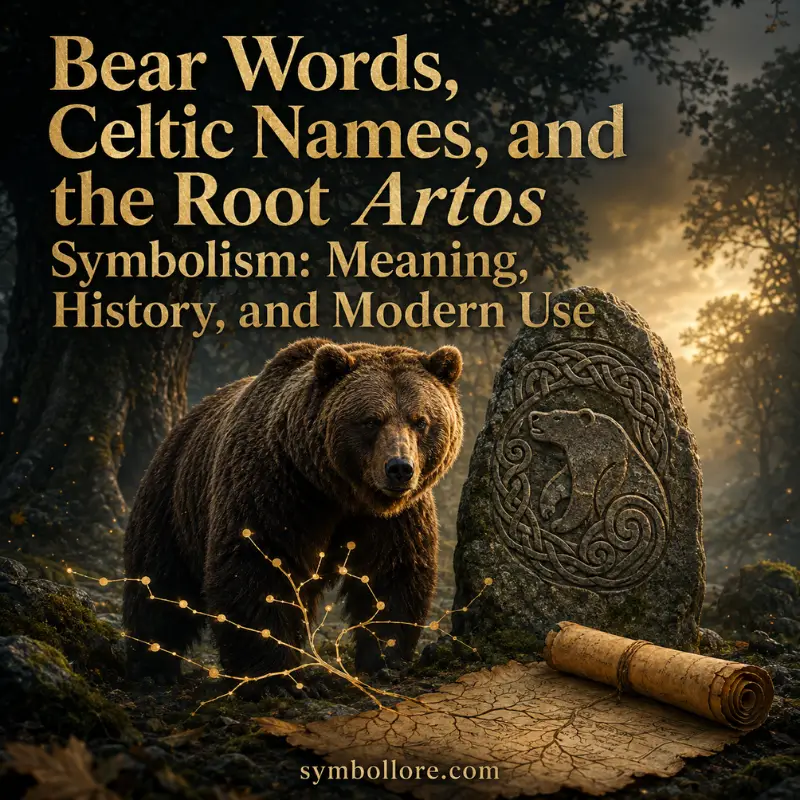
Artio is the strongest documented connection between bears and a Celtic religious figure. She was worshiped in the Gallo-Roman world, especially in areas around modern Switzerland, Germany, and neighboring Continental Europe. Her name is generally connected with a Celtic word for “bear.”
Unlike famous Irish deities preserved in medieval literature, Artio has no surviving narrative cycle. What scholars know comes mainly from inscriptions and material objects. This absence is important: articles that give her a detailed personality, family tree, festival calendar, or mythology often extend beyond the evidence.
Artio belongs specifically to a Continental Celtic and Romanized setting. Calling her simply an “Irish Celtic goddess” would be inaccurate. Roman language and artistic conventions shaped the surviving evidence, yet her Celtic name and bear association remained central.
What the Muri Bronze Group Reveals
The best-known representation of Artio is the Muri statuette group, discovered near Bern in 1832. Its reconstructed arrangement includes a large she-bear, a seated woman, a small tree, and a basket or container holding produce. The pedestal carries the dedication Deae Artioni / Licinia Sabinilla—a gift to the goddess from a woman named Licinia Sabinilla.
This object strongly establishes the religious significance of Artio and her connection with a bear. It also suggests that worship involved votive dedication. Meanwhile, the fruit and grain support a possible association with nourishment, vegetation, or abundance.
Interpretation still requires care. The individual bronze elements were not found assembled in their original arrangement. Research on the
indicates that its configuration changed and that the human figure may have been added to an earlier bear-centered display. Therefore, familiar descriptions of Artio calmly “feeding the bear” should not be treated as unquestionable fact.
Bear Words, Celtic Names, and the Root Artos
Language provides another meaningful line of evidence. Linguists reconstruct the Proto-Celtic term arto- as “bear.” Related forms include Old Irish art, Middle Welsh arth, Cornish arth, and Breton arzh. The divine name Artio belongs to this broad linguistic family.
The connection was not limited to a single place. Bear-related elements also appeared in personal and divine names. Old Irish art could carry figurative associations such as hero or warrior, showing how the animal’s power influenced human identity.
The Proto-Celtic etymological lexicon
traces arto- to an older Proto-Indo-European bear word and lists Artio as a Gaulish divine name. This linguistic evidence is stronger than modern visual claims about “Celtic bear symbols,” since many contemporary knotwork designs have no documented ancient connection to bear worship.
The name Arthur is sometimes explained as bear-related. However, its precise origin remains debated, so it should not be presented as certain proof of a bear cult.
Strength, Protection, and Sovereignty
Strength is the most direct Celtic bear meaning because it follows from the animal itself. A mature bear possesses great physical power, while its presence can dominate a landscape. Ancient observers did not need an elaborate myth to recognize those qualities.
Protection is also a reasonable association. A she-bear’s defense of her cubs creates an enduring model of fierce guardianship. For that reason, modern wearers often choose Celtic bear imagery to represent family protection, courage, or firm boundaries.
Sovereignty requires more caution. Because the bear stands near the top of its environment and bear-related words entered heroic names, the animal can suggest leadership or royal authority. Yet scholars do not possess evidence that every Celtic society used the bear as an official emblem of kingship. Sovereignty is best described as a plausible regional or later heroic association rather than a universal ancient meaning.
Hibernation, Renewal, and Seasonal Cycles
Hibernation makes the bear a natural symbol of withdrawal, survival, and renewed activity. The animal retreats during the colder period and emerges when conditions improve. Modern spiritual readers often interpret this pattern as rest, introspection, transformation, or metaphorical rebirth.
Those meanings are coherent, but direct evidence that ancient Celts maintained a shared doctrine of “bear hibernation equals spiritual rebirth” is limited. The distinction does not make the interpretation worthless. Instead, it tells readers where the meaning comes from.
A historically responsible explanation separates three layers:
- Bears display seasonal denning behavior.
- Ancient people could observe this cycle.
- Specific claims about rituals, resurrection, or spiritual journeys require additional evidence.
Thus, renewal works well as a contemporary Celtic-inspired meaning, especially when presented honestly as interpretation rather than established ancient theology.
Motherhood, Provision, and Abundance
Motherhood and protection arise from the prominence of a female bear in the Artio group. A she-bear is a powerful natural model of maternal defense. Meanwhile, the seated female deity reinforces the modern association between bear imagery and feminine power.
The produce represented beside Artio adds another dimension. Fruit and grain can suggest nourishment, seasonal plenty, agricultural well-being, or an offering made to the deity. For this reason, abundance is more historically grounded than many highly specific claims about Artio.
Nevertheless, the imagery does not prove that Artio governed fertility in every possible sense. “Abundance” or “provision” is more cautious than declaring her a universal goddess of childbirth. Today, the symbol can honor a caregiver who combines tenderness with formidable boundaries, provided the modern meaning is not misrepresented as a documented ancient belief.
Celtic Bears, Warriors, and Druids
Bears are frequently said to have been sacred warrior animals whose spirits Celtic fighters invoked before battle. The claim sounds believable because Old Irish art developed heroic connotations and because bears embody courage. However, direct proof of one widespread bear-warrior ritual remains limited.
Claims about Druids require even greater care. Surviving Greek and Roman descriptions discuss Druids, but they do not give a dependable system of “Druid bear symbolism.” Likewise, no standard ancient Celtic bear knot has been identified that carried one fixed religious meaning.
Modern Druid and pagan traditions may use bears as symbols of healing, guardianship, or the deep earth. Those practices deserve accurate description as living spiritual traditions. They should not automatically be projected backward onto Iron Age communities.
The safest conclusion is that bear power could support heroic symbolism, but elaborate warrior and Druid claims need sources tied to a specific time and place.
Regional Differences Across the Celtic World
The clearest Artio evidence comes from Continental Europe rather than medieval Ireland. This distinction matters because “Celtic mythology” is an umbrella term. Gaulish religion, Romano-Celtic worship, Welsh tradition, and Irish literature are related fields, but they are not interchangeable.
Continental Celtic religion is known largely through archaeology, inscriptions, place-names, and Roman-era material. Insular traditions are often known through manuscripts written centuries after Christianization. Each source type presents different limits.
Bears also had different environmental histories across these regions. Brown bears disappeared from Ireland long before many surviving medieval texts were recorded. Even so, bear words and bear-related names remained in Celtic languages. Therefore, a linguistic survival does not always prove that a later community continued an unchanged ancient cult.
Good interpretation identifies the region first, then considers the date and kind of evidence.
Bear Symbolism in Modern Celtic Tattoos
A Celtic bear tattoo commonly represents strength, protection, resilience, family, or connection with nature. Adding Artio can emphasize female authority, provision, and reverence for wild animals. Knotwork may express continuity or interconnection, although the exact combined design is usually modern.
Possible design choices include:
- A she-bear with cubs for fierce parental protection
- Artio with fruit or grain for provision and abundance
- A bear emerging from woodland for resilience and renewal
- A bear with restrained knotwork for continuity and heritage
- A bear paw for personal strength or a lasting journey
Avoid describing a newly designed “Celtic bear knot” as an authentic ancient emblem unless a reliable archaeological parallel exists. Additionally, do not copy ceremonial symbols from living communities outside Celtic traditions merely because they also honor bears.
A personal tattoo does not need to reproduce an ancient artifact. It only needs an honest explanation of which elements are historical and which are personal.
How to Interpret a Celtic Bear Symbol
Interpret a Celtic bear symbol by examining its source, region, surrounding details, and present purpose. A bear on a Roman-era altar requires a different reading from a modern tattoo or pagan pendant.
Use this four-part method:
- Identify the object. Determine whether it is ancient, medieval, modern, or newly designed.
- Check the location. Artio belongs mainly to the Continental Gallo-Roman world.
- Read the added symbols. Cubs suggest caregiving; fruit suggests provision; woodland emphasizes wild nature.
- Separate evidence from intention. Ask what history supports and what the modern wearer wants to express.
This method prevents overstatement while preserving the symbol’s emotional value. It also explains why two bear designs can carry different meanings without either interpretation being automatically wrong.
Common Misconceptions About Celtic Bear Meaning
The first misconception is that every ancient Celtic community worshiped one bear god or goddess. Artio is well attested in certain Continental areas, but that does not establish a universal Celtic cult.
Another misconception identifies every female woodland deity as Artio. Arduinna, for example, was associated with the Ardennes and is commonly represented with a boar, not securely as a bear goddess. Likewise, Andarta has sometimes been interpreted as a “great she-bear,” but that etymology is disputed.
Finally, Artio should not automatically be equated with the Greek Artemis or Roman Diana. Ancient religious exchange did encourage comparisons and blended forms. Still, similarity does not make separate goddesses identical.
A careful interpretation respects both connections and differences.
FAQs
Artio was a bear-associated goddess worshiped in parts of the Continental Gallo-Roman world. Inscriptions and the bronze group found near Bern provide the clearest evidence. Her name is related to the Celtic word for bear, but no detailed ancient mythology about her survives.
A bear most commonly represents strength, protection, wild authority, and endurance. It may also suggest motherhood, provision, and abundance through Artio. Renewal and inner wisdom are popular modern readings based on hibernation and solitude rather than firmly documented universal Celtic teachings.
No. Artio is primarily associated with Continental Celtic and Gallo-Roman religion, with important evidence found in Switzerland and other parts of mainland Europe. She should not be placed automatically within Irish mythology, although her name has relatives in Insular Celtic languages.
Bear-related language could carry heroic or warrior associations, but evidence for a widespread Celtic bear-warrior cult is limited. Some modern accounts turn a reasonable symbolic connection into a detailed historical claim. Warrior meaning should therefore be presented as possible or regional, not universal.
A Celtic-inspired bear can symbolize rebirth because hibernation resembles withdrawal followed by renewal. However, surviving evidence does not prove that all ancient Celts formally interpreted hibernation this way. Rebirth is most accurate as a natural and modern spiritual reading.
Possibly, but the relationship is debated. Some explanations connect Arthur with Celtic bear words such as artos or Welsh arth. Other linguistic theories derive the name differently, so the bear connection should be described as an influential possibility rather than settled fact.
A Celtic bear tattoo usually expresses courage, resilience, protection, family devotion, or closeness to nature. An Artio-inspired design may add provision and feminine strength. Its precise meaning depends on the imagery, and many knotwork combinations are modern rather than copied from ancient bear artifacts.
Conclusion
Bear symbolism in Celtic culture is best understood through strength, protection, wild authority, and the documented worship of Artio. Her name, inscriptions, and the Muri bronze group provide firmer evidence than modern claims about secret Druid teachings or universal warrior rituals.
At the same time, abundance, motherhood, seasonal renewal, and inner reflection remain meaningful interpretations when clearly identified as inferred or modern. The most respectful approach preserves the symbol’s power while remaining honest about what the historical record can—and cannot—prove.